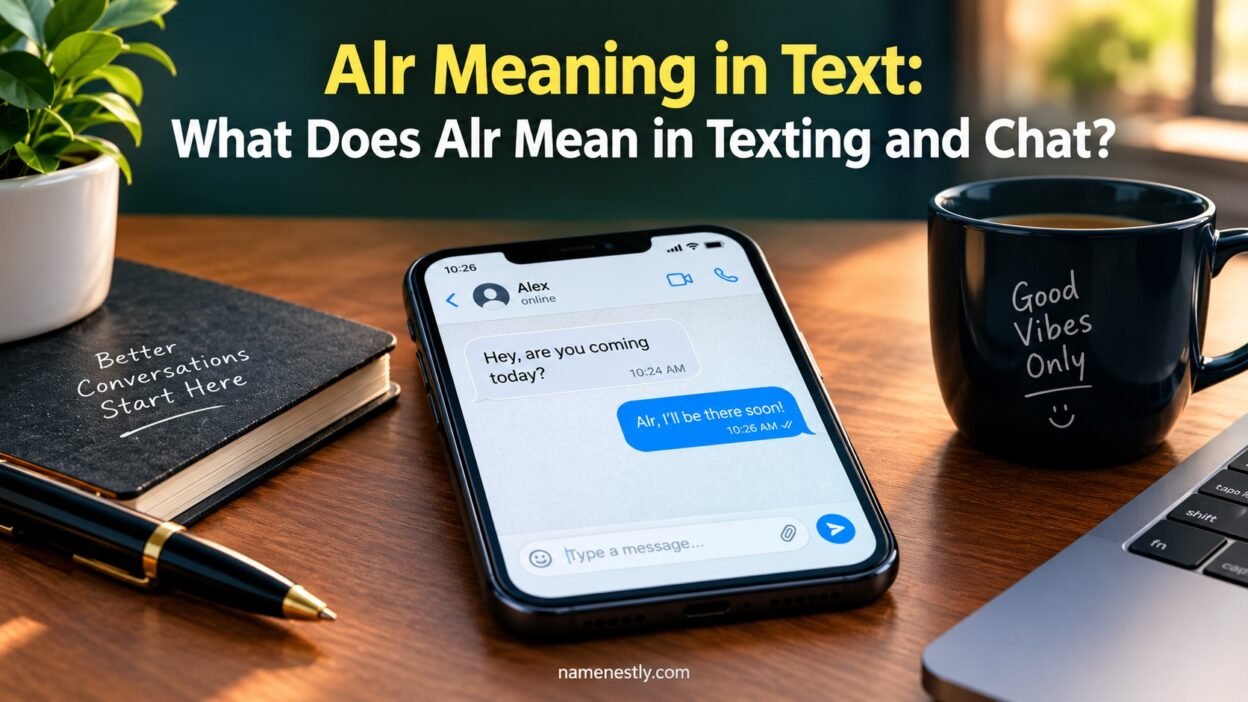
If someone sends you “alr” in a text, they usually mean “alright.” It works as a quick, casual way to show agreement, acknowledgment, acceptance, or understanding. For example, if a friend says, “Meet me at 7,” you might reply, “Alr.” In that situation, the message simply means “Alright” or “Okay.”
However, the exact tone can change with the conversation. A friendly “alr 😊” can feel relaxed, while “alr.” may sound short or slightly dismissive. The abbreviation itself doesn’t automatically indicate a particular emotion. You need to consider the surrounding words, punctuation, emojis, and relationship between the people chatting.
Because texting favors speed and convenience, shortened forms like alr have become common in informal digital communication. Understanding the context helps you avoid reading too much into a simple three-letter response.
Quick Answer
Alr meaning in text is usually “alright.” People use it as a casual abbreviation for alright, often meaning okay, fine, agreed, understood, or accepted.
For example:
- “Alr, see you later.” = “Alright, see you later.”
- “Alr, I understand.” = “Okay, I understand.”
- “Alr, I’ll do it.” = “Okay, I’ll do it.”
- “Alr.” = “Alright.” The short reply may feel more blunt depending on context.
The important point is that alr doesn’t have one fixed emotional tone. The conversation determines whether it sounds friendly, neutral, reluctant, or slightly annoyed.
Comparison Overview
| Term | Basic Meaning | Typical Setting | Common Tone |
| Alr | Alright | Texts, DMs, chats | Very casual |
| Alright | Okay, fine, acceptable | Text and speech | Casual to neutral |
| All right | Okay, satisfactory, acceptable | Formal and informal English | Neutral |
| Aight | Alright | Casual speech and texting | Very casual |
| OK | Okay | Almost everywhere | Neutral |
| K | Okay | Short text replies | Very brief |
| Gotcha | I understand | Casual conversations | Friendly and informal |
| Bet | Okay, agreed, sounds good | Modern casual slang | Casual |
Although these expressions can overlap, they don’t always carry the same feeling. Alr usually emphasizes brevity. It often works as a quick acknowledgment rather than a detailed response.
Main Differences Between Alr Meaning in Text
The main difference between alr and similar expressions comes from context, tone, and formality. Someone can use “alr” to agree with a plan, acknowledge information, or close a short exchange.
For example, compare these messages:
- “Alr, I’ll be there.” — clear agreement.
- “Alr, got it.” — acknowledgment.
- “Alr then.” — acceptance or moving forward.
- “Alr.” — brief acknowledgment that may feel neutral or cold.
- “Alright! Sounds good.” — warmer and more expressive.
So, when you see alr, don’t judge its tone from the abbreviation alone. Look at what came before it and what follows afterward.
What Does Alr Mean in Texting?
In texting, alr is generally a shortened version of alright. People type it when they want to respond quickly without writing the complete word.
It often appears in conversations where both people already understand the subject. Because the context provides most of the meaning, the sender doesn’t need a long response.
For example:
Friend: “I’ll send you the details tonight.”
You: “Alr.”
Here, alr simply acknowledges the information.
In another conversation, the same abbreviation can express agreement:
Friend: “Let’s meet outside the cafe at 6.”
You: “Alr, see you then.”
This time, alr means something closer to “Okay, that’s agreed.”
The abbreviation therefore saves typing while keeping the basic meaning intact.
What Does Alr Stand For?
Alr stands for “alright” in most casual texting situations.
The word alright itself commonly expresses acceptance, agreement, or acknowledgment. Depending on the sentence, it can also mean that something is satisfactory or acceptable.
When people shorten it to alr, they generally preserve the same basic meaning while making the message faster to type.
The abbreviation doesn’t normally require capitalization. You may see:
- alr
- Alr
- ALR
In ordinary texting, capitalization usually doesn’t change the fundamental meaning. The surrounding context matters much more.
Alr Meaning as “Alright”
The most direct interpretation of alr is simply “alright.”
Someone might use it after receiving a request:
“Can you send me the photo later?”
“Alr.”
The response indicates acceptance.
Another example:
“Don’t forget your charger.”
“Alr, thanks.”
Here, the sender acknowledges the reminder.
This use is straightforward because the abbreviation replaces the complete word without changing the basic message.
Alr Meaning as “Okay”
In many conversations, alr effectively means “okay.”
These meanings overlap because both expressions can acknowledge information or accept a suggestion.
For example:
“The meeting moved to 3 PM.”
“Alr.”
The person isn’t necessarily expressing excitement. They’re simply confirming that they received the information.
Likewise:
“Please wait here for five minutes.”
“Alr.”
The message communicates acceptance in a very compact way.
Alr Meaning as “I Understand”
Sometimes alr communicates understanding rather than agreement.
Imagine someone explains a situation:
“I can’t come tonight because I have an early class tomorrow.”
“Alr, I understand.”
In this case, alr helps acknowledge the explanation.
The complete meaning becomes clearer because of the words that follow. “Alr, I understand” feels more explicit than simply sending “alr.”
This is why context remains essential when interpreting short texting abbreviations.
Alr Meaning as “Fine”
Another possible interpretation is “fine.” However, the tone can vary significantly.
Consider:
“Can we talk about this tomorrow?”
“Alr.”
This could mean “Fine” in a completely neutral way. It could also sound slightly reluctant if the earlier conversation involved disagreement.
Compare that with:
“Alr 😊, no worries.”
The emoji and additional wording make the response feel warmer.
Now compare:
“Alr.”
The period makes the response visually sharper. Some readers may interpret it as cold or irritated. Still, punctuation alone doesn’t prove someone’s emotional state.
How People Use Alr in Text Messages
People use alr in several common situations. Its flexibility explains why it appears frequently in casual conversations.
Alr as a Simple Reply
A person may use alr when they don’t need to add anything else.
“I’ll call you after dinner.”
“Alr.”
The response acknowledges the message without extending the conversation.
Alr to Agree With Someone
The abbreviation can signal agreement with a plan or suggestion.
“Let’s watch the movie tonight.”
“Alr, I’m down.”
Here, the response clearly accepts the idea.
Alr to Acknowledge Information
Someone may use it after receiving instructions or an update.
“Your appointment starts at 10.”
“Alr, thanks.”
The sender confirms that they’ve received the information.
Alr to End a Conversation
A short alr can sometimes signal that the conversation has reached a natural stopping point.
For example:
“Okay, I’ll let you know tomorrow.”
“Alr.”
Neither person needs to continue talking.
Alr When Someone Feels Slightly Annoyed
Context can give alr a sharper tone.
“I already told you this yesterday.”
“Alr.”
Here, the response might feel reluctant or defensive. However, the abbreviation itself doesn’t prove annoyance. The preceding exchange creates that impression.
Alr Meaning on Social Media
On social media, alr generally keeps the same basic meaning: alright.
You may encounter it in:
- Direct messages
- Comment sections
- Group chats
- Gaming conversations
- Social media replies
- Casual community discussions
Social platforms encourage short responses because conversations often move quickly. Three letters can communicate the same basic acknowledgment as a longer word.
Still, alr isn’t tied to one specific platform-specific definition. If you encounter it on Instagram, TikTok, Snapchat, Discord, or another platform, the surrounding conversation remains the best clue.
Alr Examples in Texting
Realistic examples make the meaning much easier to understand.
Friendly Example
Alex: “I’ll pick you up at 8.”
Sam: “Alr, sounds good!”
Here, alr expresses agreement.
Casual Example
Alex: “I’m heading home now.”
Sam: “Alr.”
This is a simple acknowledgment.
Understanding Example
Alex: “I can’t join tonight. Something came up.”
Sam: “Alr, no problem.”
Here, alr communicates acceptance.
Slightly Cold Example
Alex: “We need to talk about what happened.”
Sam: “Alr.”
The response is short and could feel serious. The exact emotional meaning depends on the broader conversation.
Playful Example
Alex: “Don’t forget we’re getting pizza later.”
Sam: “Alr 😂”
The emoji gives the message a lighter feel.
Is Alr Rude in Texting?
Alr isn’t inherently rude. It usually functions as a casual abbreviation for “alright.”
However, extremely short replies can sometimes feel blunt. That’s especially true when the other person expects a more detailed response.
Compare these examples:
| Message | Possible Impression |
| Alr | Neutral and casual |
| Alr, thanks | Appreciative |
| Alr, no worries | Reassuring |
| Alr 👍 | Casual acknowledgment |
| Alr lol | Lighthearted |
| Alr. | Potentially blunt |
| ALR | Stronger visual emphasis, depending on context |
These aren’t fixed rules. People have different texting habits. Some users add periods to every message without intending any negative tone.
Therefore, don’t treat punctuation as a guaranteed emotional signal.
Read More: AWL Meaning in Text: What Does AWL Mean in Chat?
Is Alr Formal or Informal?
Alr is strongly informal. It fits casual digital communication much better than formal writing.
Good Situations for Alr
You can commonly see it in:
- Text messages
- Friend-to-friend chats
- Casual DMs
- Gaming chats
- Informal group conversations
- Quick online replies
Situations Where Alr Isn’t Ideal
Avoid relying on alr in:
- Job applications
- Professional emails
- Academic assignments
- Business proposals
- Official documents
- Formal customer communication
For formal communication, writing “alright,” “okay,” “understood,” or another appropriate expression creates a clearer impression.
Alr vs Alright vs All Right
The distinction becomes useful when you move beyond texting.
Alr is an informal abbreviation.
Alright is a standard informal-to-neutral word used widely in modern English.
All right is also standard and has a long-established place in English usage.
For example:
- Texting: “Alr, see you later.”
- Casual writing: “Alright, let’s go.”
- More traditional standard form: “All right, let’s begin.”
The abbreviation alr belongs to digital shorthand rather than formal written English.
Alr vs Aight
Aight also represents a casual form of alright. However, it has a different stylistic feel.
For example:
“Aight, let’s go.”
This can sound more conversational or slang-oriented.
Meanwhile:
“Alr, let’s go.”
Feels more like a shortened texting response.
Neither expression automatically carries one emotional meaning. The speaker’s style and context matter.
Alr vs K
Both alr and k can communicate agreement or acknowledgment, but they don’t always feel identical.
Alr preserves more of the original word “alright,” while k reduces the response to a single letter.
For example:
“I’ll send it tonight.”
“Alr.”
This generally feels like a normal casual acknowledgment.
Compare:
“I’ll send it tonight.”
“K.”
The second response can feel more abrupt in some conversations.
Again, neither response automatically indicates hostility. Personal texting habits influence interpretation.
Alr Meaning With Emojis and Punctuation
Small details can change how a short message feels.
“Alr 👍”
The thumbs-up emoji reinforces acknowledgment or agreement.
“Alr lol”
The addition of lol makes the response more relaxed.
“Alr 😭”
The crying emoji can make the message playful, dramatic, or humorous depending on the conversation.
“Alr…”
The ellipsis may suggest hesitation or unfinished thought.
“Alr.”
A period can make the response look more final or direct.
These interpretations aren’t universal. Emojis and punctuation work as contextual signals rather than fixed definitions.
How to Respond When Someone Says Alr
Your response should match the situation.
If someone says “alr” after confirming plans, you may simply continue with the plan.
For example:
“Alr, see you at 7.”
“Sounds good!”
If someone sends only “alr” after a serious message, you may want to clarify rather than assume their mood.
For example:
“Alr.”
“Everything okay?”
That keeps the conversation open without making assumptions.
Alr Meaning in a Conversation
The surrounding conversation often provides the clearest interpretation.
Consider this example:
Person A: “Can you bring my book tomorrow?”
Person B: “Alr.”
Here, alr means okay.
Now consider:
Person A: “Sorry, I can’t come today.”
Person B: “Alr, no worries.”
Here, it communicates acceptance.
Finally:
Person A: “I’ve explained this three times already.”
Person B: “Alr.”
This could sound defensive or reluctant because of the preceding statement.
The spelling didn’t change. The context did.
Why Do People Type Alr Instead of Alright?
Texting developed its own shortcuts because people often prioritize speed and convenience.
Typing alr takes fewer keystrokes than writing alright. In a fast conversation, that small difference can make replies quicker.
Other abbreviations follow the same principle:
- idk = I don’t know
- brb = be right back
- tbh = to be honest
- rn = right now
- wdym = what do you mean
- lmk = let me know
These shortened forms don’t necessarily replace standard English. They mainly serve a different communication setting.
Think of alr as digital shorthand. It’s closer to a quick note between friends than formal prose.
FAQs:
What does alr mean in texting?
Alr usually means “alright.” Depending on context, it can communicate okay, fine, agreement, acceptance, or understanding.
Does alr mean alright?
Yes. In ordinary texting, alr is commonly used as a shortened form of alright.
Is alr rude?
Not necessarily. Alr is generally neutral and casual, although a very short response can feel blunt in certain conversations.
What does alr mean from a girl?
The basic meaning doesn’t change based on whether the sender is a girl. It usually means alright, okay, or understood. The conversation determines the tone.
What does alr mean from a guy?
It generally means the same thing: alright, okay, or understood. Personal texting style and context matter more than gender.
Conclusion:
Alr meaning in text is usually “alright.” People use this short abbreviation to communicate okay, agreed, fine, or understood without typing the full word. Its meaning stays fairly simple, but its tone can shift with context. “Alr, sounds good” feels different from a standalone “Alr.” Emojis, punctuation, previous messages, and the relationship between the people can all influence how the response feels.