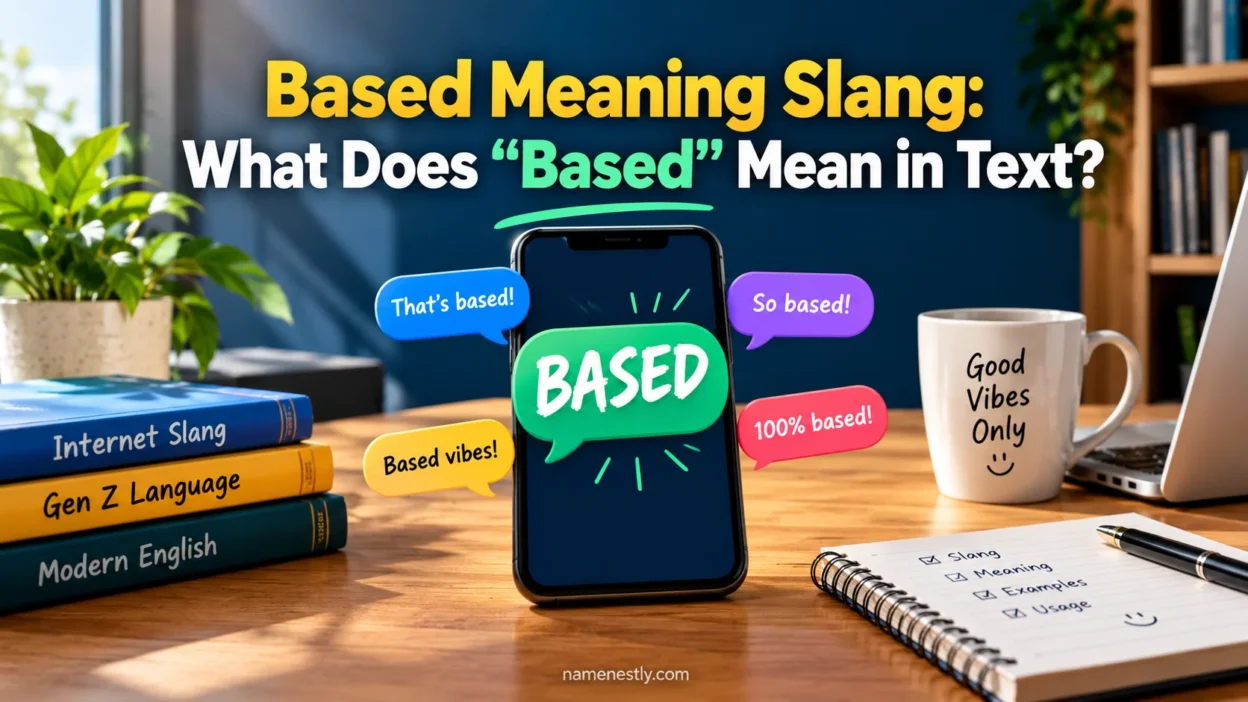
Internet slang changes quickly. A word that once carried a completely different meaning can suddenly become a popular way to react to a comment, opinion, or meme. Based is one of those words.
Today, people use “based” across text messages, social media comments, gaming communities, forums, and memes. When someone writes “based,” they usually express approval, respect, or agreement with something another person said or did.
However, the meaning isn’t always as simple as “I agree.” Depending on the conversation, based can show admiration for an honest opinion, support for an unconventional choice, or playful approval. It can also appear sarcastically.
Understanding the context makes the slang much easier to interpret. A friend saying “based” after your unpopular opinion probably isn’t discussing the dictionary definition of the word. They’re reacting to your confidence or the opinion itself.
Quick Answer
Based meaning slang usually describes someone who confidently expresses an opinion, makes a choice, or supports an idea without worrying too much about other people’s approval. Online, “based” often works as a short way to say “I respect that,” “I agree,” or “That’s a solid take.”
For example:
Person A: “I don’t care if everyone hates pineapple on pizza. I like it.”
Person B: “Based.”
Here, “based” expresses approval of the person’s unapologetic opinion.
The word can also be ironic. Someone might write “based” after an obviously ridiculous statement simply because the statement sounds bold or funny.
Comparison Overview
The following table shows how based differs from several common internet expressions.
| Slang Term | Common Meaning | Typical Tone | Example |
| Based | Respect or approval for a confident opinion | Positive or ironic | “You said what everyone was thinking. Based.” |
| Valid | Acknowledging an opinion or choice as reasonable | Supportive | “You don’t like coffee? Valid.” |
| Facts | Strong agreement with a statement | Direct | “That movie was overrated.” “Facts.” |
| Real | Agreement with something relatable or truthful | Casual | “Sleep is better than parties.” “Real.” |
| W | A win, good decision, or positive outcome | Celebratory | “I finally finished the project.” “W.” |
| Cringe | Something embarrassing, awkward, or uncomfortable | Negative | “That fake speech sounded cringe.” |
| Unbased | The opposite of based in some online communities | Negative or mocking | “That take was completely unbased.” |
These expressions overlap, but they aren’t interchangeable in every situation. Based focuses especially on confidence, independence, or approval of a particular stance.
Main Differences Between Based Meaning Slang
The biggest difference between based and ordinary uses of the word is context. In standard English, “based” often describes something founded, located, or built around something else.
For example, you might say:
- “The company is based in Chicago.”
- “The movie is based on a true story.”
- “The research is based on several studies.”
Internet slang uses the word differently. In slang, based became a reaction to someone’s attitude, statement, or position.
| Ordinary English | Internet Slang |
| Located somewhere | Shows approval |
| Founded on something | Respects an opinion |
| Derived from something | Praises confidence |
| Connected to a source | Can describe an unconventional take |
The slang version doesn’t describe physical location or evidence. Instead, it communicates a social reaction.
What Does Based Mean in Slang?
In modern internet slang, based generally means that someone deserves respect for expressing an opinion confidently or without worrying about social approval.
Imagine someone says:
“I don’t follow trends. If I like something, I wear it.”
A response of “based” can mean that the speaker respects this independent attitude.
The word can therefore carry several related ideas:
- I respect that.
- That’s a strong take.
- I agree with you.
- You’re being honest.
- You don’t care about unnecessary criticism.
- That’s confidently unconventional.
- I support that opinion.
Still, “based” doesn’t always mean complete agreement. Someone can call a statement based because they admire the confidence behind it.
For instance, two people might disagree about a movie while one still respects the other’s willingness to defend an unpopular opinion.
Based Doesn’t Always Mean “Correct”
This distinction matters.
When someone says “based,” they aren’t necessarily declaring an opinion objectively correct. They’re often reacting to the attitude behind it.
Suppose someone says:
“Everyone should eat breakfast for dinner at least once a week.”
Another person might respond:
“Based.”
The response doesn’t establish a scientific fact. It simply shows approval or amusement.
That makes based more social than factual.
Based Meaning in Text Messages
In texting, based usually works as a short reaction. Someone can send the word by itself or include it in a longer sentence.
For example:
Friend: “I’m deleting social media for a month.”
You: “Based.”
In this context, the response suggests respect for the decision.
Another example:
Friend: “I’d rather spend Saturday reading than going to a crowded party.”
You: “Honestly, based.”
The word can make the response feel casual and internet-aware.
Common Texting Examples
Here are several realistic examples:
| Message | Response | Meaning |
| “I’m choosing comfort over fashion today.” | “Based.” | I respect that choice. |
| “I’d rather save money than upgrade my phone.” | “Based.” | That’s a sensible or admirable choice. |
| “I actually enjoyed that unpopular movie.” | “Based.” | Respect for the unusual opinion. |
| “Sleep is more important than staying out late.” | “Very based.” | Strong approval. |
| “I don’t care what people think about my hobbies.” | “Based.” | Respect for the confidence. |
Because texting lacks facial expressions and vocal tone, the surrounding conversation matters.
Based Meaning on Social Media
Social media helped based become a recognizable internet reaction. Users can write it underneath posts, comments, videos, memes, or controversial opinions.
The word works particularly well online because it’s short. Instead of writing a full sentence such as “I respect your willingness to express that opinion,” someone can simply type “based.”
You may encounter it in:
- Comment sections
- Meme discussions
- Short-form videos
- Online forums
- Gaming communities
- Group chats
- Social networking posts
- Political discussions
- Entertainment debates
Its meaning can shift slightly between communities. Some groups use it seriously, while others use it almost entirely as a joke.
Why People Use “Based” Online
Internet conversations reward short, recognizable reactions. Words such as based, valid, real, and facts can communicate an entire attitude with only one word.
That makes them useful in fast-moving conversations.
A person might read a long post and simply respond:
“Based.”
The response can mean, “I agree,” but it can also mean, “I respect your confidence,” or “That was unexpectedly funny.”
What Does “Based” Mean in a Conversation?
Context determines the exact meaning.
Consider these three situations.
Supportive Use
Person A: “I’m going to stop buying things just because they’re trending.”
Person B: “Based.”
Here, the speaker expresses genuine approval.
Humorous Use
Person A: “I eat cereal at midnight because breakfast has no schedule.”
Person B: “Based.”
The response is playful but approving.
Sarcastic Use
Person A: “I only drink water when I’m already thirsty enough to suffer.”
Person B: “Absolutely based.”
Here, the exaggerated wording can make the response ironic.
The same word can therefore communicate different shades of meaning. Tone, punctuation, surrounding words, and the relationship between speakers all matter.
Read More: NTR Meaning: What Does NTR Mean in Text, Slang?
Where Did the Slang “Based” Come From?
The modern internet slang based is strongly associated with rapper and internet personality Lil B, who popularized the term and the related expression “based” during the early 2010s.
Lil B used “based” as part of a broader attitude involving individuality, positivity, and freedom from excessive concern about other people’s judgment.
Over time, online communities adopted and reshaped the expression.
The word eventually moved beyond its original cultural context. It became a general-purpose internet reaction that people could use when they admired a confident or unconventional statement.
This history explains why the modern slang meaning differs so sharply from the ordinary dictionary meaning.
From Insult to Positive Expression
One important part of the word’s history involves its earlier negative association.
“Based” had previously been used as a negative description related to behavior perceived as excessive or socially undesirable. Lil B reclaimed the term and gave it a more positive meaning.
Internet communities later helped spread that transformed usage.
The result is a useful example of how slang can evolve:
negative association → reinterpretation → online adoption → broader slang meaning
Language rarely stays still. Internet culture simply makes those changes happen faster.
How Did “Based” Become Internet Slang?
The word spread through online communities where short reactions and memes became central to everyday communication.
Several factors helped its growth:
- Short length: It takes only one word to communicate approval.
- Flexible meaning: It can mean agreement, respect, or admiration.
- Meme compatibility: The word works well as a reaction to humorous content.
- Community adoption: Different online groups adapted the expression.
- Easy repetition: Users can place it under posts without explaining themselves.
- Strong tone: The word sounds more expressive than simply saying “okay.”
As more people encountered the expression, its meaning became easier to understand from context.
Based vs. Biased: What’s the Difference?
Based and biased look somewhat similar, but their meanings differ dramatically.
Biased means showing an unfair preference toward one side, person, group, or viewpoint.
Based, when used as slang, usually expresses approval of a confident or unconventional stance.
| Word | Meaning | Example |
| Based | Internet approval or respect | “That was a based response.” |
| Biased | Favoring one side without proper neutrality | “The review seems biased.” |
The difference becomes obvious when you place the words into sentences.
“Your answer is based.”
This could be slang approval.
“Your answer is biased.”
This means the answer appears unfairly influenced toward one side.
Never assume these words have similar meanings simply because their spellings look related.
Based vs. Cringe
Online users often treat based and cringe as contrasting reactions.
Based usually communicates approval.
Cringe usually communicates embarrassment, discomfort, or disapproval.
For example:
“He admitted he still loves cartoons.”
“Based.”
The speaker approves of the honesty.
Compare that with:
“He pretended to like something just to impress everyone.”
“Cringe.”
The second response criticizes the behavior.
The contrast isn’t absolute, though. Both words can appear sarcastically.
Based vs. Woke
The terms based and woke sometimes appear together in online arguments, especially when people discuss social or political topics.
However, neither word has one universal meaning across every online community.
“Based” may express approval of a particular viewpoint. “Woke” can describe awareness of social issues, but online speakers also use it critically or humorously.
Because both terms can carry ideological or sarcastic meanings, context matters more than the words themselves.
For a neutral interpretation, examine the entire sentence rather than relying on the label alone.
Examples of “Based” in Text and Online Conversations
Realistic examples make the slang easier to recognize.
Example: Personal Choice
Person A: “I don’t need the newest phone every year.”
Person B: “Based.”
Meaning: The second person respects the choice.
Example: Unpopular Opinion
Person A: “The original movie was better than the remake.”
Person B: “Based take.”
Meaning: The second person approves of the opinion.
Example: Confidence
Person A: “I like what I like. Other people’s opinions don’t decide my hobbies.”
Person B: “That’s based.”
Meaning: The response praises the person’s independence.
Example: Humor
Person A: “Fries are a breakfast food if you eat them before noon.”
Person B: “Based.”
Meaning: The response playfully approves of the unusual idea.
Example: Sarcasm
Person A: “I haven’t slept properly in three days.”
Person B: “So based.”
Meaning: The second speaker is probably being sarcastic rather than genuinely praising the behavior.
What Does Based Mean in Different Contexts?
The word takes on slightly different flavors depending on where you encounter it.
Based in Texting
In texting, based usually functions as a quick reaction to a friend’s statement or decision.
It can replace phrases such as:
- “I respect that.”
- “I agree.”
- “Good point.”
- “That’s fair.”
- “Honestly, yes.”
The short format makes it especially useful in casual chats.
Based in Gaming
Gamers may use based when someone makes a bold decision, chooses an unconventional strategy, or expresses an opinion about a game.
For example:
“I don’t care about the meta. I’m playing the character I enjoy.”
A teammate might answer:
“Based.”
The response praises the player’s independence.
Based on Reddit
Reddit discussions often contain strong opinions, niche interests, jokes, and community-specific language. In that environment, based can signal approval of a blunt or unconventional comment.
The exact tone depends heavily on the subreddit and conversation.
Based on TikTok
TikTok comments often use “based” as a compact reaction to videos or statements.
It may appear under:
- Opinion videos
- Comedy clips
- Unpopular opinions
- Personal choices
- Memes
- Unexpected statements
The term may also appear alongside other slang such as real, W, or valid.
FAQs:
What does “based” mean in slang?
Based usually means showing approval or respect for someone’s opinion, decision, or attitude. Online, people often use it to praise someone for being confident, honest, or unapologetic. It can also mean “I agree” or “I respect that take,” depending on the conversation.
What does “based” mean in texting?
In texting, based usually works as a short reaction. If someone shares an opinion you respect, replying “based” can mean you agree with them or admire their confidence. For example, if a friend says, “I’d rather save money than follow every trend,” you might reply, “Based.”
Is “based” a compliment?
Yes, based is usually a compliment in internet slang. It often shows approval of someone’s honesty, confidence, independence, or unconventional viewpoint. However, people can also use it sarcastically, so the surrounding conversation helps reveal the intended tone.
Is “based” a bad word?
No. Based isn’t profanity or inherently offensive language. It’s casual internet slang. Still, it can appear in heated political or controversial discussions, where its meaning may depend heavily on the specific statement and community using it.
Can “based” be used sarcastically?
Yes. People frequently use based sarcastically, especially in memes and humorous conversations. Someone might call an obviously questionable decision “based” as an exaggerated joke. Tone, context, and the surrounding comments usually reveal whether the person means genuine approval or irony.
Conclusion:
The based meaning slang has become a common way to express approval across online conversations. In most cases, calling someone or something “based” means “I respect that,” “I agree,” or “That’s confidently unconventional.” The term doesn’t always signal complete agreement. Sometimes it praises the confidence behind an opinion rather than the opinion itself. Other times, people use it purely for humor or sarcasm.