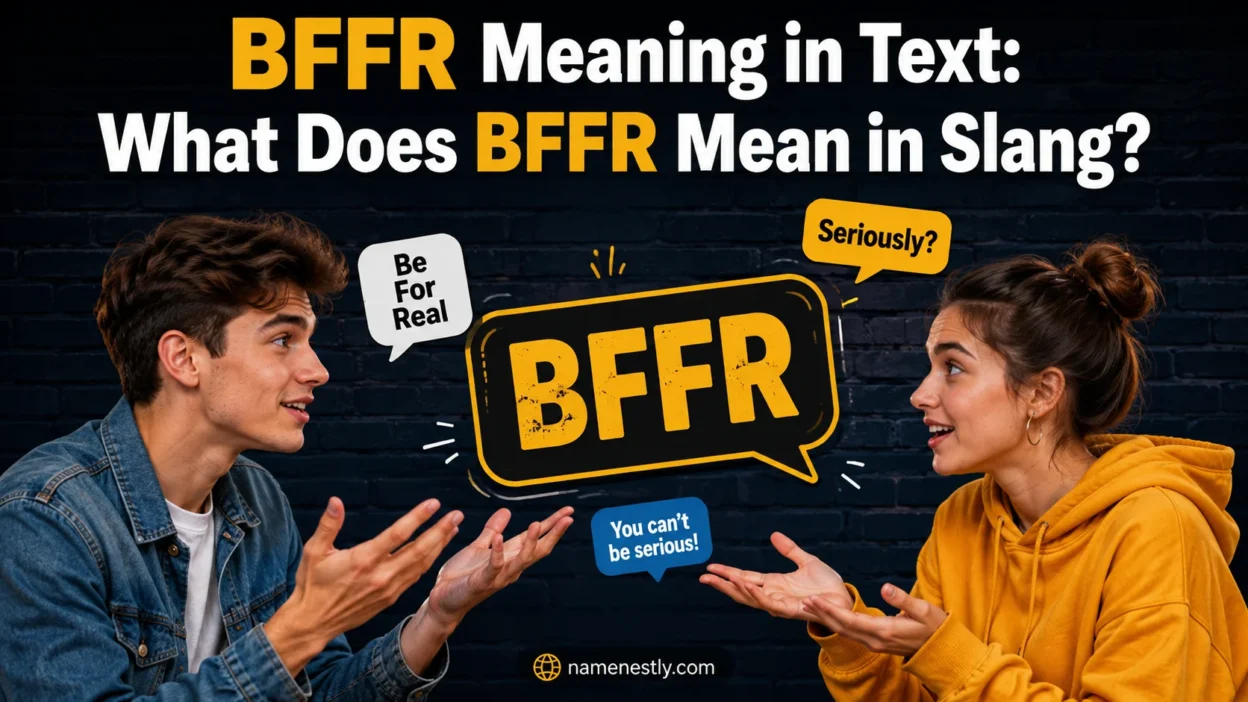
If you’ve seen BFFR in a text, TikTok comment, Instagram post, or group chat, you might wonder what those four letters mean. Unlike many harmless texting abbreviations, BFFR carries a stronger tone and can sound blunt depending on the situation. BFFR means “Be F*ing For Real.”** People use it when they want someone to be serious, realistic, honest, or reasonable. It can express disbelief, frustration, sarcasm, playful teasing, or even mild annoyance.
For example, if someone says, “I can finish this entire project in five minutes,” a friend might respond, “BFFR 😂.” In that context, the person isn’t necessarily angry. They’re basically saying, “Come on, seriously?” The meaning becomes clearer when you look at the conversation around it. A single abbreviation can sound funny between close friends but disrespectful in a serious conversation.
Quick Answer
BFFR means “Be F*ing For Real.”** It is an informal slang abbreviation used to tell someone to be realistic, serious, or honest.
Depending on the context, BFFR can mean:
- “Seriously?”
- “Come on, be realistic.”
- “Are you actually serious?”
- “Stop pretending.”
- “You can’t really believe that.”
- “Be honest with yourself.”
The abbreviation usually appears in casual digital conversations. You’ll commonly see it in texts, group chats, TikTok comments, Instagram comments, memes, and other social media conversations.
Because the original phrase contains profanity, BFFR can sound stronger than “be for real.” Friends may use it jokingly, while strangers could interpret it as rude or confrontational.
Comparison Overview
BFFR belongs to a large family of short internet expressions that communicate emotion quickly. However, each abbreviation has a slightly different purpose.
| Term | Meaning | Common Purpose | Typical Tone |
| BFFR | Be F***ing For Real | Calling out something unrealistic | Blunt, sarcastic |
| FR | For Real | Showing agreement or seriousness | Casual |
| FRFR | For Real, For Real | Strong agreement or sincerity | Casual, emphatic |
| BFF | Best Friends Forever | Talking about friendship | Friendly |
| TBH | To Be Honest | Introducing an honest opinion | Casual |
| ISTG | I Swear to God | Showing frustration or emphasis | Strong |
| NGL | Not Gonna Lie | Introducing honesty | Casual |
| Be for real | Be realistic or serious | Challenging a statement | Informal |
The biggest difference is purpose. BFFR usually challenges what another person has said, while FR and FRFR usually reinforce agreement or sincerity.
Main Differences Between BFFR Meaning in Text
The phrase behind BFFR separates it from several similar abbreviations. It doesn’t simply mean “really” or “honestly.” Instead, it usually pushes another person to reconsider what they just said.
BFFR Means “Be F***ing For Real”
The most common expansion of BFFR is “Be F*ing For Real.”**
The profanity adds emphasis. It makes the expression stronger than simply saying “be for real.”
Imagine someone telling you that they studied for only ten minutes before an exam and still expect a perfect score. You might reply:
“BFFR, you know that isn’t enough.”
Here, BFFR challenges an unrealistic expectation.
BFFR Is Different From BFF
The abbreviation BFF traditionally means “best friends forever.”
Adding the letter R completely changes the meaning.
For example:
- “She’s my BFF.” = She’s my best friend.
- “BFFR.” = Be serious or realistic.
These abbreviations look similar, but they have nothing to do with each other.
BFFR Is Stronger Than “Be For Real”
“Be for real” can sound relatively mild.
BFFR adds emotional force through profanity. That’s why people often use it when a normal response doesn’t feel strong enough.
The difference can be compared like this:
Be for real: “Please take this seriously.”
BFFR: “Come on. You can’t seriously believe that.”
The second expression carries more attitude.
What Does BFFR Stand For?
BFFR stands for “Be F*ing For Real.”**
Each letter represents a word:
- B = Be
- F = F***ing
- F = For
- R = Real
People usually write the abbreviation instead of the complete phrase because short expressions work well in fast-moving online conversations.
The abbreviation also softens the visual impact of the profanity. Someone might feel more comfortable typing “BFFR” than spelling out the entire phrase.
Still, the underlying meaning remains profane. The abbreviation doesn’t technically make the expression formal or professional.
BFFR Meaning in Texting and Chat
In texting, BFFR often works as an emotional reaction rather than a literal instruction.
Someone might send only:
“BFFR 😭”
That short message can communicate disbelief without requiring a long explanation.
For example:
Friend: “I think I can learn Spanish fluently this weekend.”
You: “BFFR 😭”
The response means something like, “Come on, be realistic.”
However, BFFR doesn’t always express anger. Context changes everything.
BFFR as Disbelief
Someone might use BFFR after hearing an unbelievable statement.
Example:
Friend: “He said he didn’t know the assignment was due today.”
Reply: “BFFR.”
Here, the speaker doubts the explanation.
BFFR as Sarcasm
BFFR can also carry a humorous or sarcastic tone.
Example:
Friend: “I’m never buying another pair of shoes.”
Reply: “BFFR 😂.”
The response playfully suggests that the friend probably won’t keep that promise.
BFFR as Frustration
The abbreviation can become more serious when someone repeatedly makes excuses or unrealistic claims.
Example:
Person: “I didn’t ignore your messages. I just forgot to check my phone for three days.”
Reply: “BFFR.”
In this situation, the abbreviation sounds more confrontational.
BFFR as a Reality Check
Sometimes BFFR simply means someone needs to look at a situation more realistically.
Example:
“You can’t study one hour before the test and expect to know everything. BFFR.”
Here, the speaker uses BFFR as a blunt reality check.
BFFR Meaning on TikTok, Instagram, and Social Media
BFFR became especially visible through modern social media culture. Short expressions work particularly well in comment sections because users can communicate a strong reaction with only a few characters.
On platforms such as TikTok and Instagram, BFFR can appear beneath videos, captions, memes, screenshots, or controversial opinions.
For example, someone might post an obviously unrealistic claim. A commenter could simply write:
“BFFR 💀.”
The skull emoji often adds a humorous sense of disbelief. It suggests that the statement seems so unrealistic that the commenter finds it funny.
You may also see variations such as:
- bffr
- BFFR
- BFFRR
- BFFR 😭
- BFFR 💀
- BFFR pls
- girl, BFFR
- bro, BFFR
The spelling may change slightly, but the core meaning remains similar.
How to Use BFFR in a Sentence
BFFR works best in informal conversations where both people understand internet slang.
Here are several natural examples:
“BFFR, you knew exactly what you were doing.”
This calls someone out for pretending they didn’t understand a situation.
“BFFR 😂 You aren’t finishing that entire pizza.”
This uses the phrase playfully.
“BFFR. That’s obviously not what happened.”
This version sounds more serious and direct.
“You think they’ll approve that request? BFFR.”
Here, the speaker doubts the possibility.
“BFFR, you can’t call yourself early after arriving twenty minutes late.”
This uses the abbreviation as a humorous reality check.
The important point is tone. BFFR usually works because the speaker assumes the other person should already recognize the obvious truth.
BFFR Examples in Text Conversations
Example 1: An Unbelievable Claim
Alex: “I finished a 50-page report in 20 minutes.”
Sam: “BFFR 😭”
Sam probably isn’t demanding an explanation. The response simply expresses disbelief.
Example 2: An Unrealistic Plan
Mia: “I’m going to save $10,000 by next month.”
Sara: “BFFR.”
Here, Sara thinks the goal sounds unrealistic based on the circumstances.
Example 3: An Obvious Excuse
Jake: “I didn’t see your message because my phone was right next to me.”
Chris: “BFFR 💀”
The response suggests that Chris doesn’t believe the explanation.
Example 4: Playful Teasing
Lena: “I’m never ordering dessert again.”
Emma: “BFFR 😂”
The phrase becomes a joke because Emma expects Lena to order dessert again.
Example 5: Calling Someone Out
Person A: “I didn’t know everyone was waiting for me.”
Person B: “BFFR. We called you three times.”
This version sounds much more serious.
Is BFFR Rude or Offensive?
BFFR can be rude, but context determines how harsh it feels.
The underlying phrase contains profanity. That alone makes it unsuitable for some situations.
Between close friends, BFFR may function almost like playful teasing. Friends often use strong slang without intending genuine hostility.
With strangers, coworkers, teachers, customers, or older relatives, the same expression can sound disrespectful.
Consider these two situations:
Close friend:
“BFFR 😂 You know you’re going to buy that jacket.”
Coworker:
“BFFR. That’s the worst excuse I’ve ever heard.”
The words remain the same, but the social meaning changes dramatically.
Why Context Matters
Tone depends on several factors:
- Your relationship with the other person
- The subject of the conversation
- Whether the situation is serious
- Punctuation
- Emojis
- Previous messages
- The platform you’re using
- The person’s communication style
A laughing emoji can soften BFFR. A period can make it sound much more direct.
BFFR Tone: Serious, Sarcastic, or Playful?
BFFR doesn’t have one fixed emotional tone.
“BFFR.”
This version can sound blunt or annoyed.
The period creates a firm ending. It may suggest that the speaker isn’t joking.
“bffr 😂”
Lowercase letters and a laughing emoji often make the expression feel more playful.
“BFFR??”
Question marks can emphasize disbelief.
The speaker may be asking, “Are you actually serious right now?”
“BFFR 😭”
The crying emoji often signals humorous disbelief rather than genuine sadness.
“BFFR 💀”
The skull emoji can suggest that the statement seems ridiculously unrealistic or funny.
These tiny details matter in digital communication because text doesn’t provide facial expressions or vocal tone.
Read More: DTF Meaning in Text: What Does DTF Mean in Slang?
BFFR vs. Similar Texting Slang
Several internet abbreviations overlap with BFFR, but they don’t mean exactly the same thing.
BFFR vs. FR
FR means “for real.”
People commonly use it to agree with someone.
Example:
“That movie was amazing.”
“FR.”
The second person agrees.
BFFR does something different. It challenges someone.
“That movie was terrible.”
“BFFR.”
Here, the response essentially says, “Seriously? You actually believe that?”
BFFR vs. FRFR
FRFR means “for real, for real.”
It usually strengthens agreement or sincerity.
“I’m definitely going to the gym tomorrow.”
“FRFR.”
BFFR has a more confrontational function.
“I’m going to become a professional athlete after training for two weeks.”
“BFFR.”
One reinforces a statement. The other challenges it.
BFFR vs. TBH
TBH means “to be honest.”
People often use it before sharing an opinion.
“TBH, I don’t like that design.”
BFFR usually responds to something another person has said.
“You think that design looks good? BFFR.”
BFFR vs. ISTG
ISTG means “I swear to God.”
It commonly expresses frustration, emphasis, or exasperation.
BFFR focuses more specifically on telling someone to be realistic or serious.
BFFR vs. BFF: What’s the Difference?
The difference between BFFR and BFF is simple once you see the extra letter.
BFF = Best Friends Forever
BFFR = Be F***ing For Real
For example:
“My BFF helped me move yesterday.”
This describes a close friendship.
Meanwhile:
“BFFR, you can’t seriously expect me to believe that.”
This challenges someone’s statement.
The additional R completely changes the phrase.
When Should You Use BFFR?
BFFR works best when the conversation is casual and the relationship allows informal slang.
You can use it when:
- A friend makes an obviously unrealistic claim
- Someone exaggerates a story
- You want to express disbelief
- You’re joking with someone close to you
- A friend needs a playful reality check
- You’re reacting to an obviously exaggerated social media post
- You want a short sarcastic response
For example, if your friend claims they’ll wake up at 5 a.m. after regularly sleeping until noon, “BFFR” can work as a humorous reaction.
The key is knowing your audience.
When Should You Avoid BFFR?
BFFR isn’t suitable for every conversation.
Avoid it when communicating in formal or sensitive settings, especially when the underlying profanity could create unnecessary tension.
It’s generally better to avoid BFFR in:
- Professional emails
- Job interviews
- Academic assignments
- Customer service conversations
- Formal business messages
- Serious complaints
- Conversations with unfamiliar people
- Situations involving grief or emotional distress
Instead, choose a softer phrase such as:
- “Are you serious?”
- “Let’s be realistic.”
- “I’m not sure that’s realistic.”
- “Can we look at this another way?”
- “I don’t think that’s accurate.”
These alternatives communicate the same basic idea without the profanity.
How to Respond When Someone Says BFFR
Your response depends on why the person used it.
If they’re joking, you can answer with humor.
Example:
“BFFR 😂”
“Let me dream!”
If they’re questioning something you said, you can explain yourself.
“BFFR.”
“I’m serious. Here’s what actually happened.”
If they misunderstood you, clarification usually works better than arguing.
“BFFR?”
“I wasn’t making a claim. I was joking.”
You can also respond playfully:
- “I am being real!”
- “Let me live 😂”
- “Okay, okay!”
- “Hear me out first.”
- “You know I’m right.”
- “Don’t call me out like that.”
Does BFFR Mean the Same Thing as “Be For Real”?
The two expressions have almost the same basic idea, but their strength differs.
“Be for real” can sound relatively mild.
“BFFR” usually feels more forceful because it represents a phrase containing profanity.
For example:
“Be for real. You aren’t going to finish that tonight.”
This sounds direct but fairly ordinary.
“BFFR. You aren’t going to finish that tonight.”
This sounds sharper and more sarcastic.
Both expressions challenge an unrealistic statement. The second simply carries more attitude.
FAQs:
What does BFFR mean in texting?
BFFR means “Be F*ing For Real.”** It tells someone to be serious, realistic, or honest. People often use it to express disbelief or call out an unrealistic statement.
What does BFFR stand for?
BFFR stands for “Be F*ing For Real.”** The phrase contains profanity, which makes it informal and unsuitable for many professional situations.
Is BFFR a bad word?
BFFR represents a phrase containing profanity. The abbreviation itself isn’t the full word, but the underlying expression remains profane.
Is BFFR rude?
It can be rude depending on context. Close friends may use BFFR playfully, while the same expression can sound insulting or aggressive when directed at a stranger.
What does BFFR mean on TikTok?
On TikTok, BFFR usually means “Be F*ing For Real.”** Users often comment it when reacting to an exaggerated, unbelievable, unrealistic, or humorous statement.
Conclusion:
BFFR means “Be F*ing For Real,”** and it’s one of those internet abbreviations where context matters almost as much as the definition. People use it to express disbelief, challenge an unrealistic claim, call someone out, or tease a friend. The phrase can sound hilarious in one conversation and unnecessarily harsh in another.
Remember the main distinction: BFFR challenges a statement, while BFF describes a friendship. Similarly, FR and FRFR generally emphasize agreement or sincerity rather than calling someone out.