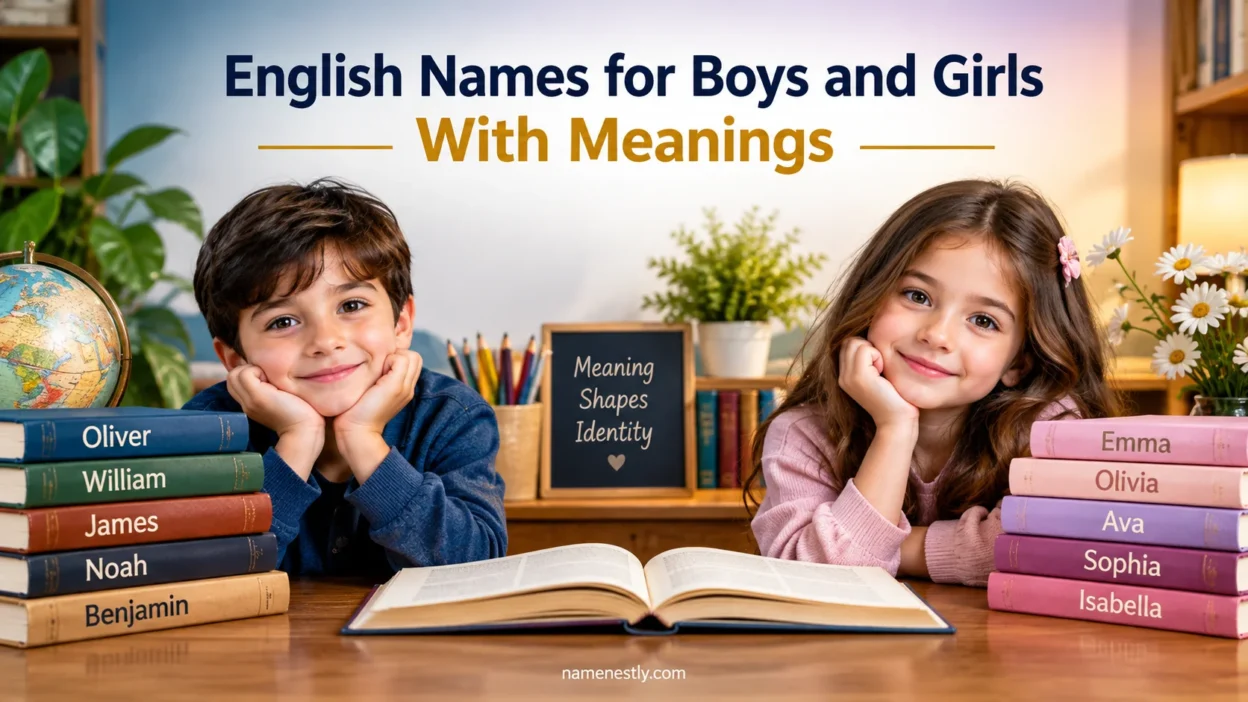
English names offer a wonderful mix of timeless classics, modern favorites, elegant choices, and uncommon gems. Some carry centuries of history, while others stand out because of their simple spelling, beautiful sounds, or distinctive personalities.
Whether you’re naming a baby, choosing a character name, or exploring English names for inspiration, the right choice should feel meaningful and memorable. This guide brings together English names for boys and girls, along with unisex options, rare discoveries, nature-inspired ideas, and helpful explanations of their meanings and origins.
🌟 DID YOU KNOW About English Names
Many names commonly used in English originally came from other languages. For example, Oliver is associated with medieval French and Latin traditions, while Sophia comes from the Greek word for wisdom. English naming traditions have developed through centuries of migration, literature, religion, and cultural exchange.
Another interesting detail is that some names change in popularity over time. Names such as Arthur and Eleanor, once associated with earlier generations, have found new audiences among modern parents.
🧭 How to Choose the Perfect English Name
Choosing a name becomes easier when you focus on the qualities that matter most to you. A name can sound beautiful, carry a special meaning, or connect you to family history.
- Consider the meaning: Names such as Sophia, meaning wisdom, and Felix, meaning fortunate or happy, have positive associations.
- Think about pronunciation: Short names like Jack, Rose, and Luke are easy to say and spell.
- Explore traditional and modern styles: William and Elizabeth feel classic, while Harper and Mason have a more contemporary feel.
- Check the origin: A name may be popular in English-speaking countries without originally coming from the English language.
- Say it aloud: Consider how the name sounds with your surname and whether its initials work well.
- Look for personal meaning: A family connection, favorite book, meaningful place, or cherished memory can make a name especially valuable.
Remember that a name doesn’t need an extraordinary meaning to be special. Sometimes, the sound and personal connection matter most.
👑 Classic English Names for Boys
Classic boys’ names have remained recognizable across generations. Many appear in English literature, royal history, and family traditions. These names suit parents who appreciate familiar spelling, established usage, and a timeless sound.
| Name | Meaning | Origin |
| William | Resolute protector | Germanic |
| James | Supplanter | Hebrew, through English tradition |
| Henry | Ruler of the home | Germanic |
| Edward | Wealthy guardian | Old English |
| George | Farmer, earthworker | Greek |
| Charles | Free man | Germanic |
| Thomas | Twin | Aramaic |
| Arthur | Meaning uncertain; traditionally associated with Arthurian legend | Celtic associations debated |
| Robert | Bright fame | Germanic |
| Richard | Brave ruler | Germanic |
| Alfred | Elf counsel | Old English |
| Harold | Army ruler | Old English |
| Walter | Army ruler | Germanic |
| Frederick | Peaceful ruler | Germanic |
| Albert | Noble, bright | Germanic |
| Samuel | Name of God; traditional Hebrew interpretation | Hebrew |
| Joseph | He will add | Hebrew |
| Daniel | God is my judge | Hebrew |
| Peter | Rock | Greek |
| Francis | Frenchman or free man, depending on historical interpretation | Latin tradition |
Best choices: William, Henry, Edward, and James are strong options for anyone who appreciates traditional English-language naming.
🌸 Beautiful English Names for Girls
English girls’ names range from graceful Victorian classics to familiar names with a soft, modern feel. Many have literary connections, historical significance, or meanings associated with beauty, wisdom, and nature.
| Name | Meaning | Origin |
| Elizabeth | Traditionally interpreted as God is my oath | Hebrew |
| Charlotte | Feminine form of Charles; free person | French/Germanic tradition |
| Eleanor | Meaning uncertain | Medieval European usage |
| Alice | Noble | Germanic |
| Grace | Elegance or divine favor | English word name |
| Rose | Rose flower | Latin through English |
| Lucy | Light | Latin |
| Emily | Rival; associated with Latin Aemilia | Latin tradition |
| Victoria | Victory | Latin |
| Margaret | Pearl | Greek |
| Catherine | Traditional meaning often given as pure; etymology is debated | Greek tradition |
| Jane | God is gracious | Hebrew, through English |
| Anne | Grace or favor | Hebrew, through French and English |
| Edith | Riches and war | Old English |
| Audrey | Noble strength | Old English |
| Beatrice | She who brings happiness; traditional interpretation | Latin |
| Florence | Flourishing or prosperous | Latin |
| Clara | Bright, clear | Latin |
| Evelyn | Origin and original meaning are debated | English usage |
| Harriet | Estate ruler | Germanic, through French and English |
For a traditional yet approachable choice, Alice, Clara, Grace, and Lucy are especially easy to pronounce and spell.
Read More: 201+ Dragon Names: Unique, Powerful, and Cute
✨ Unique English Names With Beautiful Meanings
Some names stand out without sounding unfamiliar or difficult to pronounce. This category combines established names with distinctive meanings and less common choices. It works well for readers who want something memorable without inventing a completely new name.
| Name | Meaning | Origin |
| Felix | Fortunate, happy | Latin |
| Iris | Rainbow | Greek |
| Jasper | Traditionally associated with a precious stone | Persian origin through historical transmission |
| Phoebe | Bright, radiant | Greek |
| Silas | Traditionally associated with Silvanus; exact derivation is debated | Latin tradition |
| Rowan | Associated with the rowan tree | Gaelic and English usage |
| Evangeline | Good news | Greek |
| Celeste | Heavenly | Latin |
| August | Revered, venerable | Latin |
| Leon | Lion | Greek |
| Flora | Flower | Latin |
| Seren | Star | Welsh |
| Hugo | Mind, intellect | Germanic |
| Sylvie | Forest | Latin, through French |
| Dorian | Associated with the ancient Greek Dorians; personal-name meaning is uncertain | Greek |
| Linus | Ancient Greek name with an uncertain original meaning | Greek |
| Elodie | French form associated with older European naming traditions; meaning is uncertain | French |
| Thea | Goddess; also used as a short form of longer Greek names | Greek |
| Robin | Traditionally associated with Robert; also the name of a bird | Germanic and English |
| Quentin | Fifth | Latin |
Naming tip: A distinctive name doesn’t need an unusual spelling. An established name with a less familiar sound can offer both individuality and practicality.
💙 Modern English Names for Boys
Modern boys’ names often favor clean sounds, flexible nicknames, and a balance between traditional and contemporary style. Some are old names that have gained renewed attention, while others are English word names or surnames used as first names.
| Name | Meaning or association | Origin |
| Mason | Stoneworker | English occupational surname |
| Logan | Traditionally associated with a small hollow | Scottish |
| Ethan | Strong, firm | Hebrew |
| Aiden | Little fire; traditional interpretation | Irish |
| Dylan | Traditionally associated with the sea | Welsh |
| Carter | Cart driver | English occupational surname |
| Hunter | One who hunts | English occupational name |
| Parker | Park keeper | English occupational surname |
| Blake | Meaning and historical origin are debated | Old English usage |
| Chase | To pursue | English word name |
| Wyatt | Brave in war; traditional interpretation | Germanic, through English |
| Grayson | Son of a steward or gray-haired person, depending on derivation | English surname |
| Cooper | Barrel maker | English occupational surname |
| Austin | Medieval form of Augustine | Latin |
| Miles | Meaning uncertain; sometimes associated with Latin miles, soldier | European naming tradition |
| Everett | Brave or strong boar; traditional interpretation | Germanic |
| Wesley | Western meadow | Old English |
| Bennett | Blessed | Latin, through medieval English |
| Ashton | Ash-tree settlement | Old English |
| Tristan | Associated with medieval romance; derivation is debated | Celtic and French traditions |
Names such as Mason, Carter, and Cooper reflect the English-language tradition of turning occupational surnames into first names.
💗 Modern English Names for Girls
Modern girls’ names often combine familiar sounds with a fresh personality. Some come from surnames, while others are inspired by flowers, places, seasons, and everyday English words.
| Name | Meaning or association | Origin |
| Harper | Harp player | English occupational surname |
| Madison | Son of Maud; modern feminine usage | English surname |
| Addison | Son of Adam | English surname |
| Riley | Traditionally associated with rye clearing or woodland | Irish and English surname traditions |
| Avery | Ruler of elves; traditional interpretation | Germanic, through English |
| Peyton | Meaning varies by historical derivation | English surname |
| Skylar | Related to the Dutch surname Schuyler | Dutch surname tradition |
| Kennedy | Associated with an Irish surname | Irish |
| Brooklyn | Place name used as a given name | English/American usage |
| Autumn | The autumn season | English word name |
| Summer | The summer season | English word name |
| Willow | Willow tree | English word name |
| Hazel | Hazel tree or hazel color | English word name |
| Piper | Pipe player | English occupational surname |
| Quinn | Descendant of Conn; traditional interpretation | Irish |
| Emery | Powerful or industrious; traditional interpretation | Germanic |
| Sadie | Diminutive of Sarah | Hebrew, through English |
| Delilah | Traditional meaning associated with delicacy; etymology debated | Hebrew |
| Paisley | Scottish place and surname name | Scottish |
| Sienna | Associated with the Italian place name and earthy reddish-brown color | Italian |
Worth considering: Harper and Piper have a lively sound, while Willow and Hazel suit anyone drawn to nature-inspired names.
⚖️ Gender-Neutral English Names
Gender-neutral names offer flexibility and can work well for babies, fictional characters, online identities, and creative projects. Some began as surnames or occupations, while others are ordinary English words used as names.
| Name | Meaning or association | Origin |
| Alex | Defender of people, when derived from Alexander | Greek |
| Taylor | Tailor | English occupational surname |
| Jordan | Name of the Jordan River; traditional Hebrew derivation | Hebrew |
| Morgan | Traditional meaning and derivation are debated | Welsh |
| Casey | Traditionally associated with vigilance in Irish name traditions | Irish |
| Jamie | Diminutive of James | Hebrew, through English |
| Charlie | Diminutive of Charles | Germanic, through English |
| Rowan | Rowan tree | Gaelic and English usage |
| Robin | Bird; also a diminutive of Robert | English and Germanic traditions |
| River | Flowing body of water | English word name |
| Sage | Herb; also associated with wisdom | English word name |
| Phoenix | Mythical bird associated with renewal | Greek tradition |
| Avery | Traditional interpretation: ruler of elves | Germanic, through English |
| Dakota | Indigenous North American ethnonym and place-name tradition | Dakota language |
| Sky | The sky | English word name |
| Emerson | Son of Emery | English surname |
| Ellis | Associated with forms of Elijah and other historical names | Welsh and English usage |
| Frankie | Diminutive of Frank or Frances | European naming tradition |
| Remy | French form of Remigius | Latin, through French |
| Bellamy | Traditionally interpreted as beautiful friend | French-derived English surname |
A gender-neutral name doesn’t need to have a neutral original meaning. What matters is how you want to use it and how comfortable you feel with it.
🌿 Nature-Inspired English Names
Nature-inspired names connect a person, character, or creative identity to landscapes, plants, seasons, and the natural world. They can feel gentle, adventurous, earthy, or bold depending on the word and its sound.
| Name | Meaning or association | Origin |
| River | Flowing water | English |
| Willow | Willow tree | English |
| Hazel | Hazel tree | English |
| Rose | Rose flower | Latin through English |
| Lily | Lily flower | English |
| Ivy | Climbing evergreen plant | English |
| Holly | Holly plant | English |
| Daisy | Flower name derived from “day’s eye” | Old English |
| Violet | Violet flower and color | Latin through English |
| Rowan | Rowan tree | Gaelic and English usage |
| Ash | Ash tree | Old English |
| Briar | Thorny shrub | English |
| Fern | Green, non-flowering plant | English |
| Skye | Island name and reference to the sky | Scottish place-name and English usage |
| Autumn | Season | English |
| Summer | Season | English |
| Dawn | First light of day | English |
| Meadow | Open grassy field | English |
| Wren | Small bird | English |
| Ocean | Large body of salt water | English word name |
Nature names are especially useful when you want something visually evocative. Willow suggests a tree, while Dawn creates an image of morning light.
🏛️ Mythology-Inspired Names
Mythological names bring stories, symbolism, and historical depth. Greek and Roman traditions have influenced English naming for centuries, while Norse legends and Celtic traditions offer additional inspiration. Some names belong to gods or legendary figures rather than ordinary historical people, so their associations may be stronger than their literal meanings.
| Name | Association | Tradition |
| Athena | Goddess associated with wisdom and strategy | Greek |
| Apollo | God associated with music, prophecy, and healing | Greek |
| Diana | Goddess associated with the hunt and moon in later tradition | Roman |
| Orion | Mythological hunter and constellation | Greek |
| Iris | Goddess associated with the rainbow | Greek |
| Helen | Figure of Greek legend; traditionally associated with light, though the etymology is debated | Greek |
| Hector | Hero of the Trojan War | Greek |
| Persephone | Queen of the underworld and goddess associated with spring | Greek |
| Freya | Norse goddess associated with love, beauty, and fertility | Norse |
| Thor | Norse god associated with thunder | Norse |
| Loki | Trickster figure in Norse mythology | Norse |
| Odin | Chief god in many Norse traditions | Norse |
| Arthur | Legendary king of British tradition; historical origins remain debated | Arthurian |
| Morgan | Name associated with Morgan le Fay in Arthurian legend | Arthurian |
| Tristan | Knight associated with the Tristan and Isolde romance | Medieval European |
| Guinevere | Queen in Arthurian legend | Welsh and Arthurian tradition |
| Diana | Roman goddess and established personal name | Roman |
| Aurora | Roman goddess of dawn | Roman |
| Atlas | Titan associated with bearing the heavens in Greek mythology | Greek |
| Juno | Queen of the gods in Roman mythology | Roman |
Best for: Fantasy characters, book protagonists, role-playing games, or anyone who wants a name with a recognizable story behind it.
💎 Rare and Uncommon English Names
Rare names can help you stand apart without requiring an unfamiliar spelling or an invented word. Popularity varies by country and year, so “rare” here means distinctive or less conventional in everyday English-language naming rather than guaranteed to be statistically uncommon everywhere.
| Name | Meaning or association | Origin |
| Ambrose | Immortal | Greek |
| Benedict | Blessed | Latin |
| Peregrine | Traveler or pilgrim | Latin |
| Rupert | Bright fame | Germanic |
| Alistair | Scottish form of Alexander | Greek, through Scottish usage |
| Caspian | Associated with the Caspian Sea | Place-name usage |
| Leander | Lion-man; traditional interpretation | Greek |
| Stellan | Scandinavian name with debated derivation | Scandinavian |
| Thora | Feminine form associated with Thor | Norse |
| Imogen | Literary name popularized by Shakespeare; origin is debated | English literary tradition |
| Ottilie | Diminutive of names related to Oda | Germanic, through French |
| Cordelia | Literary name associated with Shakespeare’s King Lear; derivation debated | Celtic and literary traditions |
| Marigold | Golden-yellow flower | English |
| Lavinia | Ancient Roman personal name | Latin |
| Isadora | Gift of Isis | Greek |
| Eulalie | Sweetly speaking; traditional interpretation | Greek, through French |
| Clementine | Mild or merciful | Latin |
| Romilly | English surname and place-name usage | English/French tradition |
| Wilfred | Desiring peace | Old English |
| Rosamund | Traditionally interpreted as horse protection, though popular associations differ | Germanic |
Before choosing an uncommon name, check its pronunciation and spelling in your local community. A rare name can be memorable, but it should still feel comfortable to use.
🐾 Short and Easy English Names
Short names are practical because they’re quick to say, easy to remember, and simple to write. They can suit babies, fictional characters, pets, usernames, or mascots. Some are standalone names, while others are familiar shortened forms of longer names.
| Name | Meaning or association | Origin |
| Ava | Meaning uncertain; several historical explanations exist | Multiple traditions |
| Mia | Often used as a form of Maria; also means “mine” in Italian | Multiple traditions |
| Leo | Lion | Latin |
| Max | Greatest, when derived from Maximus | Latin |
| Eli | Ascended or my God, depending on the Hebrew derivation | Hebrew |
| Eva | Life | Hebrew, through European languages |
| Ivy | Ivy plant | English |
| Joy | Happiness | English |
| Hope | Expectation or optimism | English |
| Faith | Trust or belief | English |
| Luke | From the Latin name Lucas; traditional association with Lucania | Greek/Latin tradition |
| Jack | Traditional diminutive of John | Hebrew, through English |
| Ben | Short form of Benjamin or Benedict | Hebrew or Latin, depending on the full name |
| Finn | Associated with Irish and other northern European naming traditions | Irish and European |
| Kai | Multiple origins and meanings, depending on language | Multicultural |
| May | Month name; also a form of names such as Mary | English |
| Kit | Short form of Christopher or Katherine | English |
| Nell | Traditional diminutive of Eleanor or Helen | English |
| Bea | Short form of Beatrice or Beatrix | Latin tradition |
| Gus | Short form of Augustus or Angus | Latin or Gaelic, depending on the full name |
For a name that will be called aloud frequently, try saying it several times in ordinary conversation. The best short name should feel natural rather than forced.
🎬 English Names Inspired by Literature and Fiction
Books, plays, films, and legends have helped many names become familiar across generations. Fictional inspiration is particularly useful when you’re naming a character, choosing a pen name, or looking for something with a recognizable personality.
The associations below describe literary or fictional connections, not necessarily the original meanings of the names.
| Name | Literary or fictional association | Naming style |
| Alice | Alice’s Adventures in Wonderland | Curious and imaginative |
| Oliver | Oliver Twist | Classic and approachable |
| Matilda | Roald Dahl’s Matilda | Clever and independent |
| Wendy | Peter Pan | Gentle and adventurous |
| Peter | Peter Pan and many other literary works | Familiar and versatile |
| Hermione | Harry Potter | Scholarly and distinctive |
| Luna | Harry Potter; also means moon in Latin | Dreamy and celestial |
| Atticus | To Kill a Mockingbird | Thoughtful and dignified |
| Scout | To Kill a Mockingbird | Curious and spirited |
| Holden | The Catcher in the Rye | Modern and introspective |
| Darcy | Pride and Prejudice | Refined and romantic |
| Heathcliff | Wuthering Heights | Dramatic and intense |
| Romeo | Romeo and Juliet | Romantic |
| Juliet | Romeo and Juliet | Elegant and literary |
| Ophelia | Hamlet | Poetic and dramatic |
| Puck | Shakespeare’s A Midsummer Night’s Dream | Playful and mischievous |
| Robin | Robin Hood legends | Adventurous |
| Arthur | Arthurian legends | Noble and legendary |
| Wendy | Classic children’s literature | Warm and familiar |
| Jo | Little Women | Independent and spirited |
If you choose a name from a famous story, consider whether its character association matches your intended personality. A name can carry a different impression for readers familiar with the original work.
🎨 How to Create Your Own English-Style Name
You don’t have to choose a name from an existing list. You can create something distinctive by combining familiar sounds, meaningful words, or themes that reflect a character’s personality.
Try these approaches:
- Combine nature and personality: Pair a natural image with a quality, such as Willow for gentleness or Ash for a more understated character.
- Use a surname as a first name: English-language naming often uses surnames such as Parker, Ellis, Morgan, and Taylor as given names.
- Shorten a longer name: Alexander can become Alex, while Elizabeth has several established short forms, including Ellie and Liz.
- Choose a sound pattern: Names with softer sounds, such as Clara or Lily, may feel gentle. Names with stronger consonants, such as Blake or Grant, can feel more forceful.
- Borrow inspiration without copying: A favorite landscape, constellation, historical period, or fictional setting can inspire a new name.
For a fantasy name, you might combine sounds from established names to create something original, such as Elowren or Marivelle. These are creative inventions, not traditional names with verified historical meanings.
A useful test is to write your new name beside three established names. If it looks and sounds natural alongside them, you may have found a good direction.
FAQs:
What are the most popular traditional English names?
William, James, Henry, Elizabeth, Alice, and Charlotte are established names with long histories in English-speaking communities. Actual popularity rankings vary by country and year, so check current national statistics if you want a name near the top of today’s charts.
Which English names have beautiful meanings?
Grace, Felix, Clara, Victoria, and Sophia are appealing choices because their meanings are well established. Grace refers to elegance or divine favor, Felix means fortunate or happy, Clara means bright or clear, Victoria means victory, and Sophia means wisdom.
What are some gender-neutral English names?
Taylor, Jordan, Alex, Charlie, Robin, Rowan, River, Sage, and Riley can work across genders. Usage varies by region, and some of these names may be more strongly associated with one gender in particular communities.
Should I choose a popular or uncommon name?
A popular name usually feels familiar and is easy for others to recognize. An uncommon name can offer individuality. Think about pronunciation, spelling, personal connections, and how the name will suit its bearer over time rather than relying on popularity alone.
Can I use English names for fictional characters or pets?
Yes. Many names on this list work for fictional characters, pets, plushies, mascots, and creative projects. Match the sound and meaning to the subject’s personality, appearance, or role. A name like Hunter may suit an adventurous character, while Daisy could fit a cheerful one.
Conclusion:
The best English name isn’t necessarily the most popular, unusual, or meaningful on paper. It’s the one that feels right for the person, character, or project you’re naming. Start with a few favorites, say them aloud, and consider their spelling, history, and associations. Then narrow the list to the names you keep coming back to. A name becomes memorable when its sound, story, and personal significance come together.