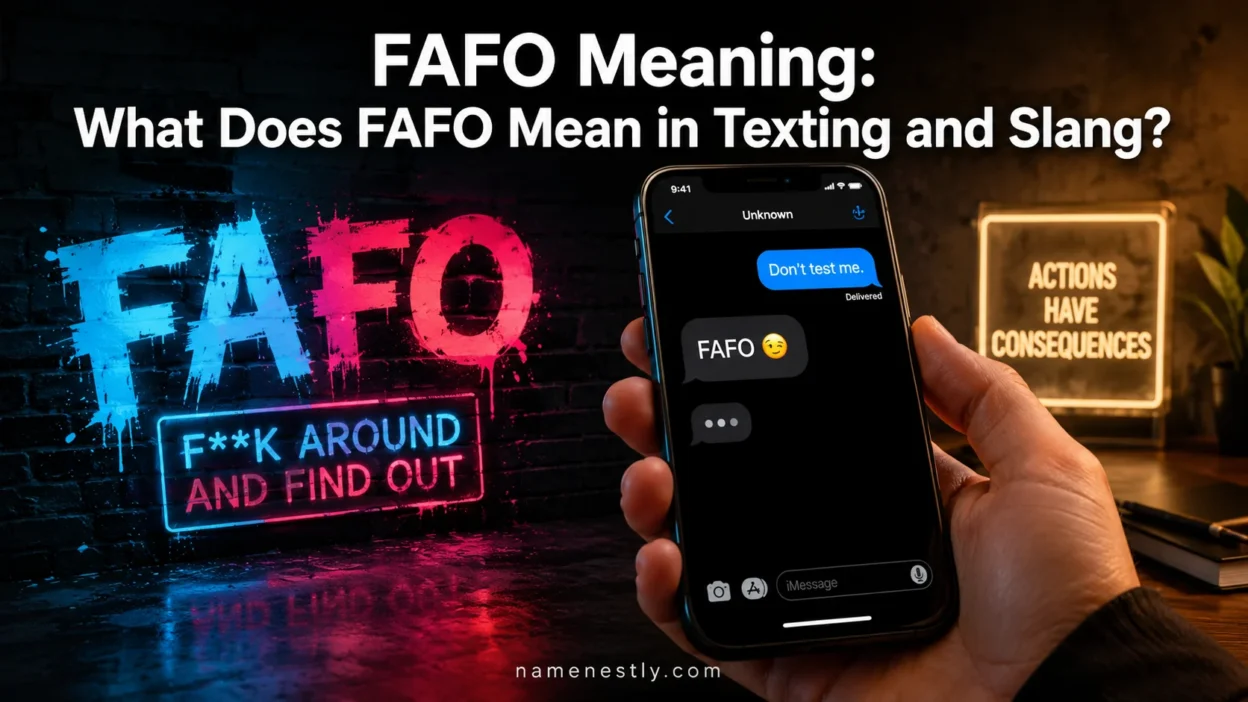
Have you ever seen someone comment “FAFO” under a video, send it in a text, or use it during an argument? This popular internet slang carries a blunt message about actions and consequences. Depending on the situation, it can sound funny, sarcastic, confident, or even threatening.
FAFO stands for “Fuck Around and Find Out.” People use it to suggest that someone who takes unnecessary risks, ignores warnings, or deliberately provokes others will eventually face the consequences. The phrase often appears when someone learns a lesson the hard way.
You might see FAFO in TikTok comments, Instagram captions, online arguments, memes, and everyday conversations. Some people use it playfully when a friend makes a silly decision. Others use it seriously to warn someone against crossing a boundary.
Understanding the context makes the expression much easier to interpret. Below, you’ll learn what FAFO means, how people use it, where it came from, and how it differs from similar slang expressions.
Quick Answer
FAFO means “Fuck Around and Find Out.” It’s an informal, profanity-based expression that warns people they may face the consequences of their actions. Someone might say it when another person ignores a warning, behaves recklessly, or deliberately provokes someone.
For example:
- Text: “Keep messing with him and you’ll FAFO.”
- Meaning: If you continue provoking him, you’ll discover what happens when you cross the line.
- Tone: Depending on the situation, the message can be humorous, sarcastic, defiant, or threatening.
FAFO isn’t always a serious threat. Friends might use it jokingly after someone makes a poor decision. However, the same phrase can sound aggressive during a heated disagreement.
Comparison Overview
FAFO belongs to a broader group of expressions about consequences, personal responsibility, and risky behavior. Although several phrases communicate similar ideas, their tones and meanings aren’t identical.
| Expression | Basic meaning | Typical tone | Common use |
| FAFO | Face the consequences of your actions | Blunt, profane, sometimes confrontational | Warnings, reactions, memes |
| Karma | Actions eventually bring consequences | Reflective, moral, sometimes humorous | Discussing fairness or payback |
| Play stupid games, win stupid prizes | Reckless behavior leads to unwanted results | Sarcastic, mocking | Comments about foolish decisions |
| You reap what you sow | Your actions determine what you eventually experience | Serious, reflective | Life lessons and personal responsibility |
| Don’t push your luck | Stop before your actions create trouble | Cautionary | Preventing a problem before it happens |
The main difference is that FAFO emphasizes discovering consequences firsthand. Karma often suggests that consequences arrive naturally, while “don’t push your luck” warns someone before anything goes wrong.
For example, if someone repeatedly ignores a friend’s boundaries, another person might respond with FAFO. If the situation later backfires, someone else might describe the outcome as karma.
What Does FAFO Mean in Texting?
FAFO is a convenient way to express a strong message without typing the entire phrase. People often use it in text messages when they want to warn someone, react to a questionable decision, or make a sarcastic comment.
Because text messages lack facial expressions and vocal tone, the meaning can sometimes feel stronger than the sender intended. A short message like “FAFO” might sound playful between close friends but hostile during an argument.
FAFO as a Warning
One of the most common uses of FAFO involves warning someone about the likely results of their behavior. The sender suggests that continuing the same actions will eventually lead to trouble.
Example:
Alex: “I’m going to keep annoying my brother until he gets mad.”
Sam: “Go ahead. FAFO.”
Here, Sam means Alex may regret provoking his brother. The message doesn’t necessarily predict violence; it simply warns that actions have consequences.
People may also use FAFO when someone repeatedly ignores rules, pushes boundaries, or assumes that others won’t react.
FAFO as a Joke or Sarcastic Reply
FAFO can also add humor to an ordinary conversation. Friends might use it when someone makes an obviously questionable decision and then experiences a predictable result.
Example:
Mia: “I ate an entire bag of extra-hot chips even though I hate spicy food.”
Jordan: “FAFO 😂”
Jordan is teasing Mia because her decision led to an uncomfortable experience. The expression works as a punchline because the outcome was easy to anticipate.
In these situations, FAFO often carries a playful “What did you expect?” meaning rather than a serious warning.
FAFO as a Reaction to Someone’s Actions
Sometimes, people use FAFO after an event has already happened. Instead of warning someone about future consequences, they’re commenting on the outcome.
Example:
“He kept ignoring the parking signs and got a ticket. FAFO.”
The speaker suggests that the person brought the problem upon himself by ignoring clear instructions.
This usage appears frequently in online discussions about preventable mistakes, public behavior, and decisions that backfire.
What Does FAFO Mean on Social Media?
On social media, FAFO is often used as a short reaction to videos, arguments, memes, and stories about people facing the results of their actions. It communicates a complete idea in just four letters, which makes it easy to use in comments and captions.
The phrase appears across platforms such as TikTok, Instagram, Reddit, and X. However, its meaning can shift depending on the content and the audience.
FAFO Meaning on TikTok
TikTok users may comment FAFO on videos showing someone ignoring a warning, breaking a rule, or taking an unnecessary risk. The comment usually suggests that the resulting problem was predictable.
For example, imagine a video showing someone repeatedly pressing a dog’s buttons despite warnings to leave it alone. If the dog finally reacts, viewers might comment, “FAFO.”
The point isn’t simply that something happened. It’s that the person ignored the warning signs and experienced the consequences.
Common TikTok situations involving FAFO include:
- Someone attempting a risky stunt and falling.
- A person provoking another individual and receiving a sharp response.
- Someone ignoring clear instructions and facing an avoidable problem.
- A prankster discovering that the target doesn’t appreciate the joke.
- A person making a bold claim and then being proven wrong.
The expression can make a video feel more dramatic or humorous. Still, the acronym doesn’t automatically mean the person deserved serious harm.
FAFO Meaning on Instagram
On Instagram, FAFO can appear in Reels comments, Stories, captions, and discussions. People often use it to react to surprising outcomes or reinforce a message about personal boundaries.
For example, someone might post a story about refusing to tolerate disrespect and caption it “FAFO.” In that context, the phrase communicates confidence and a willingness to respond when someone crosses a line.
Other common uses include:
- Reels comments: Reacting to someone experiencing the results of a reckless decision.
- Captions: Expressing a firm attitude toward disrespect or unwanted behavior.
- Stories: Sharing a sarcastic reaction to an incident.
- Memes: Making fun of situations where someone creates their own problem.
The meaning depends on the surrounding content. A laughing emoji may suggest a joke, while an aggressive message may make the same acronym feel intimidating.
Read More: MYF Meaning in Text: What Does MYF Mean in Chat?
FAFO in Memes and Online Comments
Memes have helped make FAFO recognizable beyond ordinary text conversations. The phrase fits situations where a person’s choices lead directly to an unexpected or unwanted result.
A typical meme might show someone ignoring a warning, followed by a picture of the predictable outcome. The caption “FAFO” connects the two moments.
Another popular format contrasts a person’s confidence before an event with their regret afterward. The joke works because viewers can see the connection between the original decision and the final result.
The central idea is simple: someone takes a chance, ignores a warning, or crosses a boundary, then discovers what happens next.
However, online comments can oversimplify real situations. A short caption rarely tells the entire story, so FAFO shouldn’t automatically be treated as proof that someone deserved what happened.
How to Use FAFO in a Sentence
FAFO works best when the situation involves a clear connection between someone’s actions and their consequences. You can use it as a standalone response, include it in a sentence, or apply it to an event that has already happened.
Here are examples showing how the expression works in everyday communication.
| Example sentence | What it means |
| “Ignore the warning again and FAFO.” | Continuing to ignore the warning could cause trouble. |
| “He kept provoking his teammate. FAFO.” | His behavior led to an unwanted reaction. |
| “She thought she could cheat without getting caught. FAFO.” | Her assumption proved wrong. |
| “That prank went badly. Classic FAFO.” | The prankster experienced an unexpected consequence. |
| “Don’t mistake her kindness for weakness. FAFO.” | Disrespecting her may lead to consequences. |
| “He ignored the safety rules and damaged his bike. FAFO.” | His decision caused a preventable problem. |
| “They kept breaking the rules and finally got suspended. FAFO.” | Their repeated actions resulted in punishment. |
| “You warned him three times. Now it’s FAFO.” | He ignored the warnings and must face the outcome. |
These examples demonstrate the expression’s flexibility. FAFO can describe a minor inconvenience, a social disagreement, or a more serious consequence.
FAFO in Casual Text Messages
In private conversations, FAFO often communicates a reaction without requiring a lengthy explanation.
Consider this exchange:
Chris: “I’m going to challenge my friend to a race even though he runs every day.”
Taylor: “FAFO 😂”
Taylor expects Chris might lose badly. The laughing emoji signals that the response is probably playful.
Another example:
Jamie: “I keep borrowing my sister’s clothes without asking.”
Morgan: “You’re going to FAFO eventually.”
Morgan is warning Jamie that the repeated behavior may lead to an argument.
When texting, consider your relationship with the other person. A friend who understands your humor may interpret FAFO correctly, while someone unfamiliar with the expression could read it as hostile.
FAFO in Social Media Captions
FAFO can give a caption a confident, blunt, or defiant tone. People may use it to express that they won’t tolerate disrespect or that others must accept the results of their choices.
Examples include:
- “Boundaries exist for a reason. FAFO.”
- “He ignored every warning. FAFO.”
- “Actions have consequences. FAFO.”
- “Don’t start problems you can’t handle. FAFO.”
These examples express similar ideas, but the tone changes with the wording. A caption about personal boundaries may sound assertive, while one aimed at a specific person during an argument may seem threatening.
FAFO in Memes and Online Reactions
As a meme caption, FAFO usually works best when the consequence is easy to understand.
Imagine someone repeatedly pressing an elevator button after being told it doesn’t work. When nothing happens, a friend might comment, “FAFO” sarcastically.
Or picture someone confidently attempting a simple challenge without reading the instructions, only to fail immediately. A FAFO caption highlights the gap between confidence and the actual result.
These examples are useful because they show how the acronym can function as both commentary and humor. It doesn’t need to appear in a complete sentence to communicate its meaning.
Where Did FAFO Come From?
FAFO comes from the phrase “Fuck Around and Find Out,” an informal expression built around the idea that actions have consequences. The full wording existed before the acronym became a recognizable feature of internet slang.
Its precise origin is difficult to establish. It would be misleading to assign the expression to one person, one website, or a single year without reliable historical evidence.
Early Uses of FAFO
The underlying phrase belongs to informal speech that expresses a blunt warning. Its wording combines a vulgar verb with a suggestion that someone will discover the consequences of their behavior firsthand.
Over time, people shortened the phrase to its initial letters. This made it easier to use in written conversations, online comments, and short captions.
The phrase also fits a common pattern in English: people often turn familiar expressions into compact abbreviations when the full wording is lengthy or repetitive.
However, the earliest use of the full phrase and the earliest use of the acronym aren’t necessarily the same thing. Establishing either date requires historical evidence rather than assumptions based on recent online popularity.
How Internet Memes Helped Spread FAFO
Internet culture helped the acronym travel between communities. Short expressions spread easily when users can attach them to a recognizable image, video, or situation.
FAFO works particularly well in memes because it summarizes a cause-and-effect story. A person makes a choice, the choice creates a problem, and the acronym delivers the punchline.
Social media also encourages people to reuse familiar phrases across different situations. Someone who first encounters FAFO in a funny video might later recognize it in a discussion about personal boundaries or public behavior.
That wider exposure has made the expression useful in both humorous and serious conversations.
Why FAFO Became More Widely Recognized
Several features help explain FAFO’s popularity:
- It’s short: Four letters communicate a longer phrase.
- It’s direct: The expression makes the relationship between behavior and consequences clear.
- It’s adaptable: People can use it in jokes, warnings, arguments, and commentary.
- It’s memorable: The acronym is easy to recognize and repeat.
- It fits online culture: Its blunt wording works well in short comments and meme captions.
Public discussions, including political commentary, have also used FAFO to express defiance or warn about possible consequences. In those settings, the phrase can carry a stronger tone than it does between friends.
Popularity doesn’t establish a precise origin date, though. The phrase’s history and the period when it became widely recognized are separate questions.
FAQs:
What Does FAFO Stand For?
FAFO stands for “Fuck Around and Find Out.” It’s a slang expression that warns people they may face the consequences of reckless behavior, ignored warnings, or deliberate provocation.
What Does FAFO Mean in a Text From a Girl or Guy?
The meaning depends on the conversation. A girl or guy might use FAFO jokingly, sarcastically, or as a serious warning.
The acronym alone doesn’t prove that someone is flirting, angry, or threatening you. Read the surrounding messages before deciding what the sender means.
Is FAFO a Bad Word?
Yes, the complete phrase contains profanity. Although the acronym is less explicit than spelling out the full expression, many readers recognize what it stands for.
Use caution in professional conversations, formal writing, and situations where profanity may offend someone.
What Does FAFO Mean on TikTok?
On TikTok, FAFO usually refers to someone facing the consequences of their actions. Users commonly apply it to videos involving risky decisions, ignored warnings, arguments, and humorous failures.
The comment can be sarcastic, playful, or confrontational depending on the video.
How Do You Pronounce FAFO?
People commonly pronounce FAFO as a word, rhyming approximately with “laugh-o” without the initial l sound. Others pronounce each letter separately: F-A-F-O.
Both forms are recognizable in informal conversation, although pronunciation can vary between speakers.
Conclusion:
FAFO means “Fuck Around and Find Out,” a blunt expression about facing the consequences of your actions. People use it in text messages, social media comments, memes, arguments, and everyday conversations. Sometimes, it’s a playful response to a friend’s predictable mistake. In other situations, it warns someone against ignoring boundaries or continuing risky behavior. The key is understanding the context. FAFO can communicate humor, sarcasm, confidence, frustration, or intimidation, depending on the people involved and the situation.