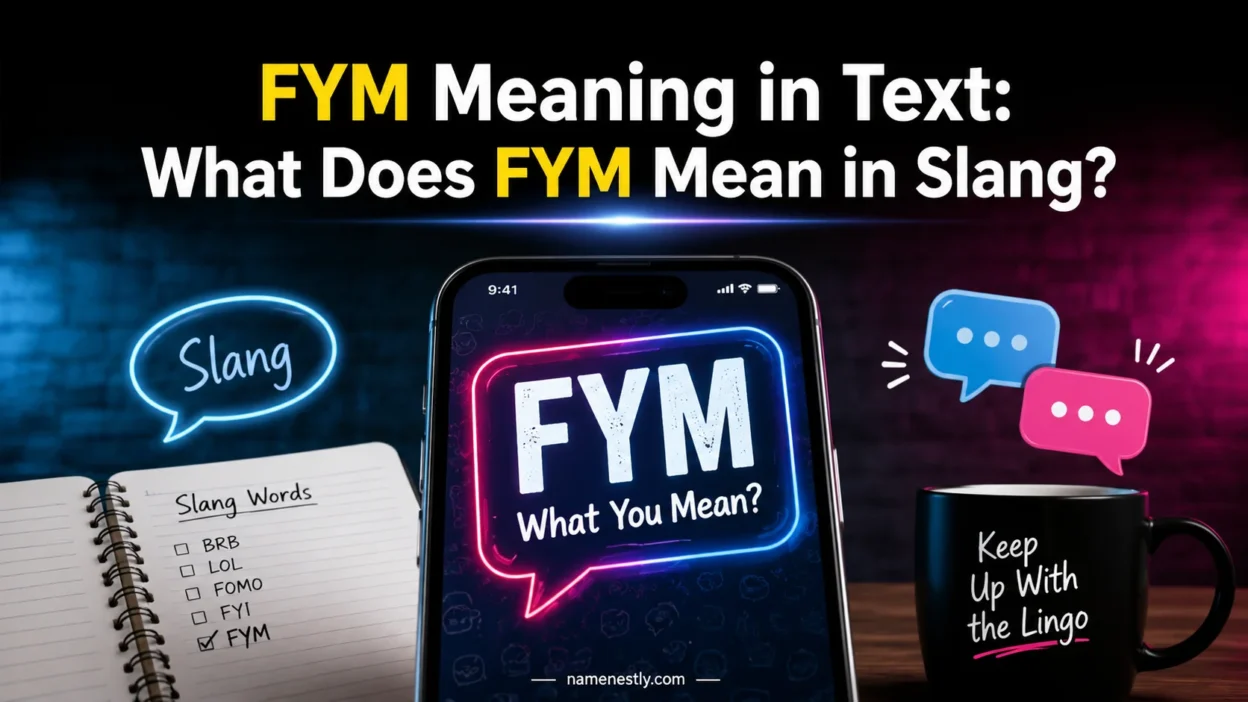
Have you ever received a text that simply says “FYM?” and wondered whether the sender was confused, annoyed, or joking? This short abbreviation appears in text messages, social media comments, and casual conversations. Its meaning often depends on the words that came before it and the relationship between the people chatting.
The most common slang meaning of FYM is “Fuck You Mean?” People use it to question someone’s statement, express disbelief, or challenge something that sounds confusing or unreasonable. Depending on the situation, it can sound playful, surprised, sarcastic, or confrontational.
Understanding FYM can help you interpret online conversations without misreading someone’s tone. Whether you saw it on TikTok, Instagram, Snapchat, or in a private message, this guide explains its meaning, examples, alternative interpretations, and appropriate responses.
Quick Answer:
FYM stands for “Fuck You Mean?” in common internet slang. It’s an informal, profane way to ask someone what they mean, question a surprising statement, or challenge something that sounds unbelievable.
For example:
- Person A: “You can’t come to the party anymore.”
- Person B: “FYM? Why not?”
In this conversation, the second person uses FYM to question the unexpected decision. Their response might express confusion, frustration, or disbelief.
The abbreviation doesn’t always indicate anger. Friends sometimes use it jokingly when reacting to unexpected news or teasing one another. However, because it includes profanity, FYM can sound disrespectful in formal or unfamiliar settings.
Comparison Overview
FYM belongs to the broader group of internet abbreviations people use to communicate quickly. However, its meaning and tone differ from similar expressions such as WYM, WTH, and WTF.
| Abbreviation | Full Meaning | Common Purpose | Tone |
| FYM | Fuck You Mean? | Questions or challenges a statement | Blunt, surprised, or confrontational |
| WYM | What You Mean? | Requests clarification | Neutral or confused |
| WYD | What You Doing? | Asks about someone’s activity | Casual |
| WTH | What the Hell? | Expresses surprise or confusion | Surprised or frustrated |
| WTF | What the Fuck? | Reacts to something shocking | Strong, emotional, or vulgar |
| FR | For Real | Shows agreement, seriousness, or disbelief | Casual |
| HUH | Huh? | Signals confusion or requests clarification | Depends on context |
The most important distinction is that FYM directly questions what another person means, often with a sharper tone than WYM.
For instance, “WYM?” may sound like a simple request for clarification. In contrast, “FYM?” can imply that the speaker finds the statement unreasonable or hard to believe.
Main Differences Between FYM Meaning and Similar Slang
FYM can resemble several other abbreviations because people often use them in response to surprising messages. Still, each expression communicates a slightly different reaction.
FYM vs. WYM
Both FYM and WYM ask someone to explain what they mean. The main difference involves profanity and tone.
WYM stands for “What You Mean?” It’s a casual, relatively mild question that works in many everyday conversations.
FYM stands for “Fuck You Mean?” It adds stronger language, which can make the question sound more challenging or emotional.
Example:
- Friend A: “I’m not going tomorrow.”
- Friend B: “WYM? I thought you were coming.”
Here, the second friend simply wants clarification.
Now consider this exchange:
- Friend A: “You need to pay for everything.”
- Friend B: “FYM? We agreed to split it.”
The second response challenges the claim rather than merely asking for an explanation.
FYM vs. WTF
WTF means “What the Fuck?” People use it to react to something shocking, confusing, or frustrating.
FYM focuses more directly on another person’s statement. WTF can express a broader emotional reaction without necessarily asking a question.
For example:
- FYM: “FYM? I never said that.”
- WTF: “WTF! I can’t believe that happened.”
The first message challenges someone’s claim. The second expresses shock about an event.
FYM vs. WYD
WYD means “What You Doing?” It’s a common abbreviation for asking what someone is doing at that moment.
FYM has a different purpose. It questions someone’s words or reacts to a statement.
Compare these messages:
- “WYD tonight?” asks about someone’s plans.
- “FYM? I already told you.” challenges or questions something the other person said.
These abbreviations aren’t interchangeable because they serve different conversational purposes.
FYM vs. WTH
WTH means “What the Hell?” It’s commonly used to express confusion, surprise, or irritation.
FYM usually addresses the meaning or validity of another person’s statement. WTH often reacts to an event, action, or unexpected situation.
For example:
- “FYM? I never promised you anything.”
- “WTH is going on here?”
The first challenges a statement. The second asks about a confusing situation.
What Does FYM Mean in Texting?
Text messaging is one of the most common settings where FYM appears. People often shorten phrases when chatting with friends because quick messages feel natural in informal conversations.
Instead of typing “What exactly do you mean by that?” someone might send “FYM?” to express the same basic question more forcefully.
However, the meaning depends on the surrounding conversation. A short abbreviation doesn’t provide facial expressions, vocal tone, or body language, so readers must interpret it using context.
FYM as a Request for Clarification
Sometimes, people use FYM because a message doesn’t make sense to them. They want the other person to explain a statement that seems confusing or unexpected.
Example:
- Alex: “You should already know what happened.”
- Jordan: “FYM? Nobody told me anything.”
Jordan uses FYM to question Alex’s assumption. The response also suggests that Jordan feels left out of the situation.
FYM as a Sign of Disbelief
People also use FYM when they find a statement difficult to believe. In this case, the abbreviation communicates surprise or skepticism.
Example:
- Mia: “He finished the entire project in one hour.”
- Chris: “FYM? That usually takes all day.”
Chris questions the claim because it conflicts with their expectations. Depending on their relationship, the response might sound amused rather than angry.
FYM as a Challenge
FYM can become confrontational when someone uses it to push back against criticism, accusations, or demands.
Example:
- Person A: “You always make the same mistake.”
- Person B: “FYM? I fixed it yesterday.”
Here, the second person challenges the accusation and provides a reason for disagreeing.
This use can escalate an argument, especially when the other person already feels defensive. A calmer alternative might be, “What makes you say that?”
Read More: Huzz Meaning in Text: What Does Huzz Mean in Slang?
FYM Meaning on TikTok, Instagram, and Snapchat
Social media encourages short, expressive messages. FYM fits this style because three letters can communicate surprise, disagreement, or disbelief without requiring a long response.
Its meaning generally remains the same across platforms, although the tone can vary with the content and audience.
FYM on TikTok
TikTok users may encounter FYM in comment sections, video captions, or direct messages. Someone might use it to react to an unexpected opinion, a surprising story, or a statement they strongly disagree with.
For example, a creator might say, “Pineapple belongs on every pizza.” A viewer could comment, “FYM? 😂” to express playful disbelief.
The laughing emoji suggests a joking reaction. Without that context, the same abbreviation could sound more aggressive.
FYM on Instagram
On Instagram, FYM may appear in comments, Stories, or private messages. People often use it when reacting to someone’s opinion, questioning a claim, or responding to an unexpected message.
Example:
- Friend: “I’m deleting all my pictures tonight.”
- You: “FYM? Why would you do that?”
Your response signals surprise and asks for an explanation. The sender’s next message will usually clarify whether the situation is serious or humorous.
FYM on Snapchat
Snapchat conversations often move quickly, making short abbreviations convenient. FYM can appear in chats between friends who already understand each other’s communication styles.
For example:
- Friend A: “I told everyone your secret.”
- Friend B: “FYM??”
The second friend appears shocked and wants to know what happened. Depending on the circumstances, this response could also express anger.
Remember that an abbreviation doesn’t establish someone’s emotional state by itself. The preceding messages, relationship, and follow-up responses provide stronger clues.
FYM Meaning in Online Gaming and Group Chats
Online gaming communities use abbreviations to keep conversations quick during matches, livestreams, and team discussions. FYM can appear when someone questions a teammate’s decision or reacts to an unexpected comment.
For example:
- Player A: “Don’t revive me. Leave me here.”
- Player B: “FYM? You’re right next to us.”
Player B questions the instruction because it seems unnecessary or confusing.
In group chats, FYM can also challenge a claim that other members find questionable.
Example:
- Member A: “Nobody contributed to the project.”
- Member B: “FYM? We all worked on it.”
Here, the abbreviation expresses disagreement with a statement that appears inaccurate.
Because gaming conversations can become intense, FYM may sound harsher during competitive moments. Teammates who don’t know one another well might interpret it as an insult rather than a casual question.
What Does FYM Mean in Different Contexts?
The same abbreviation can communicate different emotions even when its basic definition remains unchanged. Understanding these differences helps you avoid confusing playful banter with genuine hostility.
FYM as a Question
In its simplest conversational use, FYM asks someone to clarify a statement.
Example:
- A: “You know what you did.”
- B: “FYM? Tell me what you’re talking about.”
The second person wants a clearer explanation. Their response might sound defensive, but the conversation alone doesn’t prove that they’re angry.
FYM as a Reaction to Something Surprising
FYM can also express disbelief when someone shares unexpected information.
Example:
- A: “She bought a new car without telling anyone.”
- B: “FYM? When did that happen?”
The second person reacts to surprising news and asks for details.
In these situations, the abbreviation may communicate shock rather than hostility. An emoji or follow-up message can make that intention clearer.
FYM as a Confrontational Response
When someone uses FYM during an argument, the expression can challenge another person’s authority, accusation, or demand.
Example:
- A: “You’re going to apologize right now.”
- B: “FYM? You started the argument.”
The response pushes back against the demand. It can make the disagreement more intense because the wording sounds aggressive.
If you want to resolve a disagreement, consider asking, “Why do you think I should apologize?” That question invites an explanation without adding profanity.
FYM as a Playful Expression Between Friends
Close friends sometimes use strong language casually. Within a familiar relationship, FYM may communicate amusement or exaggerated disbelief rather than genuine anger.
Example:
- A: “I ate an entire pizza by myself.”
- B: “FYM 😂 Save me a slice next time.”
The response sounds playful because the second person adds a laughing emoji and continues the joke.
Still, familiarity doesn’t guarantee that everyone will interpret the phrase positively. Pay attention to the other person’s reactions and communication style.
FYM Meaning Examples in Real Conversations
Examples make slang easier to understand because they show how people use the abbreviation in everyday situations.
The following conversations illustrate common ways FYM can appear in text messages.
Example: FYM When Someone Is Confused
Conversation:
- Sam: “You know why I’m upset.”
- Taylor: “FYM? You haven’t told me anything.”
Meaning: Taylor questions Sam’s assumption and asks for clarification.
Example: FYM When Someone Is Surprised
Conversation:
- Alex: “They canceled the concert.”
- Jamie: “FYM? I bought tickets yesterday!”
Meaning: Jamie expresses disbelief because the news is unexpected.
Example: FYM During an Argument
Conversation:
- Chris: “You never help with anything.”
- Morgan: “FYM? I cleaned the whole kitchen.”
Meaning: Morgan challenges a broad accusation by pointing to a specific example.
Example: FYM Between Close Friends
Conversation:
- Riley: “I just spent $200 on snacks.”
- Jordan: “FYM 😂 Did you buy the entire store?”
Meaning: Jordan uses FYM to express exaggerated surprise and tease Riley.
Example: FYM in a Group Chat
Conversation:
- Avery: “Nobody wants to go on the trip.”
- Casey: “FYM? Everyone voted yes.”
Meaning: Casey disputes the statement because it conflicts with the group’s earlier decision.
FAQs:
What Does FYM Stand for in Texting?
FYM commonly stands for “Fuck You Mean?” in text messages. People use it to ask what someone means, question a statement, or express disbelief.
Does FYM Mean “Fuck You Mean?”
Yes. That’s a common slang expansion of FYM in informal online conversations. The expression contains profanity, so it can sound blunt, rude, or confrontational depending on context.
Is FYM the Same as WYM?
Not exactly. Both abbreviations ask someone to explain what they mean. However, WYM stands for “What You Mean?” and generally sounds less aggressive because it doesn’t contain profanity.
Does FYM Mean Someone Is Angry?
Not necessarily. FYM can express anger, but it can also communicate confusion, surprise, skepticism, or playful disbelief. The surrounding conversation provides important clues about the intended tone.
How Do You Respond When Someone Texts FYM?
If the person seems confused, explain your message clearly. If they sound angry, respond calmly and address the issue. When a friend uses FYM jokingly, a casual response may be appropriate.
Conclusion:
FYM most commonly means “Fuck You Mean?” in text messages and internet slang. People use it to question a statement, request clarification, express disbelief, or challenge something that sounds unreasonable. Its tone can range from playful to confrontational. A laughing emoji or familiar relationship may soften the expression, while an argument can make it sound aggressive.