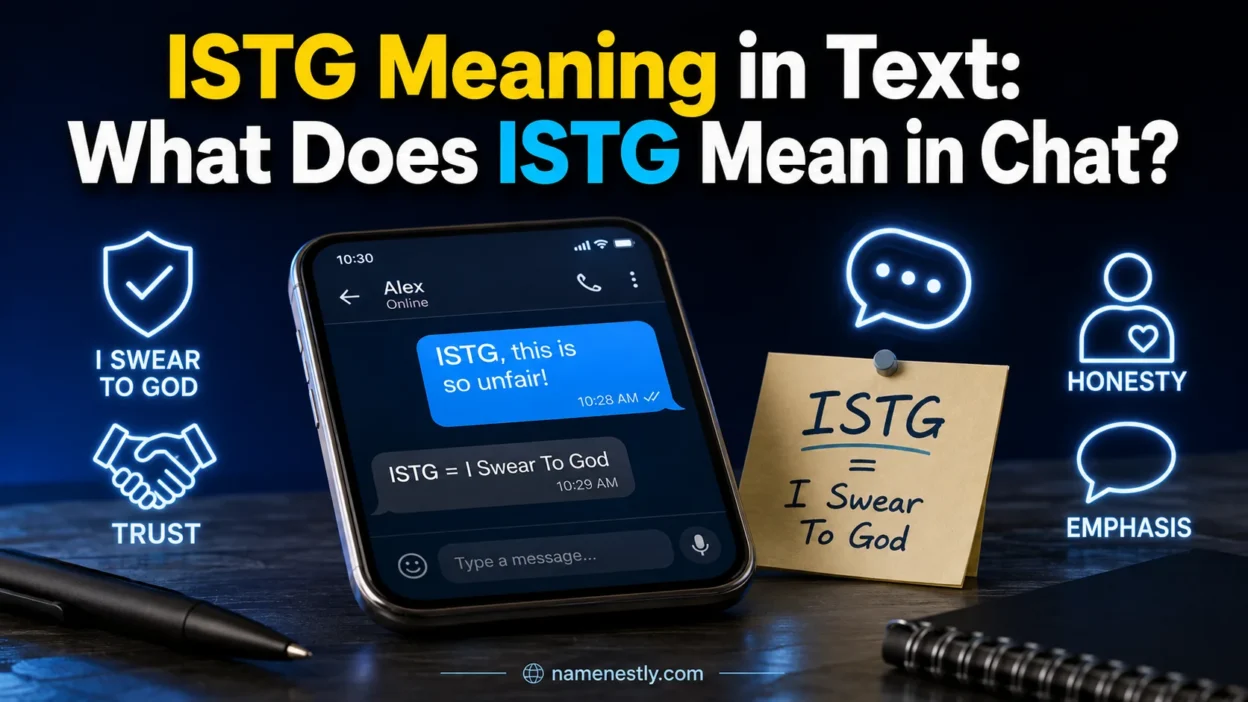
When someone types “ISTG” in a text, the message can feel much stronger than the three letters suggest. This popular texting abbreviation adds emphasis, emotion, frustration, or sincerity to everyday conversations. You’ll often see it in texts, social media comments, direct messages, and online communities.
ISTG means “I Swear to God.” People commonly use it when they want to stress that they’re telling the truth, expressing strong feelings, or reacting intensely to something. Depending on the conversation, it can sound serious, funny, annoyed, surprised, or even dramatic.
For example, someone might text, “ISTG, I didn’t take your charger.” Here, the abbreviation emphasizes honesty. In another conversation, someone might say, “ISTG, this homework is driving me crazy.” The same abbreviation now expresses frustration.
Quick Answer
ISTG means “I Swear to God” in text messages and online conversations. People use it to emphasize honesty, seriousness, frustration, excitement, surprise, or another strong emotion. It usually appears in informal communication such as texting, Snapchat, TikTok, Instagram, Discord, and casual group chats.
For example:
“ISTG, I’m telling the truth.”
This means the person strongly insists that they’re being truthful.
Another example is:
“ISTG, that was the funniest thing I’ve ever seen.”
Here, ISTG adds strong emphasis rather than functioning as a literal oath.
The abbreviation can appear as ISTG, istg, or Istg. Capitalization usually doesn’t change its meaning.
Comparison Overview
The following table shows how ISTG Meaning in Text compares with several related texting expressions.
| Texting Term | Full Meaning | Common Purpose | Typical Tone |
| ISTG | I Swear to God | Emphasis, sincerity, strong emotion | Serious, frustrated, excited, humorous |
| ONG | On God | Strong confirmation or emphasis | Casual, emphatic |
| FR | For Real | Agreement or sincerity | Casual |
| NGL | Not Gonna Lie | Honest opinion or admission | Candid |
| TBH | To Be Honest | Introducing an honest thought | Direct |
| OMG | Oh My God | Surprise, excitement, shock | Emotional |
| I SWEAR | I swear | Strong assurance | Serious or emotional |
| IKR | I Know, Right? | Agreement | Casual |
The biggest distinction involves what the abbreviation emphasizes. ISTG usually strengthens a statement or emotional reaction. NGL and TBH often introduce an honest opinion. FR generally confirms that something is genuine or true.
Main Differences Between ISTG Meaning in Text
The meaning of ISTG stays connected to “I Swear to God,” but its conversational purpose can vary considerably.
| Use | Example | Meaning |
| Honesty | “ISTG, I didn’t do it.” | Strongly insisting on the truth |
| Frustration | “ISTG, this keeps happening.” | Showing annoyance |
| Excitement | “ISTG, that concert was incredible!” | Intensifying excitement |
| Surprise | “ISTG, you actually did it!” | Showing disbelief or amazement |
| Humor | “ISTG, my dog owns this house.” | Playful exaggeration |
| Reassurance | “ISTG, I’ll be there.” | Strong assurance |
So, when someone asks “What does ISTG mean in text?”, the direct answer is “I Swear to God.” However, understanding the emotional purpose behind it gives you a much clearer picture of the conversation.
What Does ISTG Stand For?
ISTG stands for “I Swear to God.”
Each letter represents one word:
- I = I
- S = Swear
- T = To
- G = God
The phrase existed long before texting and social media. Digital communication simply shortened it into a compact abbreviation that people can type quickly.
In everyday texting, people don’t necessarily use ISTG as a formal religious oath. Many use it as an emotional expression that means something like “I’m absolutely serious” or “I really mean this.”
For example:
“ISTG, I left my phone right here.”
The speaker may simply want to emphasize certainty.
Likewise:
“ISTG, that movie made me cry.”
The person isn’t necessarily making a literal oath. They’re intensifying the statement.
What Does ISTG Mean in a Text Message?
In a text message, ISTG usually adds emphasis to whatever follows or surrounds it. The exact emotional meaning depends on the context.
Consider this example:
“ISTG, I didn’t eat your leftovers.”
The sender wants to convince someone that they’re innocent.
Now compare it with:
“ISTG, this traffic is horrible.”
The sender expresses frustration.
The abbreviation hasn’t changed. The surrounding words have.
That’s why reading ISTG by itself doesn’t always tell you exactly how the sender feels. You need to consider the entire message.
ISTG as a Way to Emphasize Honesty
One of the most common uses involves defending the truth of a statement.
For example:
“ISTG, I sent the email yesterday.”
The sender wants the other person to take the claim seriously.
Another example:
“ISTG, I didn’t touch your stuff.”
Here, ISTG makes the denial sound more forceful.
In these situations, the abbreviation works almost like an emotional underline. It tells the reader, “I really want you to believe me.”
ISTG as an Expression of Frustration
People also use ISTG when they’re annoyed by something.
For example:
“ISTG, my internet keeps disconnecting.”
Or:
“ISTG, you ask me this every day.”
Here, ISTG doesn’t necessarily mean that the person is making a formal oath. Instead, it intensifies their frustration.
The expression can make an ordinary complaint sound much more emotional.
ISTG as Strong Emphasis
Sometimes ISTG simply makes an opinion sound stronger.
For example:
“ISTG, that was the best burger I’ve ever had.”
The sender wants to emphasize how strongly they feel.
Similarly:
“ISTG, this is the funniest video ever.”
The phrase adds emotional punch to the statement.
How ISTG Is Used in Different Texting Situations
ISTG can fit several conversational situations because it functions mainly as an intensifier. Think of it as adding bold formatting to an emotional statement.
When Someone Is Telling the Truth
A person may use ISTG when they believe someone doubts them.
Example:
“ISTG, I didn’t know you were coming.”
The speaker strongly emphasizes that they didn’t know.
Another example:
“ISTG, that’s exactly what happened.”
Here, the sender wants to reinforce their version of events.
When Someone Is Annoyed
ISTG frequently appears when someone has reached the end of their patience.
Example:
“ISTG, this computer freezes every five minutes.”
The abbreviation strengthens the complaint.
When Someone Is Surprised
A person can also use ISTG when something shocks them.
Example:
“ISTG, you actually remembered my birthday!”
In this context, ISTG adds surprise and excitement.
When Someone Is Making a Strong Promise
ISTG can strengthen an assurance.
Example:
“ISTG, I’ll pay you back tomorrow.”
The sender wants the promise to sound serious.
However, the exact strength of the promise depends on the relationship and situation.
When Someone Is Joking
ISTG doesn’t always indicate anger or seriousness.
For example:
“ISTG, my cat thinks she owns this apartment.”
The sentence is playful. The abbreviation adds dramatic humor.
That’s a common feature of internet language. People often exaggerate ordinary situations for comedic effect.
Read More: WSG Meaning in Text: What Does WSG Mean in Chat?
ISTG Meaning on Social Media
ISTG has become common across informal online communication because short abbreviations fit fast-moving conversations.
You may see it in comments, captions, replies, DMs, group chats, and reaction posts.
The expression works particularly well when someone wants to make a reaction feel stronger without writing the full phrase.
ISTG on Snapchat
On Snapchat, ISTG can appear in direct messages, group chats, and replies.
A user might write:
“ISTG, you need to see this.”
The phrase signals that the sender strongly recommends whatever they’re about to share.
Another example:
“ISTG, that was so embarrassing.”
Here, it intensifies the emotional reaction.
ISTG on TikTok
TikTok comments often rely on short expressions that communicate strong reactions quickly.
For example:
“ISTG this video gets funnier every time.”
Or:
“ISTG, I thought the same thing.”
In these cases, the abbreviation adds emphasis to a reaction.
ISTG on Instagram
Instagram users may use ISTG in comments, DMs, Stories, and captions.
For example:
“ISTG, your outfit looks amazing.”
Here, the abbreviation makes the compliment feel more enthusiastic.
ISTG on Discord
Discord conversations often move quickly, particularly in gaming and community servers.
A user might write:
“ISTG, that boss fight took forever.”
The phrase adds frustration without requiring a longer explanation.
ISTG Examples in Texting
Realistic examples make ISTG meaning in text much easier to understand. Here are examples organized by the emotion behind the message.
Serious ISTG Examples
- “ISTG, I’m telling you the truth.”
- “ISTG, I didn’t take your headphones.”
- “ISTG, that’s exactly what happened.”
- “ISTG, I never said that.”
- “ISTG, I saw him at the store.”
These examples use ISTG to reinforce sincerity.
Funny ISTG Examples
- “ISTG, my dog thinks he pays rent.”
- “ISTG, my alarm hates me.”
- “ISTG, I opened the fridge five times.”
- “ISTG, Mondays last three business days.”
- “ISTG, my cat runs this entire house.”
The humor comes from exaggerating ordinary experiences.
Frustrated ISTG Examples
- “ISTG, this app keeps crashing.”
- “ISTG, this traffic isn’t moving.”
- “ISTG, you keep changing the plan.”
- “ISTG, this assignment never ends.”
- “ISTG, my Wi-Fi has one job.”
Here, the abbreviation signals irritation or impatience.
Excited ISTG Examples
- “ISTG, that concert was incredible!”
- “ISTG, this is the best news ever.”
- “ISTG, you have to watch this.”
- “ISTG, that game was insane.”
- “ISTG, I’m still excited about it.”
Surprised ISTG Examples
- “ISTG, you actually won!”
- “ISTG, I wasn’t expecting that.”
- “ISTG, he really showed up.”
- “ISTG, I’ve never seen that before.”
- “ISTG, you remembered!”
How to Reply When Someone Says ISTG
Your response should match the sender’s tone. A serious message deserves a different response than a joke.
If They Are Being Serious
If someone uses ISTG while defending themselves, acknowledge the seriousness.
You could respond:
- “Okay, I believe you.”
- “Got it. I understand.”
- “Alright, thanks for explaining.”
- “Okay, that clears things up.”
If They Are Frustrated
When someone sounds annoyed, acknowledging the frustration usually works better than arguing immediately.
You could say:
- “Yeah, I get why you’re frustrated.”
- “I know. That’s really annoying.”
- “Honestly, same.”
- “Hopefully it gets fixed soon.”
If They Are Joking
Match the playful energy.
For example:
“ISTG, my cat runs this house.”
A natural reply could be:
“At this point, you just live there.”
The response doesn’t need to explain the abbreviation. Context does the work.
If You’re Unsure What They Mean
Sometimes the message isn’t clear.
Instead of guessing, simply ask:
“What do you mean?”
That approach prevents misunderstandings, especially when the conversation involves sarcasm.
ISTG vs Similar Texting Abbreviations
Several internet abbreviations overlap with ISTG, but they aren’t identical.
ISTG vs ONG
ONG generally means “On God.”
Both expressions can emphasize sincerity or strong agreement.
For example:
“ISTG, I’m telling the truth.”
and
“ONG, I’m telling the truth.”
Both emphasize sincerity. However, the phrases have different wording and cultural usage.
ISTG vs FR
FR means “For Real.”
People often use FR to agree with something or emphasize that they’re serious.
Example:
“That movie was amazing.”
“FR.”
ISTG generally carries more emotional force because it directly comes from “I Swear to God.”
ISTG vs NGL
NGL means “Not Gonna Lie.”
People commonly place it before an honest admission or opinion.
Example:
“NGL, I didn’t like the ending.”
ISTG works differently:
“ISTG, that ending shocked me.”
NGL introduces candidness. ISTG intensifies the statement.
ISTG vs TBH
TBH means “To Be Honest.”
It often introduces an opinion.
For example:
“TBH, I prefer the first movie.”
ISTG usually emphasizes a claim or reaction rather than simply introducing an opinion.
FAQs:
What does ISTG mean in text?
ISTG means “I Swear to God.” People use it to emphasize honesty, seriousness, frustration, excitement, surprise, or another strong emotion.
What does ISTG stand for?
ISTG stands for “I Swear to God.” Each letter represents the first letter of one word in the phrase.
Is ISTG a bad word?
No. ISTG isn’t a swear word itself. However, it contains the word “God” and can function as a strong expression depending on the context.
Is ISTG rude?
ISTG isn’t automatically rude. A person can use it humorously, casually, sincerely, or angrily. The surrounding message determines the tone.
What does ISTG mean on Snapchat?
On Snapchat, ISTG still means “I Swear to God.” Users commonly use it to emphasize reactions, claims, jokes, frustrations, or serious statements.
Conclusion:
ISTG means “I Swear to God,” and it’s mainly used to add strong emphasis to casual conversations. Someone might use it while defending the truth, expressing frustration, reacting to surprising news, or making a humorous exaggeration. The most important thing to remember is that context controls the tone. “ISTG, I’m telling the truth” sounds serious, while “ISTG, my cat owns this house” sounds playful.