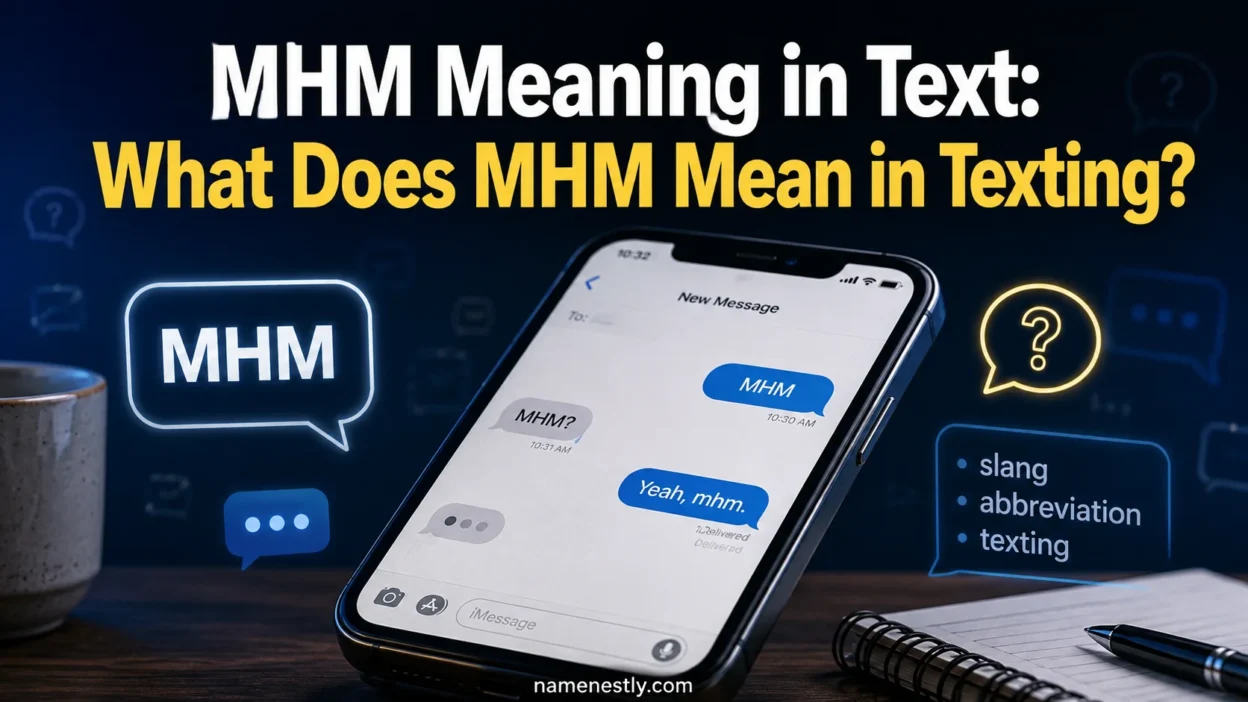
Have you ever received a text that simply says “MHM” and wondered what the other person really meant? This short expression appears in everyday conversations, social media messages, and group chats. Although it looks simple, its meaning can change depending on the situation.
MHM usually means “yes,” “I agree,” or “I’m listening.” People use it as a quick response when they want to acknowledge something without typing a complete sentence. It represents the familiar spoken sound “mm-hmm,” which people often make when agreeing with someone or showing they’re following a conversation.
However, MHM doesn’t always communicate enthusiastic agreement. Sometimes it simply means “I hear you.” In other situations, it may sound hesitant, distracted, or dismissive. The surrounding messages usually reveal the intended meaning.
This guide explains the MHM meaning in text, how people use it, what it means when a girl or guy sends it, and how you can respond naturally.
Quick Answer: What Does MHM Mean in Text?
MHM means “yes,” “yeah,” “I agree,” or “I’m listening” in most text conversations. It’s an informal expression that represents the spoken sound “mm-hmm.” People commonly use it in text messages, direct messages, and casual online chats.
For example:
- Person A: Are we still meeting at 6?
- Person B: Mhm!
Here, MHM communicates agreement and confirms the plan. However, if someone replies with a simple “mhm…” during a serious conversation, the response might suggest hesitation or uncertainty. Context makes the difference.
Comparison Overview
MHM belongs to a group of short expressions people use to acknowledge messages or communicate agreement. Although these responses can seem interchangeable, each one carries a slightly different conversational tone.
| Expression | Common Meaning | Typical Use |
| MHM | Yes, agreement, or acknowledgment | Casual texting |
| MM-HMM | Yes or acknowledgment | Spoken conversation and written dialogue |
| UH-HUH | Agreement or acknowledgment | Informal responses |
| YEAH | Direct agreement | Answering questions |
| OK | Acceptance or acknowledgment | Confirming information |
| MMM | Pleasure, thought, or consideration | Food, reactions, or reflective responses |
| IKR | I know, right? | Sharing agreement or a reaction |
| HM | Thinking, uncertainty, or consideration | Responding while weighing something |
The biggest distinction is that MHM often works as a brief acknowledgment rather than a complete explanation. Someone might use it to confirm a statement, show they’re listening, or keep a conversation moving.
For example, “Yeah, absolutely!” sounds more enthusiastic than “Mhm.” However, the shorter response doesn’t automatically mean the sender is upset or uninterested.
Main Differences Between MHM Meaning in Text and Similar Expressions
Understanding similar expressions helps you interpret messages more accurately. While their meanings sometimes overlap, their conversational roles aren’t always identical.
MHM vs. MM-HMM
MHM and MM-HMM generally represent the same spoken expression. Both can communicate agreement, acknowledgment, or attentive listening.
The main difference comes from spelling and presentation. MHM is a compact form that works well in quick text messages, while MM-HMM more closely resembles the sound’s conventional written representation.
Example:
- Friend: You think we should order pizza?
- You: MHM!
Both MHM and MM-HMM would communicate a similar response here. Neither has a completely different meaning simply because of its spelling.
MHM vs. UH-HUH
UH-HUH is another expression people use to agree or acknowledge something. In spoken conversations, its tone and delivery can influence how the listener interprets it.
MHM and UH-HUH often serve similar purposes in texting. However, the exact sound people associate with each expression can differ slightly.
Example:
- Person A: You got my message, right?
- Person B: Uh-huh.
The reply acknowledges the question. Depending on the context, it might mean “yes” or simply “I’m following you.”
MHM vs. YEAH
YEAH is a more direct verbal response. It usually communicates agreement or answers a question clearly.
MHM can perform the same function, but it may also serve as a listening signal. This makes it useful when someone wants to acknowledge a message without adding much detail.
Example:
- Person A: Do you want to come with us?
- Person B: Yeah!
This sounds like a direct answer. If the response were “Mhm,” it could still mean yes, although some people might prefer a clearer answer when making plans.
MHM vs. OK
OK often communicates acceptance, confirmation, or acknowledgment. MHM more commonly resembles an affirmative sound or a listening response.
Consider this exchange:
- Person A: I’ll send you the details tonight.
- Person B: OK.
The response acknowledges the plan. If Person B replies “MHM,” they may also be acknowledging the statement, although the tone can feel more conversational.
Neither expression is inherently rude. The surrounding conversation determines whether the response feels friendly, neutral, or dismissive.
What Does MHM Mean in Different Contexts?
The MHM meaning in text depends on what the other person says before sending it. A single abbreviation can serve several conversational purposes.
MHM as a Sign of Agreement
One of the most common uses of MHM is to express agreement. People send it when they support an idea, accept a suggestion, or agree with a statement.
For example:
- Friend: That restaurant has amazing food.
- You: MHM, especially the pasta!
In this exchange, MHM signals agreement. The additional comment reinforces the response and makes the conversation feel natural.
People also use it to confirm simple arrangements:
- Person A: Let’s start the movie at 8.
- Person B: Mhm, sounds good.
Here, the expression helps confirm the suggestion without requiring a lengthy answer.
MHM as an Acknowledgment
Sometimes, MHM means “I hear you” rather than “I completely agree.” This distinction matters because acknowledging information doesn’t necessarily mean accepting someone’s opinion.
For example:
- Person A: I think the new schedule will be difficult.
- Person B: MHM, I understand.
Person B acknowledges the concern but doesn’t necessarily agree that the schedule will fail.
This use appears in conversations about work, relationships, school, and everyday problems. People often want to show that they’re following a message before offering their own thoughts.
MHM When Someone Is Listening
MHM can act as a listening signal. In spoken conversations, people often make small sounds to show that they’re paying attention while someone else talks.
Texting has a similar pattern. A person might send MHM to encourage the other person to continue explaining a story.
Example:
- Friend: Guess what happened at work today?
- You: Mhm, tell me!
- Friend: My manager announced a surprise holiday.
The response shows interest in the story. However, a lone MHM may communicate less enthusiasm than a more detailed reply.
When someone shares important news or expresses strong emotions, a thoughtful response usually works better than repeated one-word acknowledgments.
MHM as an Uncertain or Hesitant Response
MHM can sometimes communicate uncertainty, especially when the sender adds punctuation or uses it in an unusual context.
Compare these two messages:
- “Mhm!” — May sound positive or enthusiastic.
- “Mhm…” — May suggest hesitation, uncertainty, or an unfinished thought.
These interpretations aren’t fixed rules. Some people use ellipses casually, while others use them to signal doubt.
For example:
- Person A: You really think this is a good idea?
- Person B: Mhm…
The second person might be uncertain, but the message alone doesn’t prove it. A follow-up question can help clarify the meaning.
MHM in Sarcastic or Dismissive Conversations
A short reply can occasionally sound sarcastic or dismissive. This usually happens when the surrounding conversation suggests frustration or a lack of interest.
For example:
- Person A: I’ve explained this three times already.
- Person B: Mhm.
Depending on their relationship and previous messages, Person B might be acknowledging the statement without engaging further.
However, it’s important not to assume sarcasm from the abbreviation alone. Some people naturally send short replies, even when they aren’t annoyed.
Look at the full conversation before deciding what the sender intended.
Read More: RSVP Meaning: What Does RSVP Mean in Text?
How to Use MHM in Text Messages
MHM works best when you want to communicate casually without writing a complete sentence. Still, choosing the right moment matters because some questions need clearer answers.
Responding to a Question
You can use MHM to answer a simple yes-or-no question when the context makes your meaning clear.
Example:
- Friend: Did you finish the assignment?
- You: Mhm, just submitted it.
The second part confirms the answer and removes any possible confusion.
However, if someone asks an important question about money, travel, appointments, or responsibilities, use a direct response. A clear “Yes, I’ll be there at 6” leaves less room for misunderstanding.
Agreeing With a Friend
MHM fits naturally into casual conversations with friends. It can show agreement without interrupting the flow of a relaxed chat.
Example:
- Friend: We should try that new café this weekend.
- You: Mhm! I’ve heard great things about it.
This response communicates agreement and adds enthusiasm. The extra sentence also gives your friend something to respond to.
Acknowledging Someone’s Story
When a friend shares a story, MHM can show that you’re following along.
Example:
- Friend: I missed the bus, then it started raining.
- You: Mhm, what happened next?
This keeps the conversation moving and encourages your friend to continue.
However, if someone describes a painful experience, a short acknowledgment might feel insufficient. Consider saying, “That sounds really difficult. Are you okay?” instead.
Replying in Group Chats
In group chats, MHM can acknowledge an idea without adding another long message.
For example:
- Alex: Should we meet at the mall?
- Jordan: MHM, works for me.
- Taylor: Sure, what time?
Here, the expression communicates agreement with the suggestion.
Still, group conversations benefit from clear confirmations when people need to coordinate plans. If everyone replies with vague acknowledgments, important details can get lost.
MHM Meaning in Text From a Girl or Guy
People sometimes search for MHM meaning from a girl or guy because they want to understand the sender’s feelings. The expression can provide a clue about the conversation, but it cannot reliably reveal someone’s romantic interest or emotional state.
What Does MHM Mean When a Girl Texts You?
When a girl texts MHM, she may be agreeing with you, acknowledging your message, or showing that she’s listening.
For example:
- You: That movie was better than I expected.
- Her: Mhm, the ending was great!
Her response shows agreement and adds a specific opinion.
However, if she sends only “mhm,” the meaning depends on the conversation. She might be busy, responding casually, or simply using her usual texting style.
Don’t treat MHM as proof that she likes you or wants to end the conversation. Look at the broader pattern of communication instead. Does she ask questions, share experiences, and participate willingly? Those behaviors provide more useful context than one abbreviation.
What Does MHM Mean When a Guy Texts You?
When a guy sends MHM, he may mean yes, acknowledge your message, or show that he’s following the conversation.
For example:
- You: We should watch that new series.
- Him: Mhm, let’s start it tonight.
The second part makes his agreement clear.
If he sends only MHM, avoid jumping to conclusions about his feelings. He might be distracted, responding briefly, or simply comfortable with short messages.
Consider the whole exchange. A person’s consistent communication habits tell you more than a single short reply.
Does MHM Mean Someone Is Mad or Annoyed?
Not necessarily. MHM doesn’t have an established meaning of anger or annoyance.
A sender might use it while feeling frustrated, but the same expression can appear in a perfectly friendly conversation. Context, previous messages, and communication patterns help distinguish these possibilities.
For example:
- Message A: Mhm! That’s a great idea.
- Message B: Mhm. Whatever you want.
The first message may sound supportive. The second might suggest frustration, depending on the relationship and situation.
Even then, the wording doesn’t prove the sender’s mood. If something seems wrong, ask a calm question instead of assuming the worst.
MHM Meaning on Snapchat, Instagram, TikTok, and WhatsApp
MHM generally keeps the same core meaning across messaging platforms. People use it to agree, acknowledge information, or show they’re following a conversation.
MHM on Snapchat
On Snapchat, MHM may appear in quick replies to snaps or direct messages. Friends might use it to acknowledge a comment, agree with a suggestion, or respond casually.
For example:
- Friend: This picture turned out great.
- You: Mhm, I love the lighting!
The response shows agreement while adding a little detail.
MHM on Instagram and TikTok
On Instagram and TikTok, MHM can appear in direct messages and other informal exchanges. Its meaning usually depends on the conversation rather than the platform itself.
For example:
- Person A: That video was hilarious.
- Person B: MHM 😂
Here, the response likely expresses agreement or shared amusement.
An emoji can add context, but it doesn’t establish one universal meaning. People use emojis differently, so interpret them alongside the message.
MHM Texting Examples With Meanings
Examples make the MHM meaning in text easier to understand because they show how the same expression works in different situations.
| Example Conversation | Likely Meaning | Why It Fits |
| A: Are we meeting at 6? B: MHM! | Yes | Confirms a plan |
| A: I passed my exam. B: Mhm, congratulations! | Acknowledgment and support | Recognizes good news |
| A: You know what happened yesterday? B: Mhm, go on. | Listening | Encourages the story to continue |
| A: We should leave early. B: Mhm, that makes sense. | Agreement | Supports a suggestion |
| A: Did you read my message? B: Mhm. | Acknowledgment | Indicates the message was seen or understood |
| A: Are you sure about this? B: Mhm… | Possibly hesitant | The punctuation may suggest uncertainty |
| A: That was unfair. B: Mhm, I get why you’re upset. | Understanding | Acknowledges someone’s feelings |
| A: I’ll send the file tonight. B: Mhm, thanks. | Acceptance | Acknowledges the plan |
FAQs:
What does MHM stand for in texting?
MHM represents the spoken expression “mm-hmm.” People commonly use it to mean yes, express agreement, acknowledge a message, or show they’re listening. It’s an informal expression rather than a traditional acronym with a separate expanded phrase.
Does MHM mean yes?
Yes, MHM often means yes. However, it can also communicate acknowledgment or attentive listening. When a question requires a definite answer, consider the surrounding context or ask the sender to clarify.
What does MHM mean from a girl?
When a girl texts MHM, she may be agreeing, acknowledging your message, or following the conversation. The expression alone doesn’t prove romantic interest, annoyance, or disinterest. Consider her complete message and usual communication style.
Does MHM mean someone is annoyed?
Not necessarily. MHM can appear in friendly, neutral, or tense conversations. Punctuation and surrounding messages may provide clues, but the abbreviation alone cannot reliably establish someone’s emotional state.
What’s the difference between MHM and MM-HMM?
Both expressions commonly represent the same affirmative sound. MHM is a shorter spelling often used in texting, while MM-HMM more closely resembles the conventional written form of the spoken expression.
Conclusion:
The MHM meaning in text is usually simple: yes, I agree, or I’m listening. People use it to acknowledge messages, confirm suggestions, and keep casual conversations moving. However, the expression doesn’t communicate the same tone in every situation. A cheerful “MHM!” may sound enthusiastic, while a bare “mhm” might feel neutral or distant. Neither punctuation nor message length provides a perfect reading of someone’s intentions.