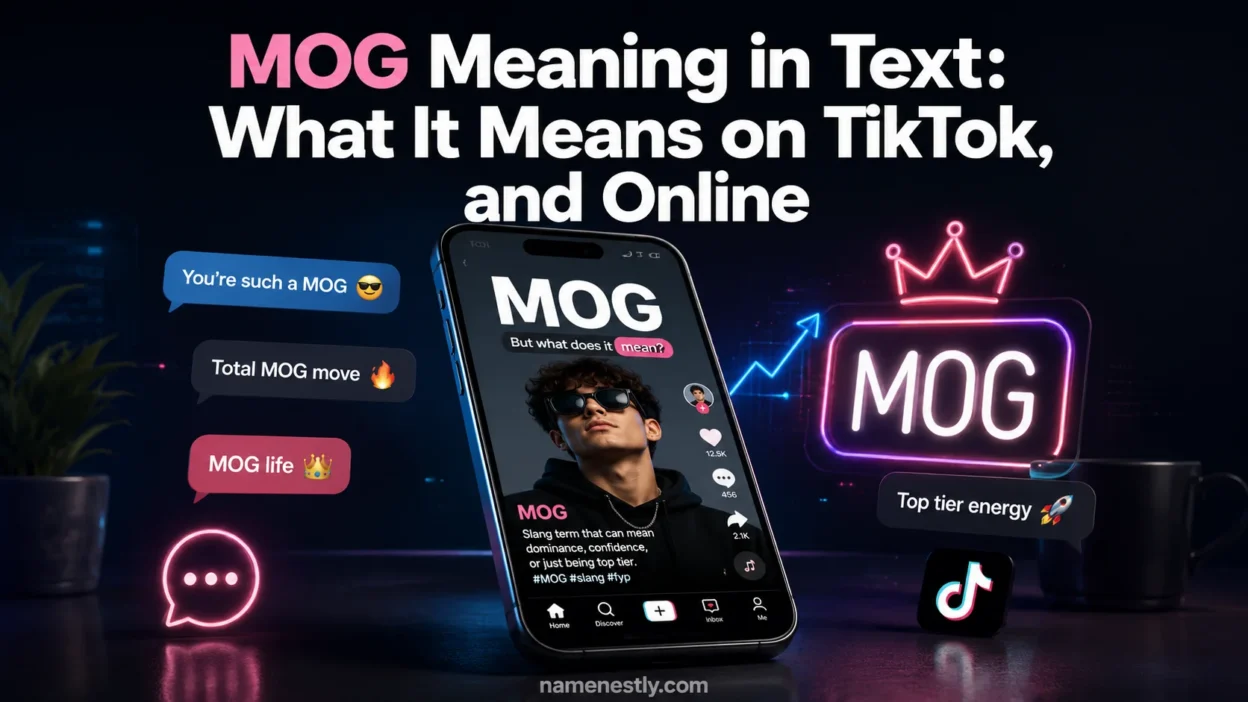
Have you ever seen someone comment “He mogs everyone” under a TikTok video and wondered what that means? You’re not alone. MOG has become a popular internet slang term, especially in conversations about appearance, confidence, and social comparisons.
The MOG meaning in text usually refers to outshining or outclassing someone. People often use it when one person appears more attractive, has a stronger physical presence, or stands out compared with others. However, the term can also describe someone who performs better or dominates in a particular situation.
You’ll commonly see MOG in TikTok comments, Instagram posts, memes, gym discussions, and everyday online conversations. Its tone can range from a playful compliment to a harsh comparison, depending on how someone uses it.
Understanding this slang helps you interpret online jokes, respond naturally to messages, and recognize when a comparison crosses the line.
Quick Answer
MOG means to outshine or outclass someone, particularly in physical appearance, height, physique, or overall presence. For example, “He mogs everyone in that photo” means he stands out compared with everyone else. The term is informal internet slang, not usually an acronym with a separate meaning.
Comparison Overview
MOG can take several forms depending on the sentence. Understanding these variations makes the slang easier to recognize in conversations.
| Term | Meaning | Example |
| MOG | To outshine or outclass someone | “He mogs the entire group.” |
| Mogging | The act of outshining someone | “He’s mogging everyone at the gym.” |
| Mogged | To be outshined or outclassed | “I got mogged in that picture.” |
| Face mogging | Outshining someone in facial appearance | “His face mogs everyone here.” |
| Height mogging | Outshining someone in height | “He height-mogs his friends.” |
| Looksmaxxing | Trying to improve one’s appearance | “He’s looksmaxxing before the photoshoot.” |
The main distinction is simple: MOG describes the comparison, while mogging and mogged indicate how that comparison happens or who experiences it. Looksmaxxing is related internet slang, but it refers to efforts to improve appearance rather than outshining another person.
Main Differences Between MOG Meaning in Text
The meaning of MOG can shift slightly depending on the situation. Someone might use it to praise a person’s appearance, joke about a gym comparison, or describe a clear winner in a competition.
Here are the main distinctions worth understanding.
MOG as a Verb
When people use MOG as a verb, they mean that someone outshines or outclasses another person. Appearance is the most common context, although the comparison can extend to other qualities.
Examples:
- “That guy mogs everyone in the room.” This means he stands out more than the others.
- “She mogs the whole group with that outfit.” This means her style makes the strongest impression.
- “He mogs his opponents every time.” This means he consistently outperforms them.
Mogging as an Action
Mogging describes the act of outshining someone. Online discussions often use it when comparing physical appearance, facial features, height, or muscular builds.
For example, someone might write, “Bro is mogging everyone at the gym.” The speaker means that the person stands out physically compared with the other people there.
Mogged as the Result
Mogged describes the person who gets outshined or outclassed. It often appears in jokes about group photos, gym comparisons, and social media trends.
For example, “I got mogged in that group photo” means someone else looked more impressive to the speaker.
These terms share the same basic idea, but their grammatical roles differ. Once you recognize the difference, you can understand most MOG-related comments without confusion.
What Does MOG Mean in Slang?
In internet slang, MOG describes a situation where one person appears noticeably superior to another in a particular area. Physical appearance is the central theme in many online uses.
The comparison can involve several things:
- Facial appearance: Someone’s facial features stand out compared with others.
- Height: A taller person appears more imposing in a group.
- Physique: Someone has a more muscular or athletic build.
- Fashion: A person’s outfit attracts more attention.
- Confidence: Someone appears more comfortable and self-assured.
- Performance: A person outperforms others in a competition or activity.
For example, imagine two friends posting pictures from the same event. One friend receives more compliments because people like their outfit and overall look. Someone might comment, “You totally mogged him.”
The comment suggests that one person stood out more than the other.
However, MOG doesn’t prove that someone is objectively better-looking or more capable. It expresses a comparison, often based on personal opinions, social expectations, or internet humor.
Is MOG Always About Physical Appearance?
No. Although appearance-related comparisons dominate much of the slang’s online use, people sometimes use MOG more broadly.
Consider these examples:
- “She mogged everyone during the debate.” This means she performed better or made a stronger impression.
- “That player mogged the competition.” This means the player dominated the contest.
- “His outfit mogs every other look here.” This means his clothing stands out.
These broader uses follow the same basic idea: one person or thing outshines another.
Still, context matters. In a discussion about facial features, MOG probably refers to appearance. In a sports discussion, it may refer to performance.
What Does MOG Stand For?
MOG generally functions as a slang verb rather than a conventional acronym. In everyday internet conversations, people usually use it to mean outshine or outclass.
However, the term has a commonly cited connection to AMOG, an abbreviation for “alpha male of the group.” The expression appeared in online pickup-artist and male-oriented communities, where people discussed social dominance and competition.
Over time, MOG developed into a more general slang expression. Online communities increasingly used it to compare physical appearance, height, physique, and perceived attractiveness.
Today, someone can use MOG without knowing anything about its association with earlier internet subcultures.
Does MOG Have One Official Meaning?
Not in the way a standard dictionary acronym might have a fixed expansion. Its meaning depends on how people use it.
In appearance-focused slang, MOG usually means to outshine another person physically. In a broader conversation, it can mean to dominate or outperform someone.
It’s also important to distinguish ordinary slang from specialized meanings. In other contexts, the letters MOG may stand for something unrelated. The surrounding sentence usually tells you which meaning applies.
For example:
- “He mogs everyone in the photo.” This uses the slang verb.
- “What does MOG stand for in this organization?” This asks about a possible abbreviation specific to that organization.
If you encounter MOG in a casual message, the slang interpretation is often the most relevant starting point.
What Does Mogging Mean?
Mogging is the act of outshining or outclassing someone. The word appears frequently in discussions about physical appearance, especially in communities that compare facial features, height, and body proportions.
Someone might say, “He’s mogging the entire group.” That means the speaker believes he stands out more than everyone else.
The word can describe an intentional comparison, but it doesn’t always imply that the person is trying to make others feel inferior.
For example, someone may simply post a picture in which one person happens to attract more attention. Viewers might then describe the situation as mogging.
Common Mogging Examples
Here are some realistic examples that show how people use the term.
| Example | What it means |
| “He’s mogging everyone in this selfie.” | The speaker thinks he looks more impressive than the others. |
| “That haircut is mogging the old one.” | The new haircut looks better to the speaker. |
| “She mogged the competition.” | She outperformed the other competitors. |
| “Bro is mogging without even trying.” | Someone appears to stand out naturally. |
| “That suit mogs every other outfit.” | The suit makes the strongest impression. |
Notice that the slang doesn’t always describe a deliberate action. Sometimes it simply expresses how a person interprets a comparison.
Is Mogging the Same as Bullying?
Not necessarily. Friends may use the term playfully, especially when joking about selfies, outfits, or gym progress.
However, mogging can become hurtful when someone uses it to embarrass another person. Repeatedly comparing people’s faces, bodies, or height can create unnecessary pressure and insecurity.
The difference often comes down to intent, context, and how the other person receives the comment.
Read More: What Does PFP Mean in Text?
MOG Meaning on TikTok and Other Social Media
TikTok has helped spread MOG through short videos, reaction clips, memes, and appearance-comparison content. Users often place the term in captions or comments when one person appears to outshine another.
For example, a video might show two people standing beside each other. A viewer could comment, “The guy on the left is mogging.”
The comment expresses the viewer’s opinion about who stands out more.
MOG also appears on Instagram, Snapchat, Reddit, Discord, and X. The slang doesn’t have a completely different definition on each platform, although the type of content can influence its meaning.
MOG Meaning on TikTok
On TikTok, MOG frequently appears in appearance-related videos and comparison trends.
Common examples include:
- Before-and-after appearance videos.
- Gym transformation clips.
- Side-by-side comparisons of celebrities or influencers.
- Fashion and grooming videos.
- Memes about height and facial features.
- Jokes about looking better in group photos.
For example, someone might post a gym transformation video and receive the comment, “Bro is mogging his old self.”
Here, the comparison is between the person’s current appearance and their earlier appearance. The commenter is suggesting that the person now looks more impressive.
Not every TikTok use is serious. Many creators exaggerate comparisons for comedy, engagement, or dramatic effect.
MOG Meaning on Instagram
On Instagram, MOG often appears under selfies, group pictures, fashion posts, and fitness content.
Imagine a group of friends sharing pictures from a wedding. One person receives most of the compliments because their outfit stands out. A commenter might say, “He mogged the whole group.”
The comment praises that person’s appearance while comparing it with everyone else’s.
However, MOG can also appear in joking exchanges between friends. A single comment doesn’t necessarily indicate hostility or a serious judgment.
MOG Meaning on Snapchat
On Snapchat, people may use MOG in direct messages, private stories, or conversations about photos.
For example:
Friend 1: “Look at this picture from yesterday.”
Friend 2: “You mogged everyone 😂”
Meaning: Friend 2 thinks the first person looked especially good in the picture.
The laughing emoji makes the message feel playful, although the exact tone still depends on the friendship and conversation.
MOG Meaning on Reddit and Discord
Reddit and Discord host many communities focused on gaming, fitness, fashion, memes, and internet culture. Within these communities, MOG can describe either physical comparisons or broader forms of dominance.
For example, someone discussing a competitive game might say, “That player mogged the entire lobby.”
The speaker means the player performed far better than everyone else.
In an appearance-focused discussion, the same expression might refer to someone’s facial features or physique.
The key takeaway: Don’t assume every use of MOG concerns attractiveness. Read the surrounding conversation to identify the intended comparison.
Common Types of Mogging
Internet users have developed several informal expressions around different kinds of mogging. These terms aren’t scientific categories, but they help explain what people are comparing.
Face Mogging
Face mogging refers to a comparison in which one person’s facial appearance is perceived as more attractive than another’s.
Someone might use the term when discussing facial structure, skin, facial symmetry, or other visible features.
Example: “His face mogs everyone in that group photo.”
The speaker believes his facial appearance stands out. However, attractiveness remains subjective, and people often disagree about which features look best.
Height Mogging
Height mogging refers to a situation where one person stands noticeably taller than another.
For example, a much taller person standing beside shorter friends might prompt someone to comment, “He’s height-mogging the whole group.”
The phrase describes a visible difference in height. It doesn’t mean taller people are inherently more attractive, successful, or valuable.
Frame Mogging
Frame mogging usually refers to body size, shoulder width, or overall physical build. The expression appears particularly often in gym and fitness discussions.
Example: “His frame mogs everyone in that picture.”
The commenter believes the person has a more imposing or muscular build.
Body structure varies naturally, and a larger frame doesn’t automatically mean someone has greater strength or fitness.
Hair Mogging
Hair mogging describes a comparison in which someone’s hairstyle, hair volume, or overall hair appearance stands out.
For example, a person might comment, “That haircut is mogging everyone at the party.”
The expression could praise a fresh haircut, an impressive hairstyle, or simply a look that attracts attention.
Fashion Mogging
Fashion mogging refers to outshining others through clothing, accessories, or personal style.
Imagine attending a party where everyone dresses casually, but one person arrives in a carefully styled suit. Someone might say, “He mogged the entire room.”
The comment suggests that his outfit made a stronger impression.
Fashion mogging is often more playful than appearance-based comparisons because clothing choices can be changed easily. Even so, personal taste differs, so one person’s favorite outfit might not impress everyone.
Performance Mogging
Performance mogging describes outperforming others in an activity or competition.
For example:
- A basketball player scores more points than everyone else.
- A student gives a particularly strong presentation.
- A gamer dominates a competitive match.
- A musician delivers an impressive performance.
Someone might describe any of these situations as mogging, particularly in informal online conversations.
This broader use demonstrates how internet slang can move beyond its original context.
FAQs:
What Does MOG Mean in Text?
MOG usually means to outshine or outclass someone, especially in appearance. People also use it to describe someone who dominates a competition or stands out in another area.
What Does “I Got Mogged” Mean?
“I got mogged” means the speaker feels someone else outshined or outclassed them. The comparison often involves appearance, height, or physique, but it can also refer to performance.
Is MOG Short for Something?
MOG generally functions as an internet slang verb rather than a standard acronym. It’s commonly associated with AMOG, meaning “alpha male of the group,” although people today often use MOG without knowing that connection.
What Does MOG Mean on TikTok?
On TikTok, MOG usually describes someone who appears more attractive or impressive than another person. It commonly appears in appearance comparisons, fitness videos, reaction clips, and memes.
Is Mogging Positive or Negative?
Mogging can be positive when it expresses admiration or a compliment. It can feel negative when someone uses it to embarrass another person or make them feel inferior.
Conclusion:
The MOG meaning in text is usually to outshine or outclass someone, particularly in appearance, height, physique, or overall presence. It’s common in TikTok comments, Instagram posts, memes, and casual online conversations. The related terms are easy to remember. MOG describes the act of outshining someone, mogging refers to the action, and mogged describes the person who gets outshined.
Although people often use this slang playfully, it can also sound insulting when it turns into an unwanted comparison. Pay attention to the context and the relationship between the people involved. Once you understand how the term works, you’ll recognize it more easily in messages, comments, and internet memes.