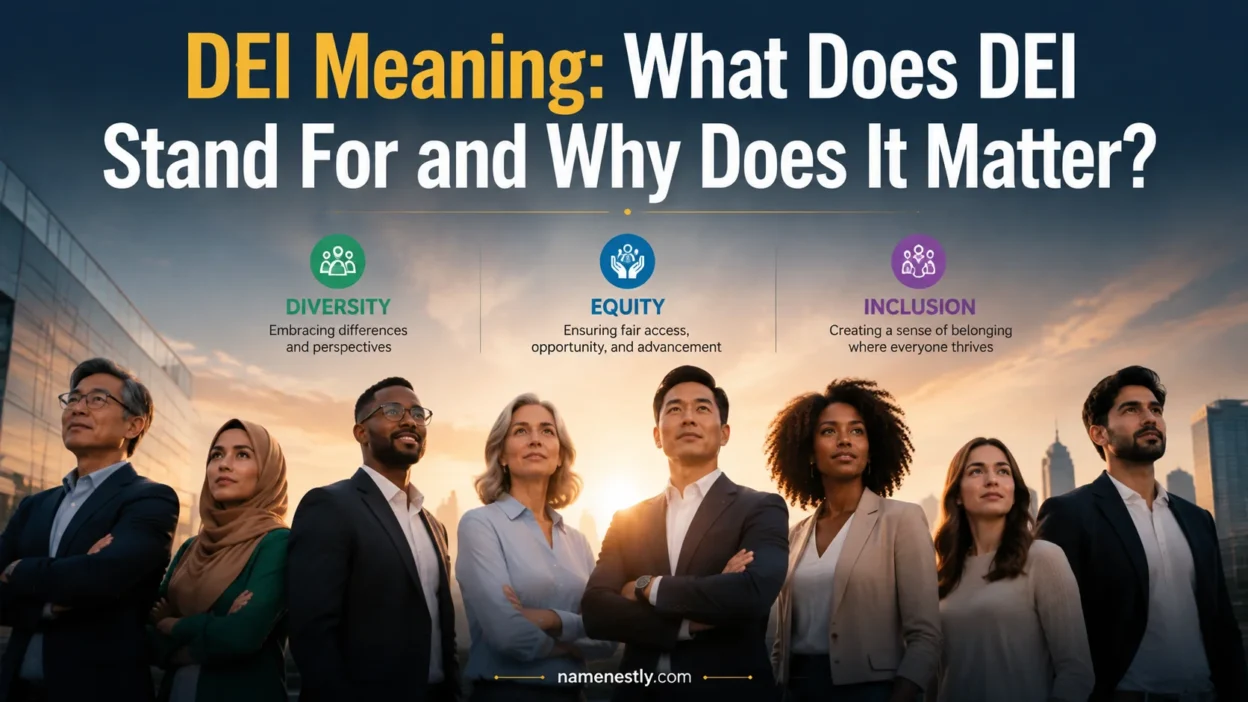
Have you ever seen the abbreviation DEI in a workplace discussion, company policy, job advertisement, or news story? You’re not alone. DEI has become a common term in conversations about employment, education, leadership, and social issues across the United States.
DEI stands for Diversity, Equity, and Inclusion. These three principles describe how organizations approach representation, fair opportunities, and an environment where people feel respected and involved.
Although DEI often appears in workplace discussions, its meaning goes beyond hiring practices. It also relates to employee development, accessibility, organizational culture, and how companies address barriers that affect different groups.
However, DEI has also become a subject of public debate. Some people support its goals because they believe it promotes fairness and opportunity. Others question particular programs, hiring practices, and their impact on equal treatment.
Quick Answer:
DEI stands for Diversity, Equity, and Inclusion. It describes principles and organizational practices that aim to recognize different backgrounds, promote fair access to opportunities, and create environments where everyone can participate and feel respected. Companies, schools, and public organizations use DEI-related approaches in areas such as recruitment, employee development, accessibility, and workplace culture.
Comparison Overview:
DEI brings three related ideas together, but each one addresses a different part of organizational culture. Diversity focuses on who participates, equity examines whether opportunities are fair, and inclusion considers how people experience their environment.
| DEI Component | Core Meaning | Main Question | Practical Example |
| Diversity | Representation of different people and backgrounds | Who is represented? | Hiring people with varied experiences |
| Equity | Fair access to opportunities and resources | Are opportunities fair? | Providing reasonable workplace accommodations |
| Inclusion | Respectful participation and involvement | Does everyone feel welcome? | Encouraging employees to contribute ideas |
| Equality | Providing equal treatment | Does everyone receive the same treatment? | Applying consistent workplace rules |
The three DEI principles work best when organizations consider them together. A company might recruit employees from different backgrounds but still struggle with inclusion if certain employees rarely receive opportunities to contribute.
Similarly, a workplace might offer identical resources to everyone without considering accessibility needs. DEI discussions examine these situations and explore ways to improve participation and fairness.
Main Differences Between DEI
Understanding the differences between diversity, equity, and inclusion makes the complete DEI meaning easier to remember. Although people frequently use these words together, they don’t describe exactly the same thing.
| Feature | Diversity | Equity | Inclusion |
| Primary focus | Representation | Fairness | Participation |
| Main concern | Different backgrounds | Existing barriers | Workplace experience |
| Key objective | Broader representation | Fair opportunities | Respect and belonging |
| Example | Diverse employee teams | Accessible training | Listening to employee feedback |
| Desired result | Different perspectives | Fair access | Meaningful involvement |
The simplest way to understand the difference: Diversity brings different people into the same environment. Equity addresses barriers that may limit their opportunities. Inclusion helps ensure everyone can participate and contribute.
What Does DEI Stand For?
DEI stands for Diversity, Equity, and Inclusion. These three terms describe a framework that organizations use to examine representation, fairness, and participation.
The framework appears in business, education, government, healthcare, and nonprofit organizations. However, its specific policies can differ depending on an organization’s purpose, size, and legal responsibilities.
Diversity Meaning
Diversity refers to the presence of different identities, backgrounds, experiences, and perspectives within a group. It recognizes that people bring different qualities and viewpoints to shared environments.
In workplaces, diversity can include differences involving:
- Race and ethnicity: People from different racial and cultural communities.
- Gender: Different gender identities and experiences.
- Age: Employees from different generations.
- Disability: People with physical, sensory, intellectual, or other disabilities.
- Religion: Different religious beliefs and practices.
- National origin: Employees from different countries and cultural backgrounds.
- Socioeconomic background: People with different financial and educational experiences.
- Language: Employees who speak different languages or communicate in different ways.
Diversity also includes professional experiences, educational backgrounds, skills, and ways of thinking.
For example, imagine a marketing department where every employee has the same educational background and similar professional experience. The team might work efficiently, but it could overlook customer perspectives outside its familiar environment.
Adding people with different experiences may introduce fresh ideas and alternative approaches. However, representation alone doesn’t guarantee that everyone receives equal opportunities or feels included.
Equity Meaning
Equity means providing fair access to opportunities and resources while recognizing that people may face different circumstances or barriers.
It doesn’t always mean giving everyone identical support. Instead, equity examines what people need to participate fairly.
Consider two employees attending the same training session. One employee can use the standard materials without difficulty. Another employee has a visual disability and needs accessible documents.
Providing both employees with the same standard document would technically offer identical treatment. However, it wouldn’t provide equal access to the training.
Offering an accessible version addresses that barrier.
Common examples of equity include:
- Providing reasonable accommodations for employees with disabilities.
- Making professional training accessible to eligible employees.
- Establishing transparent promotion requirements.
- Reviewing salary structures for unexplained differences.
- Offering mentorship opportunities through fair selection processes.
- Making workplace facilities accessible.
Equity doesn’t mean automatically giving someone a position, promotion, or reward because of their identity. It focuses on fair processes and removing unnecessary obstacles.
Inclusion Meaning
Inclusion means creating an environment where people feel respected, heard, and able to participate.
A workplace can have a diverse team without having an inclusive culture. For instance, a company might employ people from different backgrounds but consistently ignore certain employees during meetings.
Their presence increases representation, but their participation remains limited.
An inclusive workplace takes practical steps to prevent this problem.
Examples include:
- Allowing employees to share opinions without unnecessary intimidation.
- Encouraging participation during team meetings.
- Responding seriously to workplace complaints.
- Respecting different communication styles.
- Providing accessible meeting arrangements.
- Recognizing employees’ contributions fairly.
- Establishing clear policies against harassment.
Inclusion is about more than inviting people into a room. It’s about giving them a meaningful opportunity to participate.
What Is the Main Purpose of DEI?
The main purpose of DEI is to help organizations create fairer and more inclusive environments. It encourages employers and institutions to examine how their policies affect different people.
Rather than focusing only on representation, DEI also considers what happens after someone joins an organization.
For example, a company may recruit employees from several communities. However, if its promotion process lacks transparency, some employees might encounter unnecessary barriers to career development.
DEI-related practices attempt to identify and address these issues.
Its common objectives include:
Improving representation: Organizations examine whether their workforce reflects a wider range of backgrounds and experiences.
Supporting fair opportunities: Employers review recruitment, training, compensation, and promotion procedures.
Reducing unnecessary barriers: Organizations consider whether physical environments, communication methods, or workplace policies prevent participation.
Encouraging respect: Employees should understand workplace expectations and treat colleagues professionally.
Strengthening participation: Organizations create opportunities for employees to contribute ideas and participate in decisions.
Importantly, DEI doesn’t guarantee that every employee will have identical experiences or outcomes. Its purpose is to examine whether organizational practices provide fair access and meaningful participation.
How Does DEI Work in the Workplace?
Workplaces are among the most common settings where people encounter DEI. Companies may introduce policies, training programs, recruitment procedures, and accessibility improvements to support these principles.
However, DEI doesn’t look identical in every organization. A small business may focus on accessible hiring and fair promotion procedures. A large corporation might operate dedicated employee resource groups and formal workplace assessments.
DEI in Hiring and Recruitment
Recruitment is one area where companies may apply DEI principles.
Employers can review job advertisements, application procedures, interview methods, and candidate evaluation standards to identify unnecessary barriers.
Common practices include:
- Writing clear job descriptions that distinguish essential requirements from optional qualifications.
- Advertising vacancies through different recruitment channels.
- Using consistent interview questions for comparable positions.
- Evaluating candidates against job-related qualifications.
- Making reasonable interview accommodations when needed.
- Training hiring managers to recognize potential bias.
For example, a company might require a specific degree even when equivalent professional experience could demonstrate the same skills.
Reviewing that requirement could help the employer identify qualified applicants with different educational backgrounds.
The objective should remain a fair, job-related assessment rather than selecting or rejecting candidates simply because of protected characteristics.
DEI in Employee Development
Hiring someone is only the beginning of their professional journey. Employee development also matters.
Organizations can support fair career opportunities through transparent development programs.
Examples include:
- Providing employees with access to relevant training.
- Creating mentorship opportunities.
- Publishing clear promotion requirements.
- Offering leadership development programs.
- Evaluating employee performance consistently.
- Making professional development materials accessible.
Suppose two employees want to apply for a management position. Both should understand the qualifications, responsibilities, and evaluation criteria.
Clear procedures reduce confusion and help employees prepare for advancement.
DEI in Workplace Culture
Workplace culture influences how employees interact and perform their responsibilities.
An organization may have written policies supporting inclusion, but everyday behavior determines whether those policies have practical value.
Companies can encourage a respectful culture by:
- Establishing clear anti-harassment procedures.
- Providing accessible communication channels.
- Addressing workplace complaints consistently.
- Encouraging professional disagreement.
- Respecting religious and cultural practices within applicable workplace requirements.
- Making meetings accessible to employees with disabilities.
A healthy workplace doesn’t require everyone to share identical opinions. Instead, employees should understand how to communicate disagreements professionally.
Read More: What Does WP Mean in Text? Meaning, and Real Chat Examples
What Are Some Examples of DEI?
Realistic examples make the DEI meaning easier to understand because they show how these principles work outside policy documents.
Here are several situations involving diversity, equity, and inclusion.
Example 1: Accessible recruitment
A company offers job applications in an accessible digital format. Applicants who use assistive technology can complete the application process more easily.
This supports equity by addressing an accessibility barrier.
Example 2: Different professional backgrounds
A business hires employees with experience in marketing, finance, customer service, and technology.
Their different professional perspectives contribute to the team’s diversity.
Example 3: Fair promotion procedures
A company publishes clear promotion criteria and evaluates employees using consistent, job-related standards.
This supports fair access to career advancement.
Example 4: Inclusive team meetings
A manager gives employees opportunities to contribute during meetings. The manager also provides written agendas so participants can prepare.
This encourages meaningful participation.
Example 5: Employee mentorship
An organization creates a mentorship program with transparent participation requirements.
Employees can develop professional skills, receive guidance, and explore career opportunities.
Example 6: Workplace accommodations
An employee with a disability requests an appropriate adjustment to perform essential job responsibilities.
The employer considers the request under applicable disability laws.
This supports accessibility and fair participation.
A Practical DEI Workplace Example
Consider a fictional company called Northstar Digital with 120 employees.
The business notices that employees receive different levels of access to professional development. Some departments regularly nominate staff for training, while others rarely communicate available opportunities.
The company reviews its procedures and introduces several changes:
- It publishes training opportunities in a shared employee portal.
- It establishes consistent eligibility requirements.
- It provides accessible training materials.
- It introduces transparent mentorship applications.
- It collects employee feedback about participation barriers.
These changes address specific organizational problems rather than simply creating a DEI statement.
The example demonstrates how diversity, equity, and inclusion can influence everyday workplace decisions.
Why Do Companies Implement DEI Programs?
Companies implement DEI programs for several organizational, legal, and cultural reasons. Some want to improve employee experiences, while others focus on recruitment, accessibility, or compliance with applicable employment laws.
A DEI program may include written policies, employee training, recruitment reviews, and workplace assessments.
Here are the main reasons organizations consider these programs.
Better Employee Engagement
Employees may contribute more effectively when they feel respected and believe their work receives fair consideration.
Organizations can encourage engagement by listening to employee feedback, addressing workplace concerns, and communicating expectations clearly.
However, a DEI program alone cannot guarantee higher engagement. Leadership quality, compensation, management practices, and working conditions also influence employee satisfaction.
Access to a Broader Talent Pool
Companies that use clear, accessible recruitment procedures may reach qualified candidates from a wider range of backgrounds.
For example, advertising a vacancy through several professional channels can help employers connect with applicants they might otherwise overlook.
The important factor is maintaining job-related selection standards throughout recruitment.
Improved Workplace Communication
Employees with different professional and personal experiences may approach problems from different angles.
When managers encourage respectful discussion, teams can examine challenges from multiple perspectives.
This can be useful in customer service, product development, marketing, and international business operations.
Better Accessibility
Accessibility improvements help employees perform their responsibilities and participate in workplace activities.
These improvements may include:
- Accessible websites and internal software.
- Physical access to workplace facilities.
- Captioned training videos.
- Assistive technology.
- Reasonable workplace accommodations.
- Flexible communication formats where appropriate.
Clearer Organizational Policies
DEI initiatives can encourage businesses to review workplace procedures and identify inconsistent practices.
For instance, a company might examine whether its promotion criteria are clearly communicated across departments.
This review can help management identify procedural weaknesses and improve accountability.
Frequently Asked Questions
What Does DEI Mean in Simple Words?
DEI means Diversity, Equity, and Inclusion. It describes an approach to recognizing different backgrounds, promoting fair opportunities, and creating environments where people feel respected and included.
What Does DEI Stand for in the Workplace?
In the workplace, DEI stands for Diversity, Equity, and Inclusion. It refers to practices that address employee representation, fair recruitment, career development, accessibility, and workplace participation.
What Is the Difference Between Diversity and Inclusion?
Diversity focuses on having people with different backgrounds and experiences within a group. Inclusion focuses on making sure those people feel respected and can participate meaningfully. A workplace can be diverse without being genuinely inclusive.
Why Is DEI Controversial?
DEI is controversial because people disagree about certain policies and their effects. Supporters emphasize fair opportunities and representation. Critics raise concerns about preferential treatment, hiring decisions, quotas, and program effectiveness.
What Is Another Word for DEI?
There isn’t one exact replacement for DEI. Related terms include EDI (Equity, Diversity, and Inclusion), DEIA (Diversity, Equity, Inclusion, and Accessibility), and DEIB (Diversity, Equity, Inclusion, and Belonging). Each abbreviation highlights slightly different priorities.
Conclusion:
DEI stands for Diversity, Equity, and Inclusion. It describes three connected principles that organizations use to examine representation, fairness, and participation. Diversity recognizes different backgrounds and experiences. Equity focuses on fair access to opportunities, while inclusion encourages meaningful participation and respect. Although DEI commonly appears in workplace discussions, it also applies to education, healthcare, government, and other organizational settings.