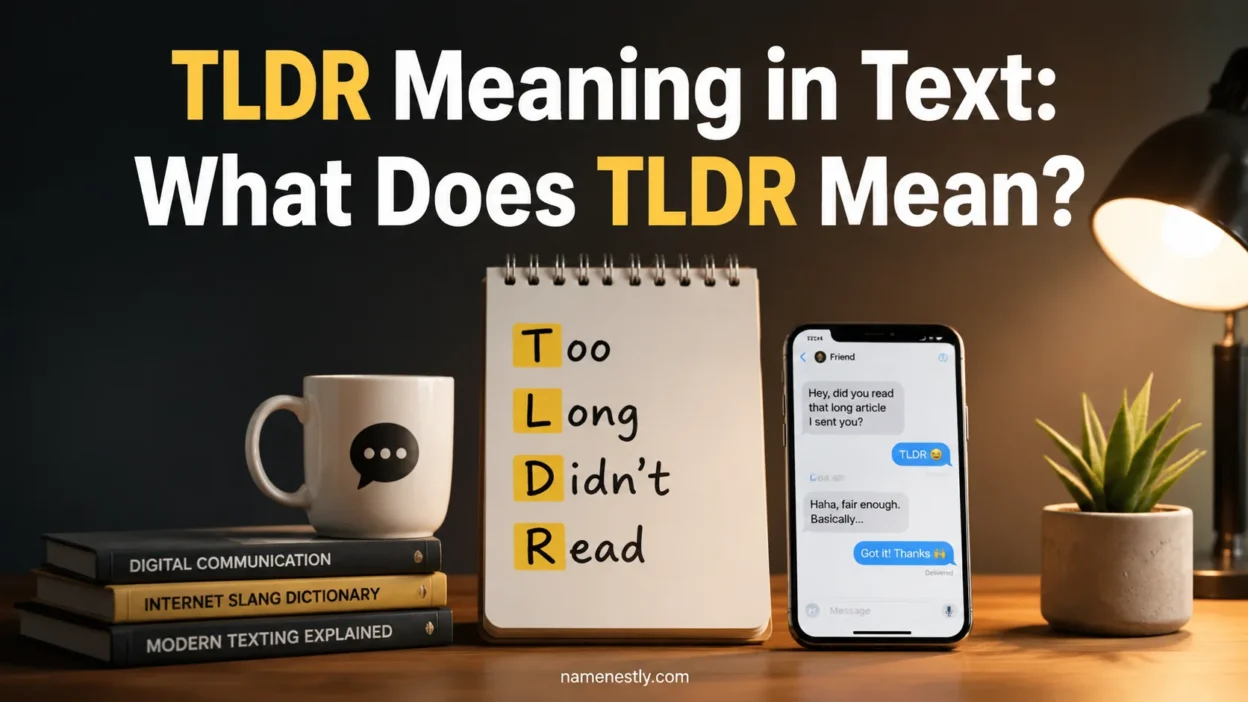
Have you ever received a long text message and wished someone would explain everything in just a few sentences? Maybe a friend sent you a lengthy story, or you opened a social media post filled with paragraphs. Instead of reading every word, you wanted the main point immediately. That’s where TLDR comes in.
TLDR is a popular internet abbreviation that stands for “Too Long; Didn’t Read.” People use it when discussing lengthy messages, articles, posts, and online conversations. However, the expression has another important use. It can introduce a short summary that explains the main idea without requiring readers to go through every detail.
You’ll commonly see TLDR on Reddit, Facebook, X, TikTok, discussion forums, and even professional emails. Its meaning can change slightly depending on the conversation. Understanding the context helps you use it naturally without sounding dismissive.
Quick Answer
TLDR means “Too Long; Didn’t Read.” It’s an internet abbreviation people use to describe lengthy content or introduce a short summary of something longer.
For example:
- Friend: I spent three hours explaining everything that happened during my vacation…
- You: TLDR?
- Friend: The flight was delayed, the hotel lost my reservation, but the trip was still amazing!
In this conversation, TLDR asks someone to share the main point without explaining every detail.
Comparison Overview
TLDR has two closely related meanings. It can express that something is too long to read, or it can introduce a shortened version of lengthy information.
| Term | Full Meaning | Main Purpose | Common Context |
| TLDR | Too Long; Didn’t Read | Introduces a short summary or comments on lengthy content | Texting and social media |
| TL;DR | Too Long; Didn’t Read | Same meaning as TLDR | Reddit and online discussions |
| Summary | Shortened version of longer content | Explains the main points | Articles and reports |
| Brief | Short and concise | Communicates information quickly | Everyday and professional writing |
| Overview | General explanation | Provides a broad understanding | Presentations and documents |
The biggest difference is tone. TLDR sounds casual and internet-friendly, while words like summary and overview work in more formal situations.
Main Differences Between TLDR
Although people often use TLDR as a simple abbreviation, its meaning depends on how someone places it in a conversation.
Here are the main differences worth understanding:
| Usage | Meaning | Example |
| TLDR as a reaction | Something is too lengthy to read | “TLDR, that’s a lot of information!” |
| TLDR as a request | Asking for a shorter explanation | “Can you give me the TLDR?” |
| TLDR as a summary | Introducing the main point | “TLDR: The project starts next Monday.” |
| TLDR as a comment | Responding to lengthy content | “TLDR: Great article with useful advice.” |
For example, someone might write, “TLDR: We canceled the event because of bad weather.” Here, the abbreviation introduces the most important information.
However, if someone comments, “I didn’t read that whole thing. TLDR!” they’re using it more literally.
What Does TLDR Stand For?
TLDR stands for Too Long; Didn’t Read. Each letter represents one word in the original expression.
Here’s the breakdown:
- T – Too: Indicates something exceeds a comfortable or expected length.
- L – Long: Describes lengthy content, such as a message, article, or explanation.
- D – Didn’t: Expresses that someone chose not to read the content.
- R – Read: Refers to going through written information.
When combined, these four letters create an abbreviation that internet users recognize across different platforms.
The original expression describes someone who skipped lengthy content because it required too much time or attention. Over time, people started using TLDR differently.
Today, writers frequently place it before a short explanation of a longer message. This allows readers to understand the main idea quickly.
Why Does TLDR Sometimes Appear as TL;DR?
You might notice two different spellings: TLDR and TL;DR.
Both communicate exactly the same meaning. The semicolon simply separates the two parts of the original expression.
- TLDR
- TL;DR
- tldr
- TLDR:
All these variations are commonly understood online. However, TL;DR is a recognizable traditional formatting style, especially in online discussions.
The punctuation doesn’t change the abbreviation’s meaning.
What Does TLDR Mean in Text Messages?
In texting, TLDR usually means someone wants a shorter explanation or wants to summarize a lengthy conversation.
People use it because messaging apps make it easy to send long paragraphs. However, not everyone has the time or interest to read every detail.
Imagine your friend sends you 15 messages explaining a disagreement with someone. You might respond, “TLDR?” This means you want the main point rather than the complete story.
Here are several common texting situations.
Asking Someone for a Short Explanation
You can use TLDR when someone sends you a lengthy message.
Example:
- Person A: I’ve been trying to explain why I changed my college schedule. There were several problems with my previous classes…
- Person B: TLDR?
- Person A: I changed my schedule because two classes overlapped.
In this situation, TLDR works as a request for a shorter explanation.
Summarizing a Long Conversation
You can also use TLDR to explain something quickly.
Example:
- Friend: What happened at the meeting?
- You: TLDR: The manager approved the new schedule.
Instead of describing the entire meeting, you provide its most important result.
Reacting to a Lengthy Message
Sometimes people use TLDR humorously when a message contains too much information.
Example:
- Friend: Here’s my complete explanation of why I stopped watching that series…
- You: TLDR, please! 😂
The laughing emoji makes the response feel playful. However, without friendly context, the same message might sound dismissive.
Sharing Important Information Quickly
TLDR can also help when you want someone to understand an important update.
Example:
– You: TLDR: The party has moved from Saturday to Sunday because the venue isn’t available.
This format highlights the important information immediately.
How Is TLDR Used in Different Contexts?
TLDR isn’t limited to private messages. Internet users apply it across social platforms, discussion communities, websites, and workplaces.
The basic meaning stays the same, but its purpose can change depending on the platform.
TLDR Meaning on Social Media
On social media, TLDR helps people communicate the main point without writing another lengthy explanation.
Platforms such as Facebook, Instagram, TikTok, and X encourage quick interactions. However, users still publish detailed captions, personal stories, and discussions.
That’s why TLDR can be useful.
For example:
Instagram Caption:
“I’ve been working on my small business for almost two years. There were many challenges, but I finally opened my first physical store.
TLDR: My first store is officially open!”
The final sentence gives followers the most important update.
People also use TLDR in comments when they want creators to provide shorter explanations.
Common social media uses include:
- Summarizing long captions.
- Explaining complicated stories.
- Highlighting important announcements.
- Making lengthy discussions easier to understand.
- Sharing the main point of personal experiences.
TLDR Meaning on Reddit
Reddit is one of the most recognizable places where you’ll encounter TLDR.
Users frequently publish detailed posts about personal experiences, advice, questions, and discussions. Some posts contain thousands of words.
To help readers, authors often add a TLDR section at the beginning or end.
Example:
A Reddit user writes a long post explaining how they prepared for a job interview. They discuss their research, practice sessions, mistakes, and final experience.
At the bottom, they add:
TLDR: I prepared for the interview by researching the company, practicing common questions, and reviewing my experience. Preparation helped me feel more confident.
This short explanation gives readers the central message without requiring them to read the entire post.
Reddit users also place TLDR at the beginning when they want to provide an immediate takeaway.
TLDR Meaning in Emails
TLDR sometimes appears in professional emails, particularly when someone wants to highlight the most important information.
However, its casual tone doesn’t suit every workplace.
For example:
Subject: Project Schedule Update
“Hi Team,
We’ve reviewed the project timeline and adjusted several deadlines. The design team needs two additional days to finish the updated layouts. Development will begin immediately afterward.
TLDR: The project deadline has moved from June 10 to June 12.
Best regards.”
This format helps busy readers understand the main update quickly.
However, consider your audience before using internet slang in professional communication. If you’re emailing clients, executives, or unfamiliar colleagues, Executive Summary, Key Takeaway, or Summary may sound more appropriate.
TLDR Meaning in Online Articles and Discussions
Bloggers and website owners use TLDR to make lengthy articles easier to navigate.
For example, a detailed article about choosing a laptop might cover processors, memory, storage, display quality, and battery life.
A TLDR section could say:
TLDR: Choose a laptop with at least 16GB of RAM for demanding multitasking. Prioritize battery life and display quality based on your daily needs.
This approach gives readers a quick understanding before they explore the full article.
It’s particularly useful when content contains:
- Technical explanations.
- Detailed product comparisons.
- Long tutorials.
- Research findings.
- Complicated discussions.
A good TLDR doesn’t replace the complete article. It gives readers a quick starting point.
Read More: DEI Meaning: What Does DEI Stand For and Why Does It Matter?
TLDR Examples in Real Conversations
The easiest way to understand TLDR is to see how people use it in everyday situations.
Here are 15 realistic examples with explanations.
Casual Texting Examples
Example 1
- Friend: I went shopping, visited three stores, and couldn’t find the shoes I wanted.
- You: TLDR: No shoes today?
Meaning: You’re asking for the main result of the story.
Example 2
- Friend: I’ve been thinking about changing my phone because the battery keeps dying…
- You: TLDR?
- Friend: I need a new phone.
Meaning: You want a shorter explanation.
Example 3
- Friend: Yesterday was probably the busiest day I’ve had this month.
- You: TLDR: You’re exhausted! 😂
Meaning: You’re summarizing your friend’s experience humorously.
Group Chat Examples
Example 4
“TLDR: We’re meeting at 7 PM instead of 6 PM.”
Meaning: You’re sharing the important schedule change.
Example 5
“Guys, here’s the TLDR: Everyone needs to bring their own food.”
Meaning: You’re highlighting the main instruction.
Example 6
“TLDR: The match is postponed because of rain.”
Meaning: You’re sharing the main announcement without unnecessary details.
Social Media Examples
Example 7
“TLDR: After months of practice, I finally passed my driving test!”
Meaning: You’re summarizing a longer personal achievement story.
Example 8
“TLDR: This movie has great visuals but a disappointing ending.”
Meaning: You’re giving readers your overall opinion.
Example 9
“TLDR: Save your money and avoid buying things you don’t need.”
Meaning: You’re presenting the central message of a longer discussion.
Reddit Discussion Examples
Example 10
“TLDR: My neighbor returned my lost wallet after finding it outside.”
Meaning: You’re summarizing a personal experience.
Example 11
“TLDR: You should compare interest rates before choosing a loan.”
Meaning: You’re sharing the main takeaway from a detailed explanation.
Example 12
“TLDR: The update fixed the performance issue but introduced a minor bug.”
Meaning: You’re explaining the main result of a technical discussion.
Workplace Examples
Example 13
“TLDR: The client approved the proposal, but requested two small changes.”
Meaning: You’re communicating the outcome of a business discussion.
Example 14
“TLDR: We need to finish the presentation before Friday.”
Meaning: You’re highlighting the most important deadline.
Example 15
“TLDR: The campaign generated more leads after we updated the landing page.”
Meaning: You’re summarizing a marketing result.
These examples show that TLDR works in different situations. The important thing is to keep the summary relevant and easy to understand.
Is TLDR Rude or Disrespectful?
TLDR isn’t automatically rude. However, the way you use it can make a big difference.
In friendly conversations, people often use it casually. Among close friends, asking “TLDR?” might simply mean you want the short version.
However, using it to dismiss someone’s effort can sound disrespectful.
When TLDR Sounds Rude
Consider these situations:
- Someone shares a personal problem and you respond, “TLDR, nobody has time for that.”
- A colleague sends an important explanation and you reply, “Too long. TLDR.”
- Someone shares exciting news and you dismiss their story without showing interest.
These responses can make the other person feel ignored.
When TLDR Sounds Friendly
The abbreviation feels more helpful when you use it to introduce a useful summary.
For example:
- “TLDR: Everything worked out in the end!”
- “Here’s the TLDR so you don’t have to read the entire report.”
- “TLDR: We should leave earlier to avoid traffic.”
The difference comes down to intention and tone.
How to Ask for a TLDR Politely
If someone sends you a long explanation, try these alternatives:
- “Could you give me the short version?”
- “What’s the main takeaway?”
- “Can you summarize the important points?”
- “What’s the bottom line?”
- “Could you explain the key details briefly?”
These expressions sound considerate and work in more situations.
What Is the Difference Between TLDR and Summary?
TLDR and summary are closely related, but they aren’t interchangeable in every situation.
A summary is a shortened version of longer information. TLDR is an informal internet abbreviation that can introduce such a summary or describe content someone didn’t read.
Here’s a closer comparison.
| Feature | TLDR | Summary |
| Full meaning | Too Long; Didn’t Read | A shortened explanation |
| Tone | Casual and informal | Neutral or professional |
| Purpose | Introduces a quick takeaway or comments on lengthy content | Condenses longer information |
| Common platforms | Reddit, texting, social media | Articles, reports, emails |
| Professional use | Depends on workplace culture | Widely accepted |
| Audience | Usually familiar with internet slang | General audience |
Frequently Asked Questions
What Does TLDR Mean in Texting?
TLDR means “Too Long; Didn’t Read.” In texting, people use it to request a shorter explanation or introduce a summary of a lengthy message. It helps communicate the main point without sharing every detail.
What Does TLDR Stand For?
TLDR stands for Too Long; Didn’t Read. The abbreviation comes from the first letters of its four words. It’s widely recognized in internet conversations, social media posts, and online communities.
Is TLDR Positive or Negative?
TLDR can sound positive, neutral, or negative depending on context. When someone introduces a helpful summary, it’s generally neutral and practical. However, using it to dismiss another person’s lengthy message can sound rude.
Is TLDR the Same as a Summary?
Not exactly. TLDR is an informal abbreviation that often introduces a short summary. A summary is a shortened explanation of longer content. Both help readers understand important information quickly.
Should TLDR Go at the Beginning or End of a Post?
You can place TLDR at either location. Putting it at the beginning gives readers an immediate overview. Placing it at the end lets readers review the complete explanation before seeing its main takeaway.
Conclusion:
Understanding TLDR meaning in text makes online conversations easier to follow. The abbreviation stands for “Too Long; Didn’t Read” and serves two main purposes: describing lengthy content and introducing a shorter explanation. You’ll commonly encounter TLDR on Reddit, social media, messaging apps, and online discussions. People also use it in workplace communication when a quick summary helps readers understand important information.