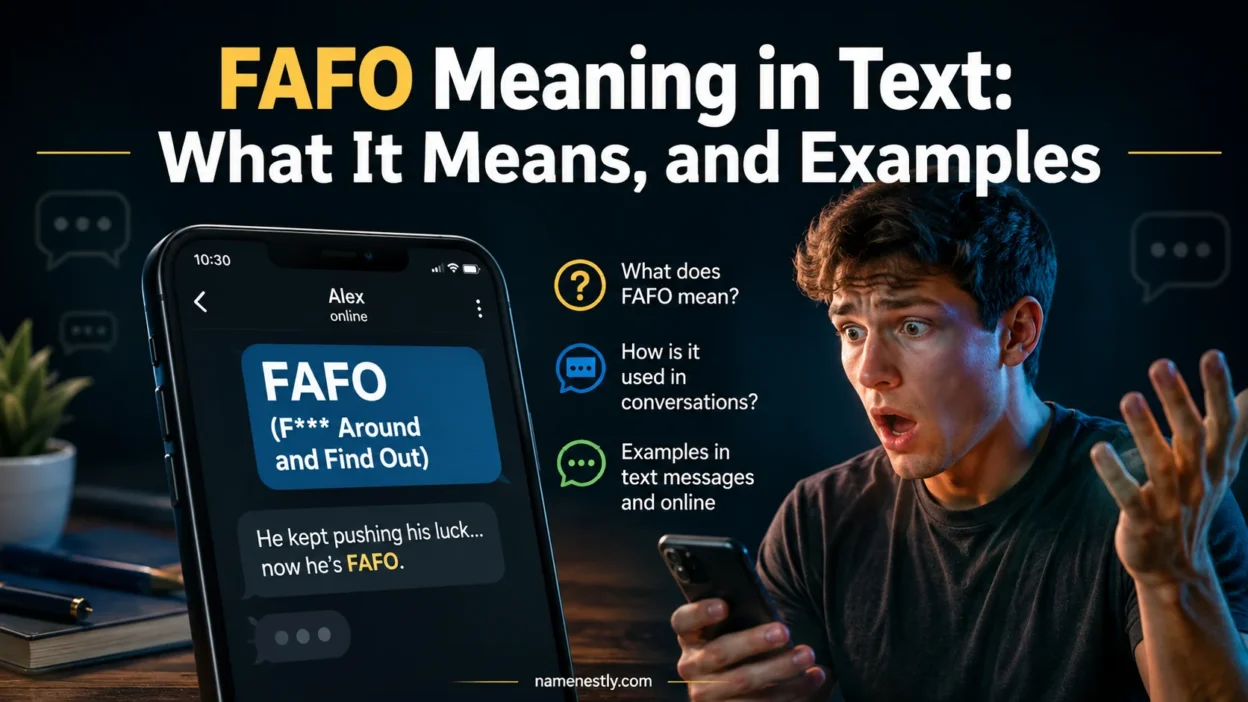
Have you ever seen someone write “FAFO” in a text message, TikTok comment, or Instagram caption and wondered what they meant? This popular internet slang often appears when someone makes a risky choice, ignores a warning, or faces the consequences of their actions.
FAFO stands for “Fuck Around and Find Out.” It’s a blunt expression that warns people they may discover what happens when they push boundaries, take unnecessary risks, or provoke someone. Depending on the situation, it can sound funny, sarcastic, confident, or aggressive.
People use FAFO in memes, everyday conversations, online arguments, and discussions about accountability. However, its meaning isn’t always serious. Friends might use it to joke about a harmless mistake, while someone in a heated argument might use it as a warning.
Understanding the context helps you figure out what the sender really means.
Quick Answer
FAFO means “Fuck Around and Find Out.” It’s an informal slang expression that suggests people will face the consequences of their actions. People commonly use it in text messages, social media comments, memes, and arguments. It can be humorous or confrontational, depending on the situation. Because the full phrase contains profanity, it isn’t suitable for every audience or professional setting.
Comparison Overview
| Feature | Details |
| Full form | Fuck Around and Find Out |
| Main meaning | Discover the consequences of your actions |
| Type | Internet slang and informal expression |
| Common platforms | TikTok, Snapchat, Instagram, Facebook, and X |
| Typical tone | Funny, sarcastic, defiant, or confrontational |
| Common use | Warning someone, reacting to a bad decision, or expressing accountability |
| Suitable for work? | Usually not in formal communication |
| Is it profanity? | Yes, the original phrase contains an explicit swear word |
| Similar expression | “Actions have consequences” |
What Does FAFO Mean in Text?
FAFO means “Fuck Around and Find Out” in text messages. People use it when they believe someone’s actions will lead to an unpleasant, surprising, or predictable result.
The phrase combines two ideas. The first suggests behaving recklessly, provoking someone, or deliberately testing limits. The second means discovering the outcome firsthand.
For example, imagine your friend keeps teasing their older brother after being warned to stop. You might text:
- “You kept annoying him. FAFO 😂”
- “I told you not to touch that pan. FAFO!”
- “He ignored every warning and got caught. That’s FAFO.”
In each example, the sender connects a person’s behavior with its consequences.
However, FAFO doesn’t always describe punishment. Someone might use it after trying a difficult challenge, taking a gamble, or making a bold decision that backfires.
The key idea stays the same: you take an action, and then you discover what happens because of it.
What Does FAFO Stand For?
The acronym represents the first letters of the words in “Fuck Around and Find Out.”
- F — Fuck: An explicit swear word that adds emphasis.
- A — Around: Part of the informal phrase “mess around,” suggesting reckless behavior or boundary-testing.
- F — Find: To discover something through experience.
- O — Out: Completes the expression “find out.”
People often write FAFO instead of spelling out the complete phrase because abbreviations are quick and recognizable in online conversations.
Although the acronym makes the expression shorter, it doesn’t remove the profanity from its underlying meaning. Some readers may find it offensive, especially in formal or family-friendly settings.
What Is the Simple Meaning of FAFO?
In simple English, FAFO means “If you do something reckless or provoke trouble, you’ll discover the consequences.”
Here are a few everyday translations:
- “You were warned, so don’t complain about the result.”
- “You might regret testing those limits.”
- “Your choices have consequences.”
- “You wanted to take that risk, so now deal with the outcome.”
The phrase can communicate a warning before something happens or a reaction afterward.
For example, someone might tell a friend, “Keep playing with that dog, and you’ll FAFO.” In this case, the speaker predicts a consequence. After the dog knocks the friend over, another person might say, “Well, FAFO.”
The timing changes, but the central message remains consistent.
Main Differences Between FAFO Meaning and Similar Slang
FAFO shares its message with several popular expressions, but each phrase carries a slightly different tone. Some focus on consequences, while others encourage risk-taking or warn someone to be careful.
| Expression | Meaning | How it differs from FAFO |
| FAFO | Fuck Around and Find Out | Warns that actions can lead to consequences |
| YOLO | You Only Live Once | Encourages people to embrace life’s opportunities and risks |
| Play stupid games, win stupid prizes | Reckless choices can produce unpleasant results | Often mocks someone’s poor decision |
| Actions have consequences | Choices lead to results | Sounds more neutral and appropriate in formal settings |
| Don’t test me | Don’t challenge or provoke me | Focuses on a person’s limits rather than consequences in general |
| You reap what you sow | Your actions eventually affect you | Emphasizes the long-term results of behavior |
| Karma | The idea that actions can bring corresponding consequences | Often suggests that people eventually receive what they deserve |
The biggest difference is tone. FAFO sounds blunt and sometimes aggressive because of its profanity. By contrast, “actions have consequences” communicates a similar idea without the same confrontational edge.
For example, a teacher might tell a student that actions have consequences. A friend watching someone ignore an obvious warning might simply reply, “FAFO.”
Both expressions communicate accountability, but they suit different audiences.
FAFO Meaning on Social Media
FAFO has become a recognizable expression in online conversations because it communicates a reaction quickly. Instead of explaining an entire situation, someone can use four letters to suggest that a person brought the outcome upon themselves.
Its meaning remains broadly consistent across platforms. However, the content surrounding the acronym often reveals whether the sender intends humor, criticism, or a serious warning.
FAFO Meaning on TikTok
On TikTok, FAFO commonly appears in captions, comments, reaction videos, and discussions about unexpected consequences.
A creator might use it when showing someone attempting a risky stunt, ignoring advice, or making a decision that immediately backfires. Viewers may respond with FAFO when the outcome seems predictable.
Examples include:
- “He ignored the warning signs. FAFO.”
- “She thought the challenge would be easy. FAFO 😂”
- “When you keep arguing with someone who warned you twice. FAFO.”
The phrase can also appear in videos about personal boundaries, accountability, and standing up to disrespectful behavior.
However, don’t assume every TikTok use is a threat. A funny video about a harmless mistake and a heated confrontation require very different interpretations.
Read More: 201+ Japanese Last Names With Meanings
FAFO Meaning on Snapchat
On Snapchat, FAFO usually appears in direct messages, group chats, snaps, and captions shared among friends.
Because Snapchat conversations often rely on shared experiences and inside jokes, the sender’s relationship with the recipient matters.
Consider this conversation:
Alex: “I told you not to eat the extra-hot wings.”
Jordan: “My mouth is on fire 😭”
Alex: “Bro, FAFO 😂”
Here, FAFO is a playful reaction rather than a serious warning. Alex is joking because Jordan ignored the advice and experienced the expected result.
In another conversation, someone might use FAFO after a friend repeatedly crosses personal boundaries. That use can sound much more serious.
FAFO Meaning on Instagram
On Instagram, people use FAFO in Reels comments, captions, Stories, and discussions about everyday behavior.
Common situations include:
- Reacting to someone who ignores an obvious warning.
- Commenting on a prank that backfires.
- Discussing personal boundaries and self-respect.
- Responding to a public argument or controversial decision.
- Sharing memes about accountability.
For example, someone might comment “FAFO” under a video showing a person repeatedly teasing a cat before getting scratched.
The commenter suggests that the person brought the outcome upon themselves.
However, the phrase can carry a more confrontational tone when people use it during disputes. Always consider the surrounding conversation instead of interpreting the acronym in isolation.
FAFO Meaning on Facebook and X
On Facebook and X, FAFO can appear in public posts, replies, political discussions, memes, and arguments about responsibility.
Someone might use it to express frustration with a person who repeatedly ignores warnings. Others may use it sarcastically to criticize a public figure’s decision or highlight an unexpected outcome.
For example:
“He ignored every warning from his team. Now he’s dealing with the consequences. FAFO.”
This example uses the acronym to criticize a decision rather than explain its literal wording.
On public platforms, the phrase can also intensify disagreements. If someone directs FAFO at another person during an argument, the recipient may interpret it as a challenge or warning.
The platform alone doesn’t determine the meaning. The surrounding words, relationship, and situation matter more than where the acronym appears.
FAFO Examples in Text Messages
Realistic examples make FAFO easier to understand because the same acronym can communicate different emotions.
The following examples show how people might use it in everyday conversations. Each example includes the context that helps explain its meaning.
Funny FAFO Examples
Funny uses usually involve harmless mistakes, playful risks, or predictable results. Friends often use laughing emojis to make the tone clear.
Example: Touching something hot
- Friend: “I touched the pan even though you said it was hot.”
- You: “FAFO 😂”
Meaning: Your friend ignored a warning and learned the lesson firsthand.
Example: Trying a difficult challenge
- Friend: “I tried doing ten pushups after months without exercising.”
- You: “And now you can’t move? FAFO 😭”
Meaning: Your friend underestimated the challenge and experienced the result.
Example: Annoying a pet
- Friend: “The cat scratched me after I kept bothering it.”
- You: “FAFO, buddy.”
Meaning: Your friend provoked the cat and got a predictable response.
These examples show that FAFO doesn’t always involve serious danger or conflict. It can simply describe a funny moment when someone’s choices lead to an expected outcome.
Serious FAFO Examples
Serious uses often involve repeated behavior, ignored warnings, or situations where someone must accept responsibility.
Example: Ignoring boundaries
- Person A: “He kept reading my private messages after I told him to stop.”
- Person B: “He shouldn’t be surprised that you ended the friendship. FAFO.”
Meaning: The response connects repeated boundary violations with their consequences.
Example: Ignoring a warning
- Person A: “She ignored the safety instructions and damaged the equipment.”
- Person B: “That’s a classic FAFO situation.”
Meaning: Someone disregarded instructions and experienced the result.
Example: Provoking an argument
- Person A: “He kept insulting everyone, then got called out.”
- Person B: “He started the drama. FAFO.”
Meaning: The speaker believes the person helped create the situation they now face.
Although these examples can express accountability, FAFO isn’t proof that the outcome was fair. People can face consequences that are excessive or undeserved. The speaker’s opinion and the actual facts aren’t necessarily the same.
Sarcastic FAFO Examples
Sarcasm adds an ironic edge to FAFO. The speaker may highlight how someone created a problem they could easily have avoided.
| Situation | Example message | Intended meaning |
| Ignoring advice | “You did the exact opposite of what I said. FAFO.” | You ignored advice and got the expected result |
| Taking an unnecessary risk | “That seemed like a brilliant idea. FAFO.” | The decision wasn’t as clever as you thought |
| Starting an argument | “You picked a fight and lost. FAFO.” | Your actions helped cause the outcome |
| Making a careless choice | “You had one job. FAFO.” | Your mistake produced an avoidable problem |
Sarcasm can make the phrase funny among friends, but it can also make someone feel mocked. If the person is already embarrassed or upset, a softer response may be more considerate.
How to Use FAFO in a Sentence
Using FAFO correctly starts with understanding what you want to communicate. The acronym works best when a situation involves a risk, a warning, a challenge, or an outcome connected to someone’s behavior.
You can use it in a few common ways.
Use FAFO as a Reaction
This is one of the simplest ways to use the acronym. Someone describes a mistake or consequence, and you respond with FAFO.
Examples:
- “You ignored the instructions and broke it? FAFO.”
- “He kept teasing his brother and got roasted. FAFO.”
- “She took the risk and lost the bet. FAFO.”
In these examples, the acronym sums up the situation without requiring a long explanation.
Use FAFO as a Warning
You can also use FAFO before a consequence occurs. In this context, the phrase suggests that someone should stop pushing limits.
Examples:
- “Keep ignoring the rules, and you’ll FAFO.”
- “Don’t keep provoking people just to get a reaction. FAFO.”
- “You’re taking a bigger risk than you realize. Don’t FAFO.”
The last example uses the acronym less naturally than the others. In ordinary conversation, people more often say “You’re going to FAFO” or use the complete expression. This distinction matters because internet slang doesn’t always follow the same patterns as formal grammar.
Use FAFO in a Caption or Comment
Short social media captions often benefit from the acronym’s blunt tone.
Examples include:
- “Consequences came knocking. FAFO.”
- “Warnings were given. FAFO.”
- “He learned the hard way. FAFO.”
- “Sometimes, you have to let people FAFO.”
The final example uses FAFO as a verb in informal online language. It means letting someone experience the consequences of their own choices.
Although this construction appears in slang, it remains informal. For a formal article or workplace report, “experience the consequences” is clearer.
Understand the Role of Punctuation and Emojis
Small changes can affect how a message sounds.
- “FAFO 😂” often suggests humor or playful teasing.
- “FAFO.” can sound blunt, dismissive, or matter-of-fact.
- “FAFO!” adds emphasis and may sound excited or confrontational.
- “You’re about to FAFO.” can sound like a warning.
- “FAFO, I guess.” may express resignation or sarcasm.
These interpretations aren’t universal rules. A laughing emoji doesn’t automatically make a hostile message harmless, and a period doesn’t always signal anger.
Consider the entire conversation before deciding how the sender intended the message.
FAQs:
What Does FAFO Mean in Texting?
FAFO stands for “Fuck Around and Find Out.” In texting, it means that someone may experience the consequences of their choices, especially after ignoring warnings, taking risks, or provoking trouble. Friends may use it jokingly, while others use it as a serious warning.
What Does FAFO Mean on TikTok?
On TikTok, FAFO commonly appears in comments, captions, memes, and reaction videos. People use it when someone ignores advice, takes a risky action, or faces an expected result. The tone can range from humorous to confrontational depending on the video and discussion.
Is FAFO a Bad Word?
Yes, the original expression contains the F-word, which many people consider vulgar or offensive. The acronym hides the explicit word but still represents the same phrase. It’s generally best to avoid FAFO in formal communication or when speaking with people who may find profanity inappropriate.
Does FAFO Mean Someone Is Threatening You?
Not necessarily. FAFO can be a joke, a sarcastic reaction, or a warning about consequences. However, if someone uses it alongside aggressive language, specific threats, or intimidating behavior, the message may be threatening. Consider the full context before deciding what the sender intends.
Can You Use FAFO in a Professional Message?
You can, but it’s usually better not to. FAFO contains profanity and can sound confrontational, especially in emails, client discussions, or formal reports. Expressions such as “actions have consequences” or “we need to address the results of this decision” communicate the idea more professionally.
Conclusion:
FAFO means “Fuck Around and Find Out.” It’s a popular slang expression used in text messages, TikTok comments, Instagram captions, memes, and everyday conversations to describe the consequences of someone’s actions. People use it when someone ignores advice, pushes boundaries, takes a risk, or creates a problem through their own behavior. Depending on the situation, FAFO can sound funny, sarcastic, defiant, or threatening.