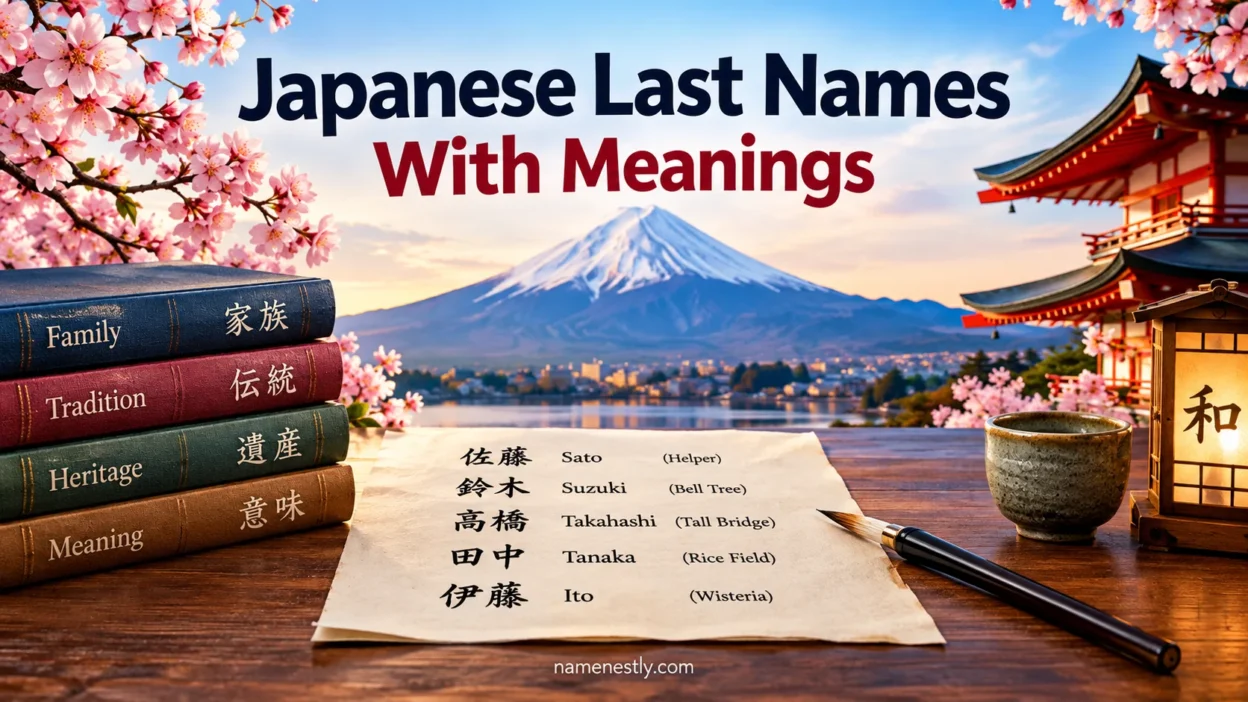
Japanese last names offer a fascinating mix of nature, geography, history, and family heritage. Many traditional surnames contain kanji characters associated with mountains, rivers, forests, rice fields, and villages. Their sounds can feel elegant, powerful, mysterious, or wonderfully simple.
Whether you’re naming a fictional character, building a Japanese-inspired story, researching family names, or choosing a surname for a game, the right choice can make your character feel more distinctive. This guide explores popular Japanese surnames, rare family names, beautiful meanings, traditional options, and anime-inspired choices, with notes to help you select a name that fits your purpose.
🐾 DID YOU KNOW About Japanese Last Names
- Satō (佐藤) and Suzuki (鈴木) are among Japan’s most common surnames. Their popularity makes them recognizable choices for realistic Japanese characters.
- Many Japanese surnames use kanji connected to natural features or landscapes. For example, Yamada (山田) combines characters associated with a mountain and a rice field.
One important detail: a surname’s meaning depends on the kanji used to write it. Similar-sounding surnames can have different written forms and interpretations, so a simple English translation doesn’t always tell the full story.
🧭 How to Choose the Perfect Japanese Last Name
A good Japanese surname should fit the character, setting, and purpose behind your choice. Consider these factors before settling on one.
- Personality: A traditional surname can suit a grounded, realistic character, while a less common one may give a fictional character a distinctive feel.
- Meaning: Look for kanji connected to nature, family heritage, geography, or themes that matter to your story.
- Pronunciation: Names such as Mori, Sato, and Hara are relatively easy for English speakers to pronounce. Longer surnames may offer a more distinctive rhythm.
- Realism: If you’re writing a contemporary Japanese character, a genuine surname is usually more convincing than a made-up combination of Japanese-sounding syllables.
- Cultural context: Japanese surnames are generally written before given names in Japanese contexts. In English-language settings, the order may be reversed.
- Kanji accuracy: Check the exact written form and reading before assigning a specific meaning to a surname.
For fictional characters, it’s also worth considering the time period, region, and family background. A surname should feel like part of the character’s identity rather than just a decorative label.
🌸 1. Popular Japanese Last Names
Popular Japanese surnames are excellent choices when you want a character to feel like an ordinary person living in Japan. They’re especially useful for contemporary fiction, school stories, role-playing games, and realistic character profiles. Many have familiar pronunciations and established use as family names. The list below includes widely recognized surnames alongside other established Japanese family names.
| Japanese last name | Common romanization |
| Satō | Sato |
| Suzuki | Suzuki |
| Takahashi | Takahashi |
| Tanaka | Tanaka |
| Watanabe | Watanabe |
| Itō | Ito |
| Yamamoto | Yamamoto |
| Nakamura | Nakamura |
| Kobayashi | Kobayashi |
| Katō | Kato |
| Yoshida | Yoshida |
| Yamada | Yamada |
| Sasaki | Sasaki |
| Yamaguchi | Yamaguchi |
| Matsumoto | Matsumoto |
| Inoue | Inoue |
| Kimura | Kimura |
| Hayashi | Hayashi |
| Shimizu | Shimizu |
| Yamazaki | Yamazaki |
| Mori | Mori |
| Abe | Abe |
| Ikeda | Ikeda |
| Hashimoto | Hashimoto |
| Ishikawa | Ishikawa |
Naming tip: Sato, Tanaka, and Suzuki are sensible starting points for everyday characters. If several characters appear in the same story, choose surnames with distinct sounds to help readers tell them apart.
🏔️ 2. Japanese Last Names Inspired by Mountains and Landscapes
Japan’s landscape includes mountains, valleys, forests, and coastal plains, and many surnames use kanji associated with these features. Such names can create a subtle connection to nature without sounding like fantasy inventions. They work well for characters with rural backgrounds, outdoor interests, or family histories connected to particular places.
| Japanese last name | Common kanji-based association |
| Yamaguchi | Mountain and entrance |
| Yamashita | Below the mountain |
| Ueyama | Upper or above the mountain |
| Nakayama | Middle mountain |
| Okuyama | Inner or distant mountain |
| Kitayama | Northern mountain |
| Minamiyama | Southern mountain |
| Nishiyama | Western mountain |
| Higashiyama | Eastern mountain |
| Ōyama | Great or large mountain |
| Komiyama | A surname with mountain-related kanji |
| Akiyama | Often written with characters for autumn and mountain |
| Koyama | Small mountain |
| Tokuyama | A surname with mountain-related kanji |
| Sakiyama | A surname commonly written with mountain-related kanji |
| Takayama | High mountain |
| Iwasaki | Rocky promontory or cape, depending on kanji |
| Iwata | Rock and rice field in a common spelling |
| Ishiyama | Stone mountain |
| Ishida | Stone and rice field |
| Kawaguchi | River and entrance |
| Kawamura | River and village |
| Okada | Open field and rice field in a common spelling |
| Hara | Field or plain in common spellings |
| Nozawa | Field and marsh or swamp in a common spelling |
Meaning note: These are associations suggested by common kanji spellings, not guaranteed explanations of every family’s surname. Individual families may use different characters.
🌊 3. Japanese Last Names Connected to Rivers, Water, and the Sea
Water-inspired surnames can suggest movement, calmness, coastal life, or a strong connection to the natural world. They’re useful for novels set near fishing villages, stories about travelers, and characters whose personalities feel reflective or adventurous. Some names have straightforward water-related kanji, while others can be interpreted differently depending on their written form.
| Japanese last name | Common kanji-based association |
| Mizuno | Water and field |
| Mizutani | Water and valley |
| Mizushima | Water and island |
| Kawashima | River and island |
| Kawabata | River and edge |
| Kawai | River and well in a common spelling |
| Kawano | River and field |
| Nagai | A common surname with several possible kanji spellings |
| Umino | Sea and field in a common spelling |
| Umemura | Plum and village in a common spelling |
| Hamada | Beach and rice field in a common spelling |
| Hama | Beach or shore in common spellings |
| Nagasawa | Long and marsh in a common spelling |
| Sawada | Marsh and rice field |
| Ogawa | Small river |
| Furukawa | Old river |
| Shinkawa | New river in a common spelling |
| Asakawa | A surname often written with river-related kanji |
| Kitagawa | Northern river |
| Minagawa | A surname often written with river-related kanji |
| Sekiguchi | Barrier or checkpoint and entrance in a common spelling |
| Yanagawa | Willow and river in a common spelling |
| Shiozaki | Tide or salt and cape in a common spelling |
| Matsunaga | Pine and long in a common spelling |
| Enomoto | A surname with several possible kanji spellings |
For a character who lives near the ocean, Umino, Hama, or Kawashima may fit the setting naturally. If the character’s connection to water is symbolic rather than literal, consider using the name’s sound and overall impression instead of treating its meaning as destiny.
🌿 4. Japanese Last Names Inspired by Trees, Plants, and Flowers
Plant-related surnames can feel gentle, traditional, or quietly distinctive. They suit characters associated with gardens, seasonal festivals, rural settings, or a love of nature. Some include kanji for familiar trees and flowers, though the exact interpretation depends on the spelling. These are real surname choices rather than a list of invented botanical names.
| Japanese last name | Common kanji-based association |
| Matsuda | Pine and rice field |
| Matsui | Pine and well |
| Matsumura | Pine and village |
| Matsushita | Below the pine tree |
| Matsubara | Pine grove or plain |
| Fujita | Wisteria and rice field |
| Fujiwara | Wisteria and plain in a common spelling |
| Fujimoto | Wisteria and origin or base |
| Fujii | Wisteria and well in a common spelling |
| Hanazawa | Flower and marsh in a common spelling |
| Hanamura | Flower and village in a common spelling |
| Sakurai | Cherry blossom and well in a common spelling |
| Sakura | Cherry blossom in a common spelling |
| Umehara | Plum and plain |
| Uematsu | Above or planted pine, depending on spelling |
| Takeuchi | Bamboo and inside |
| Takemura | Bamboo and village |
| Takeuchi | Bamboo and inside |
| Yanagi | Willow in a common spelling |
| Yanagisawa | Willow and marsh in a common spelling |
| Kikuuchi | Chrysanthemum and inside in a possible spelling |
| Sugimoto | Cedar or Japanese cedar and origin in a common spelling |
| Sugiyama | Cedar and mountain |
| Morita | Forest and rice field |
| Hayashida | Forest and rice field |
A small correction for accuracy: Takeuchi appears twice in the table above, so count it only once when building your final shortlist. If you want to avoid repeating it, consider Kinoshita (tree and below) as an alternative.
Read More: 201+ Beautiful Japanese Girl Names With Meanings
🏯 5. Traditional Japanese Last Names With Historical Character
Traditional surnames can give fictional families a grounded, established feel. They’re particularly useful for historical fiction, period dramas, family sagas, or stories involving samurai-era settings. However, a surname alone doesn’t prove that someone descends from a samurai family or a particular historical clan. Use historical background only when you can support it independently.
| Japanese last name | Naming impression |
| Tokugawa | Strong historical association with the Tokugawa shogunate |
| Minamoto | Historical clan name |
| Taira | Historical clan name |
| Fujiwara | Historical clan and established surname |
| Ashikaga | Historical association with the Ashikaga shogunate |
| Hojo | Historical clan name |
| Oda | Associated with the Oda clan |
| Takeda | Associated with the Takeda clan |
| Uesugi | Associated with the Uesugi clan |
| Sanada | Associated with the Sanada clan |
| Shimazu | Associated with the Shimazu clan |
| Mori | Established surname with important historical associations |
| Date | Associated with the Date clan |
| Akechi | Historical surname associated with Akechi Mitsuhide |
| Ii | Historical clan name |
| Honda | Established surname with historical associations |
| Hattori | Historical surname associated with ninja folklore and history |
| Saigō | Established surname associated with modern Japanese history |
| Sakamoto | Established surname associated with historical figures |
| Okubo | Established surname associated with Japanese history |
| Kuroda | Established surname with historical associations |
| Hosokawa | Established surname and historical clan name |
| Maeda | Established surname with historical associations |
| Kato | Established surname with historical associations |
| Sakai | Established surname with historical associations |
These surnames are especially useful when a character’s family background matters to the plot. For a historical novel, research the period carefully: a famous clan name should not be treated as proof of a character’s lineage without a story reason.
✨ 6. Beautiful and Elegant Japanese Last Names
Some surnames stand out because of their sound rather than a dramatic meaning. Names such as Shiraishi, Hoshino, and Ichikawa have a smooth rhythm that can suit thoughtful protagonists, artists, musicians, or characters in slice-of-life stories. This category focuses on names that feel graceful when spoken, while keeping the distinction between a name’s sound and its literal meaning clear.
| Japanese last name | Common kanji-based association or note |
| Shiraishi | White and stone in a common spelling |
| Hoshino | Star and field |
| Ichikawa | One and river in a common spelling |
| Arakawa | A surname often written with river-related kanji |
| Asano | A surname with several possible kanji spellings |
| Hoshikawa | Star and river in a common spelling |
| Shirakawa | White and river |
| Shiroyama | White and mountain in a common spelling |
| Akagi | Red and tree in a common spelling |
| Akasaka | Red and slope in a common spelling |
| Kaneko | A common surname often written with gold and child |
| Nishikawa | Western river |
| Sakakibara | A traditional surname with several possible kanji interpretations |
| Ichinose | One and rapids or shallows in a common spelling |
| Tachibana | An established surname also associated with a citrus plant and historical clan |
| Amamiya | Often written with characters for heaven and shrine |
| Tsukino | Moon and field in a common spelling |
| Shinohara | A surname with several possible kanji spellings |
| Kisaragi | A poetic-sounding name also used as a Japanese word for the traditional name of the second month |
| Hasegawa | A surname often written with river-related kanji |
| Kirishima | Mist and island in a common spelling |
| Kurosawa | Black and marsh in a common spelling |
| Takashima | High and island in a common spelling |
| Morikawa | Forest and river |
| Ayase | An established surname whose meaning depends on its kanji |
Best for: Characters whose names should sound refined without being overly elaborate. If you’re writing a realistic contemporary story, check the intended kanji and avoid assigning a poetic translation that the actual spelling doesn’t support.
⚔️ 7. Japanese Last Names for Strong, Mysterious, or Powerful Characters
For a detective, rival, warrior, or serious protagonist, a surname with a crisp sound can create the right first impression. You don’t need a surname that literally means “warrior” or “darkness.” Rhythm, cultural context, and the character’s actions can do much of the work. These established surnames offer a variety of sounds, from short and sharp to more formal.
| Japanese last name | Why it may suit a character |
| Kuroki | Compact sound; one common spelling uses black and tree |
| Kuroda | Strong, concise sound |
| Onishi | Distinctive rhythm and familiar surname structure |
| Ishida | Crisp sound with stone-related kanji in a common spelling |
| Kiryu | Short and memorable; kanji vary |
| Kanzaki | Formal, distinctive sound |
| Kamiyama | Mountain-related spelling in a common form |
| Kujo | Short and striking; written forms vary |
| Saeki | Compact and easy to remember |
| Sakuma | Balanced rhythm |
| Naruse | Smooth sound, suitable for contemporary fiction |
| Akizuki | Autumn and moon in a common spelling |
| Shiba | Short, sharp sound |
| Shibata | Familiar, firm rhythm |
| Goto | Brief and direct |
| Endo | Simple, recognizable sound |
| Kondo | Strong two-part rhythm |
| Kanda | Short, memorable surname |
| Tendo | Distinctive sound; kanji can vary |
| Arima | Elegant yet assertive |
| Kirishima | Atmospheric sound that can suit mystery fiction |
| Shishido | Bold, memorable rhythm |
| Saionji | Formal, aristocratic impression in fiction |
| Ryuuzaki | Dramatic sound; spelling and reading should be checked |
| Akabane | Distinctive sound that can suit a thriller character |
These are stylistic suggestions, not claims that the surnames have inherently powerful personalities. A gentle character can carry a sharp-sounding surname, and a villain doesn’t need a dark-sounding name to feel believable.
🌙 8. Less Common and Distinctive Japanese Last Names
If you want a character to stand out from a cast filled with Satos and Suzukis, a less familiar surname may help. “Less common” here means less immediately recognizable to many English-speaking readers; it doesn’t establish a statistical ranking of surname frequency in Japan. These names are useful for supporting characters, fantasy-inspired fiction grounded in Japanese naming, and memorable character profiles.
| Japanese last name | What makes it useful |
| Amakawa | Distinctive sound; kanji determine its meaning |
| Amami | Short, soft sound; written forms vary |
| Fuyutsuki | Seasonal, atmospheric sound |
| Hanabusa | Distinctive traditional surname |
| Himekawa | Memorable rhythm; kanji vary |
| Inukami | Strong fictional-name potential; verify the intended kanji |
| Kagami | Familiar word association with a mirror in one spelling |
| Kagaribi | Unusual sound; check whether the intended form is used as a surname |
| Kamishiro | Distinctive sound and multiple possible kanji |
| Kanzawa | Established surname with spelling variations |
| Kirihara | A surname with several possible kanji interpretations |
| Kisarazu | Distinctive name associated with a Japanese place |
| Koganei | Established surname and place name |
| Kogure | Established surname with varied kanji possibilities |
| Miyanaga | Smooth, traditional-sounding surname |
| Natsume | Established surname also associated with literary history |
| Otonashi | Distinctive sound; kanji matter |
| Saotome | Traditional surname and recognizable literary-style name |
| Shigemori | Established surname with varied kanji spellings |
| Shiranui | Distinctive name with historical and literary associations |
| Takatsuki | Established surname and place name |
| Tsukishima | Moon and island in a common spelling |
| Yukimura | A traditional surname associated with Japanese history |
| Yorozuya | Better known in some fictional contexts; verify suitability as a real-world surname |
| Yuzuki | A surname and given name whose written form varies |
Important: Some names in this list also occur as place names, literary names, or fictional names. If your character needs a strictly documented, contemporary Japanese surname, verify the exact spelling before using it.
🎌 9. Short Japanese Last Names That Are Easy to Remember
Short surnames are practical when you need names for games, social profiles, team rosters, or stories with a large cast. They are often easier for English-speaking readers to remember, and they can pair neatly with longer given names. A short romanized form doesn’t necessarily mean the name has only one syllable in Japanese, so pay attention to pronunciation as well.
| Japanese last name | Pronunciation guide |
| Abe | Ah-beh |
| Aso | Ah-soh |
| Hara | Hah-rah |
| Hori | Hoh-ree |
| Kato | Kah-toh |
| Kida | Kee-dah |
| Kishi | Kee-shee |
| Kubo | Koo-boh |
| Maki | Mah-kee |
| Mito | Mee-toh |
| Mori | Moh-ree |
| Noda | Noh-dah |
| Oka | Oh-kah |
| Ota | Oh-tah |
| Sato | Sah-toh |
| Seki | Seh-kee |
| Suga | Soo-gah |
| Taki | Tah-kee |
| Ueda | Oo-eh-dah |
| Ueno | Oo-eh-noh |
| Ueno | Oo-eh-noh |
| Wada | Wah-dah |
| Yagi | Yah-gee |
| Yano | Yah-noh |
| Yuda | Yoo-dah |
The pronunciation guides are approximate for English speakers. Japanese vowels generally stay more consistent than English vowels, and the romanization may omit marks used to show long vowels.
🌺 10. Japanese Last Names With Nature-Related Kanji
Nature-related surnames are useful when you want meaning to be part of a character’s identity. This section brings together names associated with fields, trees, flowers, stones, and animals. Some overlap with earlier categories in theme, but the emphasis here is on kanji associations rather than overall style. Choose the exact written form carefully because a surname can have several spellings.
| Japanese last name | Common kanji-based association |
| Aoki | Blue or green and tree |
| Akamatsu | Red and pine |
| Ishimori | Stone and forest in a common spelling |
| Iwasawa | Rock and marsh in a common spelling |
| Kameda | Turtle and rice field in a common spelling |
| Kamei | Turtle and well in a common spelling |
| Kashiwa | Oak or Japanese emperor oak in a common spelling |
| Kato | Multiple spellings; one common form uses wisteria |
| Kinoshita | Below a tree |
| Komatsu | Small pine |
| Kurihara | Chestnut and plain in a common spelling |
| Matsuki | Pine and tree in a common spelling |
| Momose | Peach and shallows in a common spelling |
| Morimoto | Forest and origin or base |
| Nishimura | Western village |
| Oishi | Great or large stone |
| Otsuka | Large mound |
| Sakurada | Cherry blossom and rice field |
| Shibasaki | Brushwood and cape in a common spelling |
| Sugawara | Sedge or grass and plain in a common spelling |
| Tanimura | Valley and village |
| Tsuchiya | Earth and house in a common spelling |
| Wakabayashi | Young forest |
| Yamashiro | Mountain and castle in a common spelling |
| Yoshikawa | Good or auspicious and river in a common spelling |
Kanji associations are a useful starting point, but don’t assume that a person’s surname reflects their personality, family history, or place of origin. The written characters can suggest an image without telling the whole story.
🎬 11. Japanese Last Names for Anime, Manga, and Fictional Characters
A memorable surname can help define a character before the reader learns anything else about them. For anime-inspired writing, manga projects, games, and original stories, you can choose a genuine Japanese family name that matches the character’s setting. The names below are established surnames, although their familiarity in popular media varies. A real surname usually feels more natural than inventing Japanese-sounding syllables without checking their use.
| Japanese last name | Character type it could suit |
| Akagi | A competitive, confident character |
| Amuro | A science-fiction or mystery protagonist |
| Chiba | A grounded contemporary character |
| Fushimi | A reserved or thoughtful character |
| Goto | A practical, straightforward character |
| Hoshino | A dreamer or astronomy enthusiast |
| Ichijo | A formal or sophisticated character |
| Inaba | A calm, observant character |
| Jinno | A distinctive supporting character |
| Kagura | A character in a myth-inspired story; verify surname usage |
| Kaji | A concise name for a serious character |
| Kamata | A realistic contemporary character |
| Kasai | A determined protagonist |
| Katsuragi | A formal, dramatic-sounding character |
| Kirishima | A bold character in action or mystery fiction |
| Konishi | A natural fit for an everyday character |
| Makino | A thoughtful, approachable character |
| Minobe | A distinctive supporting character |
| Murota | A grounded contemporary character |
| Nagumo | A mysterious or strategic character |
| Oikawa | A competitive or charismatic character |
| Onodera | A thoughtful character in a school story |
| Shinohara | A reserved or analytical character |
| Tsuruta | A distinctive name for a supporting role |
| Wakabayashi | A character with a traditional family background |
These are creative matching suggestions, not established personality meanings. For a Japanese character, choose the surname based on the character’s family and setting first. Then use appearance, behavior, and story themes to shape the character’s personality.
🌏 12. More Japanese Last Names for a Unique Shortlist
Sometimes the right surname isn’t the most common, the prettiest, or the most dramatic. It may simply be one that sounds natural alongside your chosen first name. This final collection offers additional established Japanese surnames to expand your shortlist without relying entirely on familiar options.
| Japanese last name | Naming note |
| Adachi | Established surname with multiple possible kanji spellings |
| Akutsu | Distinctive surname |
| Ando | Common romanization of a surname with different possible kanji |
| Arakida | Established surname; check the intended kanji |
| Chinen | Established surname associated with Okinawa |
| Eguchi | Established surname |
| Enomoto | Established surname with multiple possible kanji spellings |
| Furuta | Established surname |
| Genda | Established surname |
| Hamaguchi | Established surname |
| Hase | Short, recognizable surname |
| Hirano | Established surname |
| Imai | Established surname |
| Imai | A repeat in this shortlist; count it once |
| Iwasaki | Established surname |
| Jinnai | Established surname |
| Kagawa | Established surname |
| Kaneko | Established surname |
| Kawabe | Established surname |
| Koyanagi | Established surname |
| Maekawa | Established surname |
| Maruyama | Established surname |
| Nishida | Established surname |
| Nomura | Established surname |
| Ogasawara | Established surname with historical associations |
A practical note: Some surnames have several legitimate kanji spellings, and some romanized forms can represent different names. For formal writing, genealogical research, or a character meant to represent a specific Japanese background, confirm the spelling and reading instead of relying on romanization alone.
FAQs:
What is the most common Japanese last name?
Satō (佐藤) is widely recognized as one of Japan’s most common surnames. Suzuki, Takahashi, Tanaka, and Watanabe are also very common. Exact rankings can vary by dataset and year.
What are some beautiful Japanese last names?
Hoshino, Sakurai, Shiraishi, Tachibana, and Fujimoto are appealing options for their sound and established use. If the surname’s meaning matters to you, check its kanji before making a final choice.
What Japanese last names have nature-related meanings?
Examples include Aoki, commonly associated with a blue or green tree; Ogawa, meaning small river in a common spelling; and Sugiyama, meaning cedar mountain in a common spelling. These interpretations depend on the written characters.
Are Japanese last names written before first names?
Yes. Japanese names generally put the family name first, followed by the given name. English-language publications often reverse this order to match English naming conventions.
Can I use a Japanese surname for an anime character?
Yes. A real Japanese surname can help your original character feel grounded in a Japanese setting. Choose a name that suits the character’s background, verify its spelling, and avoid assuming that a surname alone establishes a particular personality or historical lineage.
Do Japanese surnames always have one meaning?
No. A surname can have different kanji spellings, readings, and family histories. Even when the characters have recognizable meanings, those meanings don’t necessarily explain the surname’s historical origin.
Conclusion:
The best Japanese last name is one that fits the person, family, or fictional world you’re creating. A familiar surname can make a character feel realistic, while a less familiar one may help them stand out. Before choosing, say the full name aloud, check its kanji, and consider the character’s background. A surname that sounds natural and carries the right context will usually be more memorable than one selected only because its English translation seems beautiful.