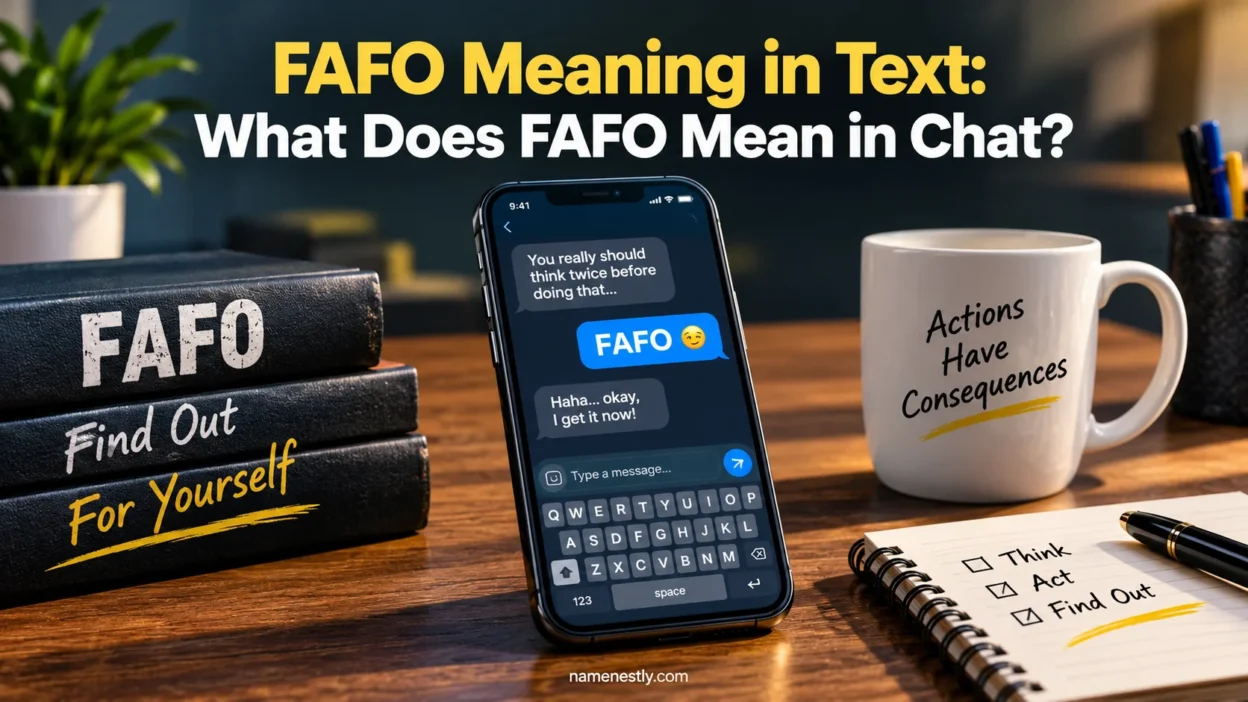
If someone sends you “FAFO” in a text, the message usually carries more weight than four simple letters suggest. FAFO is internet slang that people use when talking about risks, consequences, warnings, challenges, or reckless behavior. You may see it in texts, comments, memes, captions, arguments, and casual conversations.
The acronym stands for “Fuck Around and Find Out.” In simple terms, it means that someone will discover the consequences of their actions by going ahead with something risky, foolish, annoying, or provocative. The phrase can sound funny between friends, yet it can also sound aggressive in a serious argument.
Context matters. A friend might jokingly say “FAFO” after eating an extremely spicy meal. Someone else might use the same acronym as a serious warning during an argument. Understanding the surrounding conversation helps you determine the intended tone.
Quick Answer
FAFO means “Fuck Around and Find Out.” In texting, people use it to say that someone will experience the consequences of their actions. It can function as a warning, joke, challenge, sarcastic comment, or statement about cause and effect.
For example:
“Keep messing with him and FAFO.”
Here, FAFO means that the person should expect consequences if they continue.
Another example is:
“I ordered the hottest wings on the menu. FAFO.”
In this situation, the speaker uses FAFO humorously. They knowingly took a risky choice and expect to deal with the result.
The acronym contains profanity in its full form. Therefore, it fits casual conversations better than professional, academic, or formal communication.
Comparison Overview
FAFO has a straightforward central meaning, but its tone changes dramatically depending on the situation. The table below shows how people commonly interpret it.
| Use of FAFO | Meaning | Typical Tone |
| Warning | You may face consequences | Serious |
| Challenge | Try it and see what happens | Defiant |
| Joke | I took a silly risk | Humorous |
| Reaction | Someone experienced consequences | Sarcastic |
| Argument | Don’t push the situation further | Aggressive |
| Caption | Actions produced predictable results | Playful |
| Meme | Someone’s risky choice backfired | Comedic |
The important point is that FAFO doesn’t automatically mean a threat. The same acronym can appear in a harmless joke or a heated disagreement.
Main Differences Between FAFO Meaning in Text
The basic definition stays the same, but people use FAFO in several different ways. Understanding these differences makes online conversations much easier to interpret.
| Context | What FAFO Communicates |
| Friendly conversation | A playful warning or joke |
| Argument | A strong warning about consequences |
| Social media | A reaction to someone’s behavior |
| Meme culture | Humor about cause and effect |
| Personal challenge | A willingness to accept the outcome |
| Risky decision | Recognition that consequences may follow |
In other words, FAFO focuses on consequences. The speaker usually suggests that a person’s actions will produce an expected result.
What Does FAFO Stand For?
FAFO is an acronym for “Fuck Around and Find Out.”
Each letter represents part of the phrase:
- F = Fuck
- A = Around
- F = Find
- O = Out
The phrase uses profanity, which gives it a stronger emotional impact than a neutral expression such as “actions have consequences.”
For example, someone could say:
“If you keep ignoring the warning, you’ll face the consequences.”
That sounds formal and measured.
Someone using FAFO might instead write:
“Keep going. FAFO.”
The second version feels shorter, sharper, and more confrontational.
That’s one reason the acronym works particularly well in texting and social media. Four letters can communicate an entire attitude.
FAFO Meaning in Text Messages
In text conversations, FAFO usually appears when someone discusses behavior that could produce consequences.
A person might send FAFO after warning a friend not to do something. Another person may use it after deliberately taking a risk.
Consider this exchange:
Friend: “Should I send that message to my ex?”
Reply: “You already know how this ends. FAFO.”
Here, the speaker isn’t necessarily threatening anyone. They’re suggesting that the person should accept whatever happens after making the decision.
FAFO can also appear as a reaction:
“He kept ignoring everyone’s advice. FAFO.”
The writer means that the person’s eventual problem resulted from choices they made earlier.
Common Reasons People Use FAFO in Texts
People commonly use the acronym to:
- Warn someone about consequences
- React to reckless behavior
- Joke about a bad decision
- Challenge someone
- Express confidence
- Mock an avoidable mistake
- Describe cause and effect
- End an argument with a blunt statement
Because the acronym carries profanity, it usually belongs in informal communication.
FAFO Meaning in Simple English
The easiest way to understand FAFO is:
“Do what you want, then deal with what happens.”
It combines two ideas: choice and consequence.
Someone uses FAFO when they believe another person is taking an unnecessary risk. The speaker suggests that the person may eventually discover why the warning mattered.
For example, imagine someone repeatedly touches a hot pan after being warned. A friend might jokingly say FAFO after they get burned.
The phrase doesn’t always describe a literal physical consequence. It can refer to social, emotional, financial, professional, or practical consequences too.
FAFO Tone and Context
The meaning of FAFO becomes much clearer when you examine the speaker’s tone.
When FAFO Is Used as a Warning
A person may use FAFO to tell someone to stop before things become worse.
For example:
“Don’t keep provoking her. FAFO.”
The speaker suggests that continued behavior could lead to consequences.
This usage sounds more serious because the acronym directly follows a warning.
When FAFO Is Used as a Joke
Friends frequently use FAFO for harmless situations.
Imagine someone orders an enormous dessert and says:
“I know I’ll regret this, but FAFO.”
Here, the phrase adds humor. The person understands the risk and chooses to accept it anyway.
When FAFO Sounds Aggressive
During an argument, FAFO can become confrontational.
For example:
“You can keep talking like that. FAFO.”
Depending on the circumstances, this may imply that the speaker expects some form of retaliation or consequence.
Because of that possibility, you shouldn’t automatically interpret every FAFO message as playful.
When FAFO Describes Consequences
Sometimes the speaker isn’t warning anyone at all.
They may simply comment on something that already happened:
“He ignored the instructions and broke it. FAFO.”
In this context, FAFO essentially means “his choices produced predictable consequences.”
FAFO Examples in Texting
Realistic examples make the slang much easier to understand.
| Situation | Example | Meaning |
| Warning | “Keep pushing me and FAFO.” | Stop before your actions create consequences. |
| Risk | “I bought the mystery box. FAFO.” | I took a risk and accepted the outcome. |
| Joke | “I ate six tacos. FAFO.” | I knowingly made a ridiculous choice. |
| Challenge | “Go ahead and try it. FAFO.” | Try it and discover the result yourself. |
| Reaction | “She ignored every warning. FAFO.” | Her actions eventually caused problems. |
| Meme | “He touched the wet paint. FAFO.” | He ignored an obvious warning and suffered the result. |
The surrounding words often tell you whether the message sounds playful or serious.
Read More: JOI Meaning: What Does JOI Mean in Text and Online?
How to Respond When Someone Says FAFO
Your response should match the tone of the conversation.
If someone uses FAFO jokingly, a humorous reply can keep things light.
For example:
“Fair enough. I knew the risk.”
If someone uses it during a disagreement, a calm response usually works better:
“Let’s not turn this into an argument.”
If you don’t understand the intended meaning, you can simply ask:
“What do you mean by FAFO here?”
That approach prevents unnecessary misunderstandings.
Friendly Responses
When the situation feels playful, you could respond with:
- “Guess I’ll find out!”
- “Risk accepted.”
- “I knew what I was getting into.”
- “Worth the gamble.”
- “Well, here goes nothing.”
Serious Responses
If the message feels hostile, consider keeping your response neutral:
- “Let’s keep this respectful.”
- “I don’t want any problems.”
- “I’m not looking for an argument.”
- “Let’s talk about what happened.”
The best response depends on the relationship and surrounding conversation.
Is FAFO a Bad Word?
The full phrase “Fuck Around and Find Out” contains profanity. That makes FAFO more vulgar than many everyday abbreviations.
However, internet users often write the acronym instead of spelling out the entire phrase. The shortened version still carries the original meaning and attitude.
FAFO generally works in:
- Casual texting
- Friend group chats
- Memes
- Social media comments
- Informal conversations
- Humorous captions
It generally doesn’t fit well in:
- Formal emails
- Job applications
- Academic assignments
- Professional reports
- Customer-service communication
- Official documents
Even when someone understands the acronym, the wording can still appear disrespectful in formal settings.
Is FAFO Rude or Offensive?
FAFO can be rude, but context determines how strongly it comes across.
A friend might use it after you make a silly mistake. In that setting, the phrase could feel harmless and funny.
During an argument, however, the same acronym may sound hostile. It can suggest that the speaker expects consequences if the other person continues.
Consider these two examples:
“I ate the whole cake. FAFO 😂”
This clearly leans toward humor.
Compare it with:
“Keep threatening me. FAFO.”
This version sounds much more serious.
The surrounding situation, punctuation, emojis, relationship between speakers, and previous messages can all change the interpretation.
Is FAFO Always Serious?
No. FAFO isn’t automatically serious.
Internet users frequently turn serious-sounding expressions into jokes. FAFO works particularly well for situations involving obvious consequences.
For example:
“I stayed up until 4 a.m. watching movies. FAFO.”
The person isn’t threatening anyone. They’re joking about their own poor decision.
Likewise:
“He touched the cactus after everyone told him not to. FAFO.”
The phrase works as a humorous reaction to predictable consequences.
Signs FAFO Is Probably Playful
Look for clues such as:
- Laughing emojis
- Self-deprecating comments
- Obviously harmless situations
- Friendly conversations
- Exaggerated statements
- Memes or humorous captions
Signs FAFO May Be Serious
Pay attention when:
- The conversation involves an argument
- Someone has issued a direct warning
- The speaker sounds angry
- The message discusses retaliation
- There has been repeated conflict
- The phrase follows a threatening statement
Context is the key.
FAFO vs. “Play Stupid Games, Win Stupid Prizes”
“Play stupid games, win stupid prizes” communicates a similar idea.
Both expressions focus on consequences. However, they differ in tone.
FAFO sounds shorter, sharper, and more confrontational. Play stupid games, win stupid prizes often sounds more sarcastic or humorous.
For example:
“He ignored every warning and lost his account. FAFO.”
A similar statement could be:
“Play stupid games, win stupid prizes.”
Both suggest that the outcome resulted from the person’s own choices.
FAFO vs. “You’ll Find Out”
The phrase “you’ll find out” can sound neutral or mysterious.
FAFO carries considerably more attitude because it contains profanity and implies that the person is knowingly taking a questionable action.
Compare:
“You’ll find out soon.”
with:
“Go ahead. FAFO.”
The first sentence simply suggests future knowledge. The second suggests consequences resulting from someone’s decision.
FAFO vs. “Actions Have Consequences”
“Actions have consequences” expresses the same broad principle in formal language.
FAFO delivers that idea with much more slang, emotion, and attitude.
| Expression | Tone | Typical Setting |
| FAFO | Blunt and informal | Texts and social media |
| Actions have consequences | Formal and neutral | General communication |
| You’ll find out | Neutral | Everyday conversation |
| Play stupid games, win stupid prizes | Sarcastic | Informal conversation |
The choice depends on how strongly and casually you want to communicate the idea.
How FAFO Is Used in Memes and Internet Culture
FAFO fits meme culture because it compresses an entire situation into four letters.
A typical meme might show someone ignoring an obvious warning. The final image shows the predictable consequence. A caption containing FAFO then provides the punchline.
The humor usually comes from the gap between:
- What someone was warned about.
- What they chose to do anyway.
- What happened afterward.
This structure makes FAFO useful for reaction posts and short-form content.
Common Meme Situations
FAFO often appears with situations involving:
- Ignoring obvious warnings
- Taking unnecessary risks
- Overestimating one’s abilities
- Provoking someone
- Breaking simple rules
- Making impulsive decisions
- Trying something clearly questionable
The acronym acts almost like a verbal stamp saying, “The outcome shouldn’t surprise anyone.”
Examples of FAFO in Different Conversations
Between Friends
“You said the hot sauce wasn’t spicy. FAFO 😂”
The phrase is playful because the speaker jokes about someone’s risky food choice.
During an Argument
“If you keep insulting people, don’t be surprised when they respond. FAFO.”
Here, the phrase carries a stronger warning.
In a Social Media Comment
“He really thought nobody would notice. FAFO.”
The commenter suggests that the person’s actions eventually caught up with them.
In a Meme Caption
“Ignored the sign. FAFO.”
The short caption highlights an obvious cause-and-effect relationship.
After Someone Takes a Risk
“I knew the shortcut might be terrible. FAFO.”
The speaker accepts responsibility for choosing the risky option.
FAQs:
What does FAFO mean in texting?
FAFO means “Fuck Around and Find Out.” In texting, it usually means that someone will discover the consequences of their actions.
What does FAFO stand for?
FAFO stands for “Fuck Around and Find Out.” It is an informal acronym commonly used online and in casual conversations.
Is FAFO a swear word?
The full phrase contains profanity. Although FAFO abbreviates the wording, it still carries the same vulgar expression and should be treated as informal slang.
Is FAFO a threat?
Not necessarily. FAFO can be humorous, sarcastic, or serious. During an argument, however, it may function as a warning that someone expects consequences.
What does FAFO mean on TikTok?
On TikTok, FAFO usually means “Fuck Around and Find Out.” Users commonly use it in captions, comments, memes, and reaction content involving consequences.
Conclusion:
FAFO meaning in text is simple once you know the acronym: it stands for “Fuck Around and Find Out.” The phrase describes situations where someone’s choices lead to consequences. People use FAFO as a warning, joke, challenge, sarcastic reaction, or commentary about reckless behavior. Its meaning remains consistent, but its tone depends heavily on context.