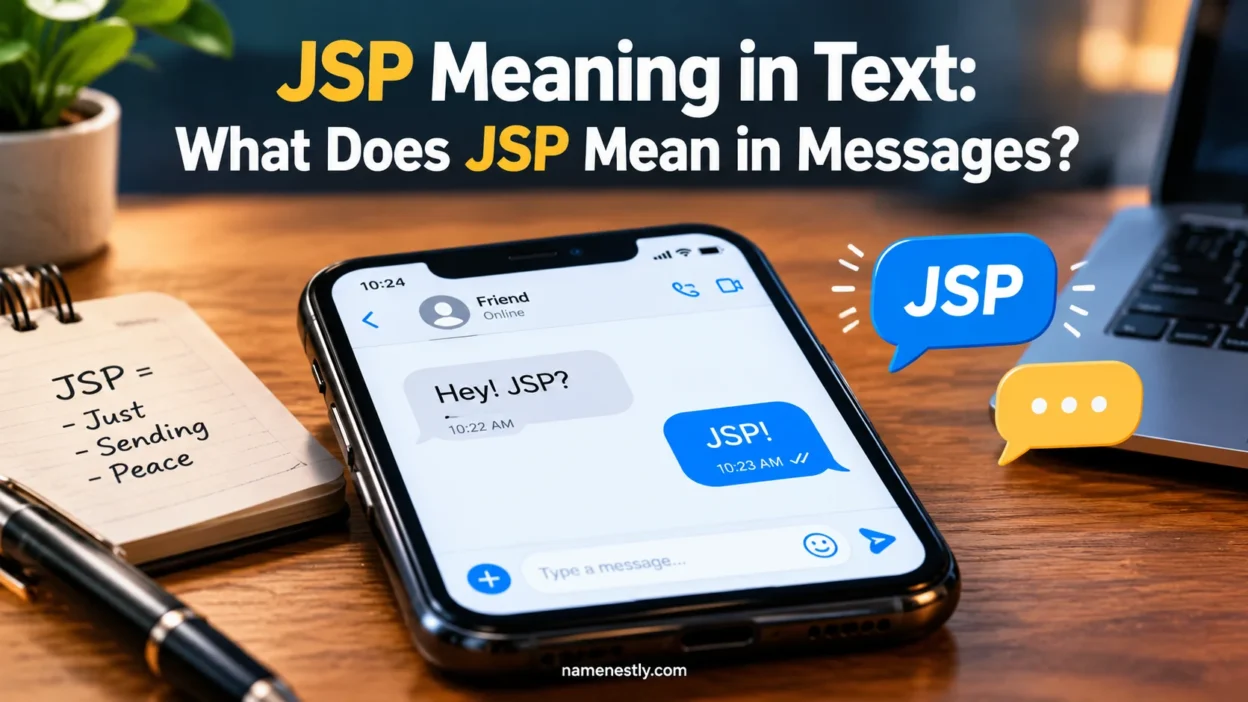
If you received a message containing “JSP”, the abbreviation may look straightforward at first glance. However, its meaning can change dramatically depending on the language, platform, and conversation.
In French texting, JSP commonly means “je sais pas,” which translates to “I don’t know.” French speakers frequently shorten expressions in casual digital conversations, especially when chatting quickly with friends.
In English-language conversations, however, JSP does not have one universally accepted texting meaning. It can also refer to JavaServer Pages, a technology used in web development. That distinction matters because the surrounding conversation usually reveals what the sender intended.
Quick Answer
JSP in text most commonly means “je sais pas” in French, which means “I don’t know.” It comes from the first letters of the French words Je Sais Pas. In casual French messages, people often use JSP instead of typing the complete phrase.
For example:
“JSP, demande-lui.”
“I don’t know, ask him.”
The abbreviation usually expresses uncertainty, lack of knowledge, or hesitation.
However, JSP doesn’t have one universal English texting definition. In technology discussions, JSP commonly means JavaServer Pages, a server-side web technology associated with Java.
| JSP context | Likely meaning | Example |
| French texting | Je sais pas (“I don’t know”) | “JSP quoi faire.” |
| French social media | Je sais pas | “JSP 😂” |
| Java programming | JavaServer Pages | “This application uses JSP.” |
| Other specialized contexts | Depends on the subject | Check the surrounding discussion |
So, if someone sends “JSP” in an ordinary French-language chat, “I don’t know” is usually the relevant interpretation.
Comparison Overview
The meaning of JSP depends heavily on the language and subject of the conversation.
| Feature | French texting | Programming |
| Full form | Je sais pas | JavaServer Pages |
| English meaning | I don’t know | A Java-based web technology |
| Typical setting | Texts, DMs, social media | Software development |
| Tone | Casual | Technical |
| Example | “JSP quoi dire” | “The JSP renders the page” |
| Main clue | French words around it | Java or web-development terminology |
| Audience | French-speaking texters | Developers and programmers |
This difference explains why a person familiar with programming may immediately think of JavaServer Pages. Someone chatting in French may understand JSP as a simple abbreviation for uncertainty.
Main Differences Between JSP Meaning in Text
The biggest difference comes from context.
When JSP appears in a French conversation, it generally represents the phrase “je sais pas.” When it appears in a software-development discussion, it usually refers to JavaServer Pages.
The two meanings have completely different purposes.
“JSP” in French texting describes what someone knows or doesn’t know.
“JSP” in programming describes a web-development technology.
Consider these examples:
- “JSP, peut-être demain.” → “I don’t know, maybe tomorrow.”
- “JSP quoi choisir.” → “I don’t know what to choose.”
- “We need to update the JSP.” → A reference to JavaServer Pages.
- “The JSP page contains the form.” → A programming reference.
The surrounding words provide the strongest clue.
What Does JSP Mean in Messages?
In a French-language message, JSP means “je sais pas.”
The phrase literally breaks down as:
- Je = I
- sais = know
- pas = not
Together, “je sais pas” is a common informal way to say “I don’t know.”
The more formal grammatical construction is generally “je ne sais pas.” In everyday spoken French, however, people commonly omit ne. Texting makes this shortened form even more common.
That explains why JSP works naturally as a texting abbreviation.
For example:
“JSP où il est.”
This means:
“I don’t know where he is.”
Another example:
“JSP si je peux venir.”
This means:
“I don’t know if I can come.”
The abbreviation can therefore replace the entire informal phrase without changing the basic idea.
What Does JSP Mean in a French Text?
In French texting, JSP normally expresses uncertainty or lack of knowledge.
It can answer a question directly:
“Tu sais à quelle heure il arrive?”
“JSP.”
Meaning:
“Do you know what time he’s arriving?”
“I don’t know.”
It can also appear inside a longer sentence:
“JSP quoi choisir.”
Meaning:
“I don’t know what to choose.”
Because the expression is informal, you are more likely to see JSP in texts, DMs, comments, and casual chats than in formal French writing.
JSP Meaning in Social Media and Online Chat
On social media, JSP can carry the same French meaning while taking an even more casual form.
People often shorten common expressions online because abbreviated messages are quick to type and easy for familiar audiences to understand.
You might see:
- “JSP 😭”
- “JSP mdrr”
- “JSP quoi”
- “JSP si c vrai”
- “JSP moi”
- “JSP comment expliquer”
The exact tone depends on the rest of the message.
For instance, “JSP 😭” can communicate uncertainty with frustration, embarrassment, or humor. The emoji adds emotional information that the three letters alone don’t provide.
JSP on Snapchat
On Snapchat, abbreviations often appear in fast, informal conversations.
A French-speaking user could write:
“JSP, on verra.”
That means:
“I don’t know. We’ll see.”
The abbreviation doesn’t automatically have a special Snapchat-only definition. The French context remains the important clue.
JSP on Instagram
Instagram comments and direct messages can also contain JSP when French is being used.
For example:
“JSP pourquoi il a fait ça.”
Translation:
“I don’t know why he did that.”
Again, the surrounding French words make the intended meaning clear.
JSP on TikTok
French-speaking TikTok users may use JSP in captions, comments, or replies.
A comment such as:
“JSP mais c’est drôle.”
means:
“I don’t know, but it’s funny.”
Here, JSP introduces an uncertain or loosely expressed opinion rather than a technical term.
JSP Meaning in Different Contexts
Although “je sais pas” is an important meaning of JSP in French digital communication, context remains essential.
JSP in Casual Texting
Casual French texting is where this abbreviation makes the most sense.
Friends might use it while discussing plans, relationships, school, work, entertainment, or everyday problems.
Example:
“Tu viens ce soir?”
“JSP encore.”
Translation:
“Are you coming tonight?”
“I don’t know yet.”
Here, JSP communicates uncertainty about a decision.
JSP in Social Media Comments
Social media users may use JSP to respond quickly without writing the complete phrase.
For example:
“JSP pourquoi tout le monde aime ça.”
This translates roughly to:
“I don’t know why everyone likes that.”
The phrase can sound casual and conversational rather than formal.
JSP in Group Chats
Group chats provide another natural setting for abbreviations.
Suppose several friends are deciding where to eat:
“On va où ce soir?”
“JSP, choisissez vous.”
The second message means:
“I don’t know. You guys choose.”
The abbreviation helps keep the conversation quick.
JSP in Professional or Formal Messages
JSP is generally not appropriate for formal French writing.
A professional email would normally use the complete expression or a more polished construction.
Instead of:
“JSP si c’est possible.”
A formal message might use:
“Je ne sais pas si cela est possible.”
The difference isn’t about grammar alone. It also concerns register.
JSP belongs to informal digital communication. Formal contexts generally call for complete words and conventional phrasing.
How to Use JSP in a Text
If you’re communicating with French-speaking friends, JSP can make a message sound casual and natural.
You can use it when you genuinely don’t know something or aren’t certain about an answer.
Examples of Natural JSP Usage
| Message | English meaning | Situation |
| “JSP.” | “I don’t know.” | Direct answer |
| “JSP encore.” | “I don’t know yet.” | Uncertain decision |
| “JSP quoi faire.” | “I don’t know what to do.” | Asking or discussing a problem |
| “JSP où il est.” | “I don’t know where he is.” | Missing information |
| “JSP si je viens.” | “I don’t know if I’m coming.” | Making plans |
| “JSP pourquoi.” | “I don’t know why.” | Explaining uncertainty |
| “JSP quoi dire.” | “I don’t know what to say.” | Unsure how to respond |
The abbreviation works best when the conversation already establishes the context.
Read More: Audiodisplayed Meaning in Text: What Does Audiodisplayed Mean?
JSP Texting Examples
Realistic examples make the meaning much easier to recognize.
Example 1: Making Plans
Person A: “Tu viens avec nous?”
Person B: “JSP encore.”
Meaning: “Are you coming with us?” / “I don’t know yet.”
Here, JSP shows that the person hasn’t made a decision.
Example 2: Asking About Someone
Person A: “Tu sais où est Sarah?”
Person B: “JSP.”
Meaning: “Do you know where Sarah is?” / “I don’t know.”
The abbreviation functions as a short standalone answer.
Example 3: Discussing a Problem
Person A: “Pourquoi il répond pas?”
Person B: “JSP, peut-être qu’il dort.”
Meaning: “Why isn’t he responding?” / “I don’t know, maybe he’s sleeping.”
The second speaker first admits uncertainty, then offers a possibility.
Example 4: Choosing Something
Person A: “Tu veux regarder quel film?”
Person B: “JSP, choisis.”
Meaning: “Which movie do you want to watch?” / “I don’t know, you choose.”
This use can sound relaxed and casual.
Example 5: Social Media
Comment: “Pourquoi cette vidéo est partout?”
Reply: “JSP 😂”
The reply means “I don’t know” with a playful or amused tone.
How to Reply When Someone Says JSP
Your response depends on what the person means and what you were discussing.
If JSP means “je sais pas,” you can respond by providing information, asking another question, or moving the conversation forward.
If You’re Making Plans
If someone says:
“JSP encore.”
You could respond:
“Pas de souci, dis-moi quand tu sais.”
That means:
“No problem, let me know when you know.”
If They’re Unsure About Something
You could provide an option:
“Tu peux peut-être lui demander directement.”
Meaning:
“Maybe you can ask them directly.”
If Their Message Is Too Vague
Ask for clarification.
“Tu sais pas quoi exactement?”
Meaning:
“What exactly don’t you know?”
This works particularly well when JSP appears by itself.
If You’re Not Sure What JSP Means
Look at the language and subject first.
If the surrounding messages contain French expressions such as “quoi,” “pourquoi,” “comment,” “encore,” or “si,” the French interpretation becomes much more plausible.
If the conversation contains terms such as Java, servlet, server, HTML, web application, or code, the programming meaning becomes much more likely.
JSP vs Similar Text Abbreviations
JSP can appear alongside other abbreviations, especially in multilingual online conversations.
| Abbreviation | Meaning | Language/context |
| JSP | Je sais pas / I don’t know | French texting |
| IDK | I don’t know | English texting |
| IDC | I don’t care | English texting |
| IKR | I know, right? | English texting |
| IMO | In my opinion | English internet slang |
| JS | Just saying / JavaScript, depending on context | English or technical |
| JSP | JavaServer Pages | Programming |
One important distinction is JSP versus IDK.
Both can communicate uncertainty, but they belong to different linguistic contexts:
- JSP → French: je sais pas
- IDK → English: I don’t know
For example:
“JSP quoi faire.”
and
“IDK what to do.”
communicate essentially the same idea in different languages.
Other Meanings of JSP
JSP doesn’t belong exclusively to texting.
The abbreviation has an established technical meaning in software development: JavaServer Pages.
JavaServer Pages is a technology associated with Java web applications. It allows developers to create dynamically generated web content using JSP pages.
That meaning has nothing to do with the French phrase je sais pas.
JSP in Programming
In a programming discussion, you might encounter sentences such as:
“The application uses JSP for its web pages.”
Or:
“Check the JSP file before changing the servlet.”
Here, the subject clearly concerns Java web development.
Terms such as these can help identify the technical meaning:
- Java
- servlet
- server
- web application
- JSP file
- HTML
- backend
- Java EE
- Jakarta EE
- web page
If several of these terms appear nearby, interpreting JSP as “I don’t know” would make little sense.
Why Context Matters
The same three letters can represent completely different concepts.
Consider these two messages:
“JSP, je sais pas quoi répondre.”
This is clearly French texting.
Now consider:
“The JSP calls the servlet and renders the HTML.”
This is clearly technical.
The letters haven’t changed. The context has.
FAQs:
What does JSP mean in text?
In French texting, JSP usually means “je sais pas,” or “I don’t know.” It expresses uncertainty or a lack of information.
What does JSP mean in messages?
When used in a French-language message, JSP normally stands for “je sais pas.” For example, “JSP quoi faire” means “I don’t know what to do.”
What does JSP mean on social media?
On French-language social media, JSP can mean “je sais pas.” Users may write it in comments, captions, replies, and direct messages.
Can JSP have more than one meaning?
Yes. JSP has multiple meanings depending on context. In French texting it commonly means “je sais pas,” while in programming it can mean JavaServer Pages.
What does JSP mean in programming?
In programming, JSP usually means JavaServer Pages. It refers to a Java-related technology used to create dynamically generated web content.
Conclusion:
JSP meaning in text depends on context, but French texting gives the abbreviation a particularly clear interpretation: “je sais pas,” meaning “I don’t know.” French speakers may use JSP in texts, DMs, group chats, comments, and other casual online conversations. It can express uncertainty about a decision, answer, person, event, or situation.