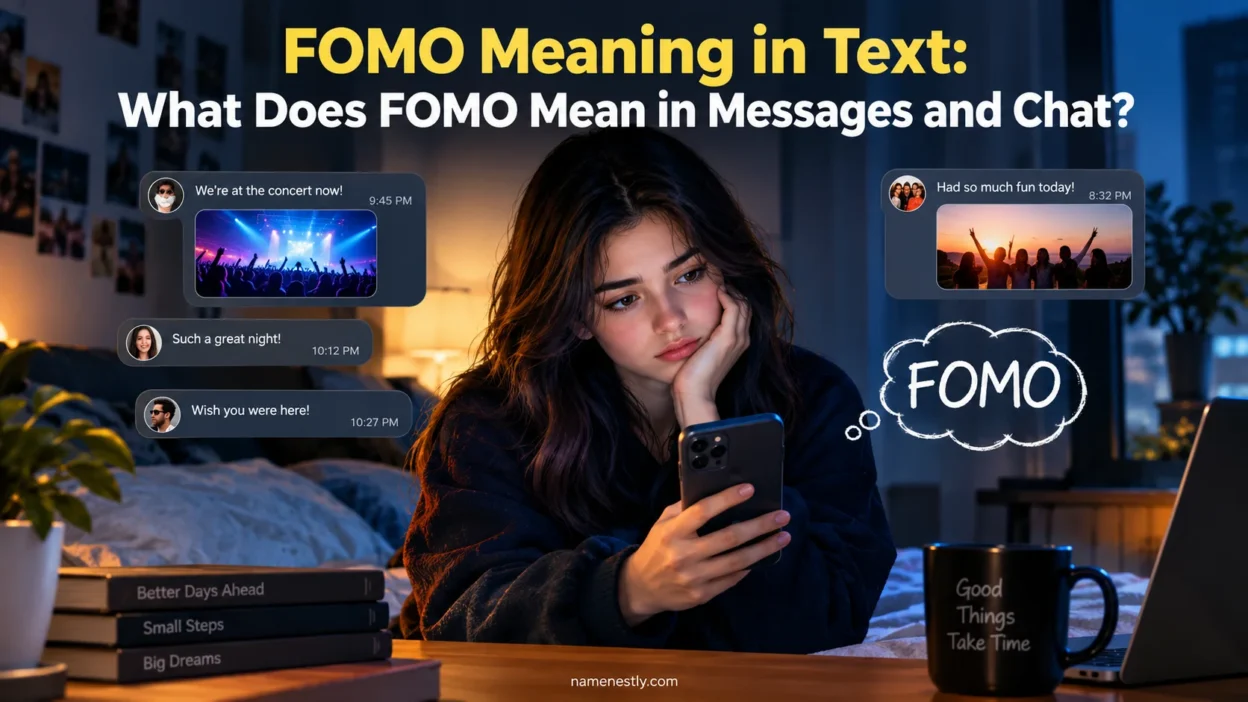
Have you ever seen your friends having fun without you and thought, “Maybe I should’ve gone”? That feeling has a name: FOMO. In texting, social media, and everyday conversations, people use FOMO to describe the fear of missing out on something exciting, enjoyable, popular, or important.
You might see someone write, “I have FOMO,” after watching friends attend a party. Another person might say, “That vacation is giving me FOMO,” after seeing photos online. The phrase can describe genuine disappointment, playful jealousy, or simply the feeling that you should have joined.
Although FOMO appears everywhere online, its meaning depends heavily on context. Sometimes it describes a strong emotional reaction. Other times, people use it casually as a humorous excuse for joining a trend, buying something, or attending an event.
Understanding FOMO meaning in text becomes much easier when you look at the words around it. The same abbreviation can describe missing a party, skipping a concert, watching a trend from the sidelines, or seeing friends make memories without you.
Quick Answer
FOMO means “Fear of Missing Out.” In text messages, it describes the feeling that you might be missing an enjoyable, exciting, interesting, or important experience that other people are having.
For example:
“Everyone is going to the concert tonight. I have serious FOMO.”
This means the person feels bad or uneasy because they aren’t going to the concert while others are enjoying it.
Another common example is:
“Your pictures are giving me FOMO!”
Here, the person is saying that the pictures make them wish they were there too.
FOMO doesn’t always mean serious fear. In casual texting, people often use it playfully or exaggerate their feelings.
Comparison Overview
FOMO belongs to a group of popular internet and texting expressions that describe decisions, emotions, and social behavior. Comparing it with related terms makes the meaning much clearer.
| Term | Full Meaning | Main Idea | Common Texting Context |
| FOMO | Fear of Missing Out | Worry about missing something | Parties, trends, events, trips |
| JOMO | Joy of Missing Out | Feeling happy about staying away | Rest, privacy, staying home |
| YOLO | You Only Live Once | Enjoying an opportunity because life is short | Spontaneous plans and decisions |
| FOBO | Fear of a Better Option | Worry about choosing the wrong option | Decisions and choices |
| OMO | Opportunity/Missing-Out context | Depends on the specific conversation | Informal online communication |
The most important distinction is between FOMO and JOMO. FOMO makes you think, “I wish I were there.” JOMO makes you think, “I’m glad I stayed home.”
YOLO has a different focus. Someone experiencing FOMO might attend an event because they don’t want to miss it. Someone saying YOLO might attend because they want to make the most of the opportunity.
Main Differences Between FOMO Meaning in Text
The meaning of FOMO stays connected to missing out, but the situation can change its tone. It can express disappointment, excitement, social pressure, humor, or even a simple desire to participate.
| Phrase | Meaning | Typical Tone |
| “I have FOMO.” | I feel like I’m missing something. | Casual or emotional |
| “Major FOMO.” | I strongly feel left out. | Informal |
| “FOMO is real.” | I’m genuinely feeling the urge to participate. | Casual |
| “This is giving me FOMO.” | Seeing this makes me wish I were involved. | Playful or emotional |
| “FOMO got me.” | My fear of missing out influenced my decision. | Humorous |
| “Don’t give me FOMO.” | Don’t show me something that makes me wish I were there. | Playful |
| “I got serious FOMO.” | I strongly regretted missing something. | Informal |
The important point is that FOMO doesn’t automatically mean jealousy. A person can feel FOMO because they genuinely wanted to experience something themselves.
What Does FOMO Mean in Text?
In text messages, FOMO means “Fear of Missing Out.” It describes concern that other people are enjoying an experience while you aren’t part of it.
Imagine your friends suddenly make plans for Saturday. You already have something else scheduled, so you can’t join them. Later, they send pictures from dinner. You might text:
“Okay, I definitely have FOMO now.”
You aren’t necessarily angry with your friends. You simply wish you could have shared the experience.
FOMO can involve almost anything:
- Parties
- Concerts
- Vacations
- Sports events
- Family gatherings
- Friend groups
- New restaurants
- Viral trends
- Video games
- Shopping deals
- Social media activities
- New movies or shows
- Limited-time experiences
The phrase has become especially useful because one short abbreviation communicates an entire emotional situation.
Instead of writing, “Seeing everyone having fun without me makes me wish I had gone,” someone can simply write “FOMO.”
What Does FOMO Stand For?
FOMO stands for Fear of Missing Out.
Each letter represents a word:
- F — Fear
- O — Of
- M — Missing
- O — Out
The phrase became widely associated with modern social and digital life because people can constantly see what others are doing.
Before social media became part of everyday communication, you might not know what you were missing. Today, a few photos or videos can show you an entire event while you’re sitting at home.
That constant visibility helps explain why FOMO meaning in text often appears alongside social media conversations.
FOMO Meaning in Chat and Social Media
FOMO is particularly common in casual digital communication. People use it when reacting to posts, stories, group chats, videos, and photos.
For example, someone might post pictures from a beach trip. A friend comments:
“This is giving me major FOMO.”
The person isn’t necessarily saying the trip was better than their own plans. They’re simply expressing that the images make them wish they had been there.
Social media can amplify this feeling because people usually share highlights rather than ordinary moments. You might see someone’s perfect dinner, exciting vacation, birthday celebration, or concert experience without seeing the boring parts around it.
That creates a strange effect. You see the exciting moment without seeing the complete experience.
Common Social Media FOMO Examples
Instagram:
“Everyone’s at the festival and I’m stuck at home. FOMO!”
TikTok:
“Now I want to try this trend. FOMO got me.”
Snapchat:
“Why did you send me those pictures? Instant FOMO 😂”
Group chat:
“Wait, you guys went without me? FOMO is real.”
Gaming:
“Everyone is playing tonight. I can’t miss it.”
In each case, the exact situation differs. The underlying idea remains the same: the person doesn’t want to miss an experience other people are having.
How People Use FOMO in Text Messages
FOMO can function in several ways within a conversation. It isn’t limited to one specific emotional situation.
FOMO About Friends
Friends often use FOMO when someone misses a group activity.
For example:
“You guys went bowling without me? I have FOMO now.”
The speaker probably wishes they had joined. The statement can be serious or playful depending on the relationship.
FOMO About Events
Events create some of the clearest examples.
“I wasn’t planning to go to the concert, but now everyone is talking about it. FOMO.”
Here, FOMO describes the growing desire to participate.
FOMO About Trends
Online trends can create a different type of FOMO.
“Everyone is trying that new game. I might have to download it.”
The person may not have been interested originally. Seeing others participate changed their desire to join.
FOMO About Shopping
FOMO also appears around limited products and sales.
“I wasn’t going to buy the shoes, but they’re almost sold out. FOMO got me.”
The person bought the item because they didn’t want to miss the opportunity.
FOMO About Experiences
Sometimes the thing being missed isn’t a physical product or event.
It could be a conversation, inside joke, trip, achievement, or shared memory.
That’s why FOMO is broader than simple jealousy. The central issue is missing participation.
Read More: WYF Meaning in Text Slang: What Does WYF Mean in Text?
FOMO Text Examples and Their Meanings
| Text Message | Meaning |
| “I have FOMO 😭” | I wish I were part of what you’re doing. |
| “This is giving me FOMO.” | Seeing this makes me want to be there. |
| “Major FOMO right now.” | I strongly feel like I’m missing something. |
| “FOMO is real.” | I’m genuinely feeling the urge to join. |
| “FOMO got me.” | The fear of missing out influenced my decision. |
| “Don’t give me FOMO.” | Don’t make me wish I had joined you. |
| “I’m getting FOMO.” | I’m starting to feel left out. |
| “No FOMO here.” | I’m completely fine with missing it. |
The surrounding conversation provides the missing context.
For example, “FOMO got me” could mean someone bought concert tickets, joined a party, downloaded an app, or ordered a popular product.
FOMO vs. YOLO
FOMO and YOLO sometimes appear together, but they don’t mean the same thing.
YOLO stands for “You Only Live Once.” It often encourages someone to enjoy an opportunity rather than worry about consequences or hesitation.
FOMO focuses on what you might miss.
YOLO focuses on what you can experience now.
Consider this conversation:
“Should we go to the concert tonight?”
One person says:
“Everyone’s going. I don’t want FOMO.”
Another says:
“Let’s go. YOLO!”
Both people might make the same decision, but their reasoning differs.
The first person doesn’t want to miss the experience. The second person wants to take advantage of the opportunity.
FOMO vs. JOMO
JOMO means “Joy of Missing Out.”
It describes the opposite reaction. Instead of feeling bad about staying away, someone feels satisfied with their choice.
Consider two people on the same Saturday night.
Person A sees friends at a crowded party and thinks:
“I wish I were there. FOMO.”
Person B stays home, watches a movie, and thinks:
“I’m glad I stayed home tonight. This is perfect.”
That’s JOMO.
| FOMO | JOMO |
| Fear of missing something | Happiness about missing something |
| “I wish I were there.” | “I’m happy here.” |
| Encourages participation | Can encourage staying away |
| Often linked to social comparison | Often linked to personal comfort |
| May create pressure | May create relief |
Neither term automatically tells you whether a decision is good or bad. They simply describe different reactions to missing an experience.
Is FOMO Positive or Negative?
FOMO usually describes an uncomfortable feeling, but the outcome isn’t necessarily negative.
For example, FOMO might encourage someone to reconnect with friends. A person who keeps declining invitations might realize that they genuinely want more social time.
On the other hand, FOMO can push someone into choices they don’t actually want.
Someone might attend an event because everyone else is going even though they’re exhausted. Another person might buy something unnecessary because they fear it will disappear.
The key difference is whether the decision reflects genuine interest or pressure.
A useful question is:
“Would I want this if nobody else were doing it?”
That question can help separate personal interest from social pressure.
FOMO in Social Media
Social media and FOMO have a natural connection because platforms make other people’s activities highly visible.
You might scroll through several posts and see:
- Friends traveling
- Someone attending a concert
- A group having dinner
- A new product everyone owns
- A viral challenge
- A sold-out event
- A friend’s exciting weekend
None of those posts necessarily show the complete reality. Social media usually captures selected moments.
That’s important when interpreting FOMO. A person may compare their ordinary day with someone else’s carefully selected highlight.
A Simple FOMO Example
Imagine someone stays home on Saturday.
They scroll through social media and see:
- A friend at a concert.
- Another friend at a restaurant.
- Someone else on a weekend trip.
- A popular event trending online.
Suddenly, their quiet evening feels boring.
They text:
“Why does everyone have plans except me? FOMO 😭”
The abbreviation summarizes that entire reaction.
FOMO in Different Texting Contexts
FOMO About Friends
Friend-related FOMO often happens when someone misses a group activity.
Examples include:
- Dinner
- Movie nights
- Gaming sessions
- Parties
- Road trips
- Casual hangouts
- Birthday celebrations
The speaker may feel left out even when nobody intentionally excluded them.
FOMO About Events
Events can create intense short-term FOMO because they’re often time-sensitive.
Concerts, festivals, games, and special gatherings happen at a specific time. Once they’re over, the opportunity disappears.
That’s why someone might suddenly say:
“I should’ve bought tickets. I’m getting major FOMO.”
FOMO About Trends
Trends can create a different kind of pressure.
A new app, game, meme, challenge, or fashion trend might suddenly appear everywhere. Someone who ignored it initially may become interested after seeing everyone else participate.
FOMO About Shopping
Retailers and marketers often use scarcity to encourage faster decisions.
Phrases such as:
- “Limited edition”
- “Only a few left”
- “Ends tonight”
- “Last chance”
- “Selling fast”
can create a sense that waiting means missing an opportunity.
In casual conversation, someone may describe that reaction as FOMO.
Common FOMO Phrases in Texting
“I Have FOMO”
This means:
“I feel like I’m missing something.”
Example:
“You guys are going out tonight? I have FOMO already.”
“FOMO Is Real”
This emphasizes that the feeling is strong.
Example:
“Those vacation photos are amazing. FOMO is real.”
“FOMO Got Me”
This means the fear of missing out influenced a decision.
Example:
“I bought the tickets. FOMO got me.”
“This Is Giving Me FOMO”
This usually appears after seeing something enjoyable.
Example:
“Your beach pictures are giving me FOMO.”
“Don’t Give Me FOMO”
This is often playful.
Example:
“Stop sending concert videos. Don’t give me FOMO!”
FOMO With Emojis
Emojis can change the emotional flavor of FOMO.
| Emoji | Common Effect |
| 😭 | Dramatic or exaggerated disappointment |
| 😂 | Makes the statement humorous |
| 😩 | Shows frustration or longing |
| 👀 | Shows interest or curiosity |
| 🥲 | Mixes sadness with humor |
| 😭😂 | Usually makes the FOMO clearly playful |
For example:
“Everyone looks amazing at the party 😭”
The crying emoji doesn’t necessarily mean genuine distress. In casual texting, it may simply emphasize that the speaker wishes they were there.
Context matters more than the emoji itself.
FAQs:
What does FOMO mean in texting?
FOMO means “Fear of Missing Out.” In texting, it describes feeling like you’re missing an enjoyable, exciting, or important experience.
What does FOMO stand for?
FOMO stands for Fear of Missing Out. Each letter comes from the first letter of the four words.
What does “I have FOMO” mean?
“I have FOMO” means “I feel like I’m missing something.” The speaker may wish they were attending an event or participating in an activity.
What does “FOMO got me” mean?
“FOMO got me” means the person made a decision partly because they didn’t want to miss an experience or opportunity.
For example:
“I wasn’t going to go, but FOMO got me.”
This means the person eventually decided to participate.
What does “This is giving me FOMO” mean?
It means “Seeing this makes me wish I were involved.”
Someone might say this after seeing vacation photos, party videos, concert clips, or exciting plans.
Conclusion:
FOMO means “Fear of Missing Out.” In texts and online conversations, people use it when they feel like they’re missing an enjoyable, exciting, popular, or meaningful experience. The phrase can describe a serious feeling, but casual texting often uses it playfully. “I have FOMO,” “FOMO got me,” and “This is giving me FOMO” are all common ways to express the idea.