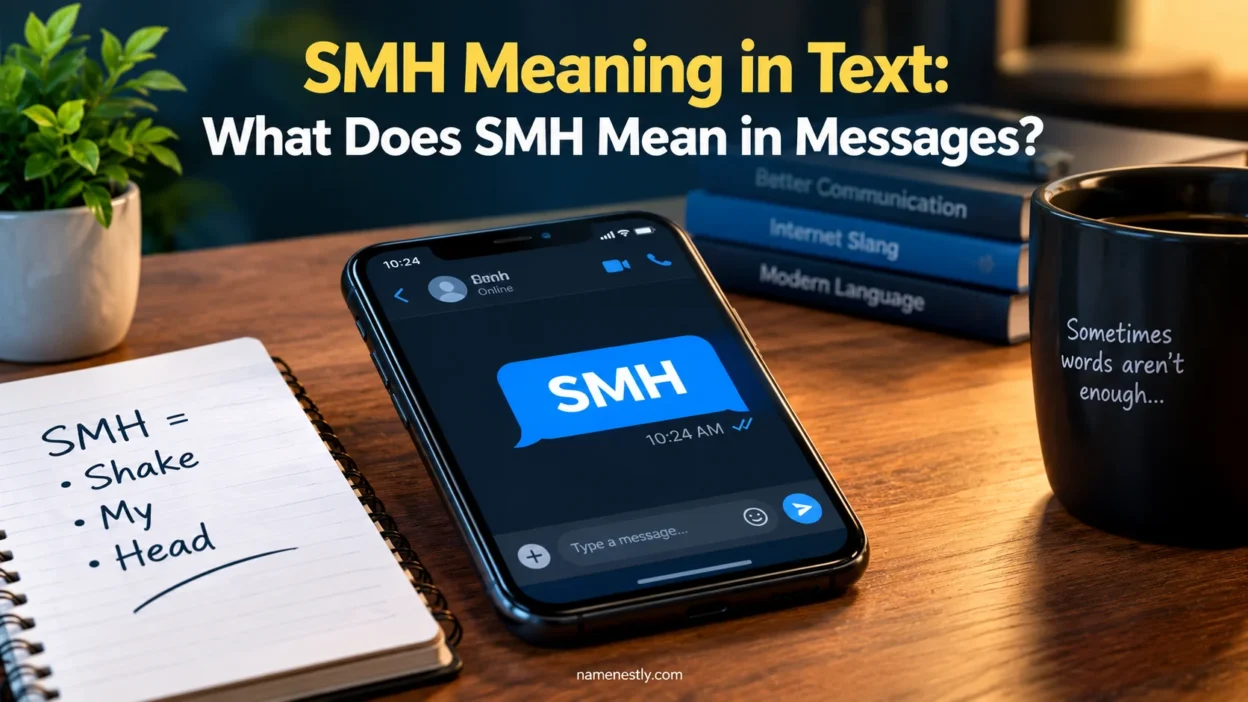
If someone sends you “SMH” in a text, they usually aren’t talking about a physical movement. In most online conversations, SMH means “shaking my head.” People use it to show disbelief, disappointment, annoyance, frustration, or mild disapproval.
The expression works much like the reaction you might have when a friend makes the same mistake twice. You may not need a long explanation. A simple shake of the head says enough. Online, SMH fills that same conversational role.
You can see SMH in text messages, social media comments, group chats, gaming conversations, and casual online discussions. Its meaning stays fairly consistent, although the emotional tone can change depending on the situation.
For example, “SMH, you forgot your wallet again” might sound annoyed. Meanwhile, “SMH 😂 you actually ate the whole pizza” could be completely playful. That context matters. The letters themselves don’t tell you exactly how the sender feels.
Quick Answer
SMH means “shaking my head” in text and online conversations. It usually expresses disbelief, disappointment, annoyance, frustration, or disapproval. Someone might write “SMH” after hearing something unreasonable, watching someone make an obvious mistake, or reacting to an awkward situation.
For example:
“SMH, you left your phone at home again.”
Here, SMH means something like “I can’t believe you did that again” or “I’m shaking my head at this.”
It isn’t normally meant literally. The sender isn’t necessarily saying they’re physically shaking their head. Instead, they’re using the phrase as a quick emotional reaction.
Comparison Overview
| Expression | Meaning | Common Tone | Typical Use |
| SMH | Shaking my head | Disappointed, annoyed, amused | Reacting to someone’s action |
| SMDH | Shaking my damn head | Stronger frustration | More intense disbelief |
| OMG | Oh my God | Surprise or shock | Unexpected events |
| LOL | Laughing out loud | Amusement | Funny situations |
| WTF | What the fuck | Shock, anger, disbelief | Strong reactions |
| Facepalm | Embarrassment or disbelief | Frustrated or humorous | Obvious mistakes |
| IDK | I don’t know | Uncertain | Lack of knowledge |
| TBH | To be honest | Direct or sincere | Giving an honest opinion |
The main difference is that SMH focuses on a reaction of disbelief, disappointment, or disapproval. Other abbreviations can express surprise, laughter, confusion, or stronger frustration.
Main Differences Between SMH Meaning in Text
SMH, SMDH, OMG, LOL, and WTF can all appear as reactions. However, they don’t communicate exactly the same emotion.
SMH usually carries a “come on, really?” feeling. SMDH adds stronger emphasis. OMG centers on surprise. LOL signals amusement. WTF can communicate much stronger shock, confusion, or anger.
Understanding those differences helps you read the emotional temperature of a conversation.
| Text Expression | Core Reaction | Emotional Intensity |
| SMH | Disbelief or disappointment | Mild to moderate |
| SMDH | Strong disbelief or frustration | Moderate to strong |
| OMG | Surprise or shock | Mild to strong |
| LOL | Amusement | Usually light |
| WTF | Shock, confusion, or anger | Strong |
| Facepalm | Embarrassment or disbelief | Mild to moderate |
What Does SMH Mean in Text?
SMH stands for “shaking my head.” It has become a common shorthand for expressing a reaction without writing a complete sentence.
Imagine your friend tells you they drove to the store and forgot why they went. You might simply shake your head. In a text conversation, “SMH” conveys a similar response.
The abbreviation can communicate several related feelings:
- Disbelief
- Disappointment
- Annoyance
- Frustration
- Disapproval
- Amusement
- Mild embarrassment
The exact meaning depends on what happened before the message.
For example:
“I studied for three hours and forgot the exam was tomorrow.”
A friend might reply:
“SMH 😂”
The sender probably isn’t seriously angry. The emoji changes the tone and makes the response feel more playful.
SMH Meaning in Chat and Social Media
SMH appears frequently in casual digital communication because short abbreviations make quick reactions easier.
You might encounter it in:
- Text messages
- Group chats
- Instagram comments
- TikTok comments
- Snapchat conversations
- Facebook discussions
- Reddit threads
- Gaming chats
- Direct messages
- Online forums
The abbreviation fits especially well when someone wants to react without writing a long response.
For example:
Person A: “I locked my keys inside my car again.”
Person B: “SMH 😭”
The second message doesn’t require a paragraph. The sender understands the situation and reacts immediately.
On social media, people may also use SMH when responding to news, opinions, jokes, mistakes, or questionable behavior. In those settings, the surrounding conversation becomes especially important because a short abbreviation can sound sarcastic without additional context.
What Does SMH Mean in Different Situations?
SMH for Disbelief
One of the most common uses of SMH involves disbelief.
You might use it when someone tells you something difficult to believe or does something completely unexpected.
For example:
“He said he forgot his own birthday.”
A response such as “SMH” communicates disbelief without needing a detailed explanation.
The feeling is often similar to saying, “I can’t believe this.”
SMH for Disappointment
SMH can also express disappointment when someone’s behavior doesn’t meet expectations.
For example:
“You promised you’d call, then disappeared all evening.”
A response of “SMH” can signal disappointment without turning the conversation into an argument.
In this context, SMH may carry more emotional weight than simple disbelief.
SMH for Annoyance
People often use SMH when something repeatedly gets on their nerves.
Consider this example:
“The Wi-Fi stopped working right before my presentation.”
Someone might respond:
“SMH, that’s the worst.”
Here, the abbreviation reflects frustration with the situation rather than criticism of a person.
SMH for Disapproval
SMH can communicate that someone doesn’t agree with a decision or action.
For example:
“He spent his entire paycheck on something he didn’t need.”
A response such as “SMH” may mean:
“That was a bad decision, and I don’t understand why you did it.”
The expression doesn’t automatically mean serious condemnation. Tone depends heavily on the relationship between the people involved.
SMH as a Playful Reaction
Not every SMH message is negative.
Friends often use it while joking with one another.
For example:
Friend: “I ordered fries and finished them before the food arrived.”
You: “SMH 😂”
That response can mean:
“You’re ridiculous, but that’s hilarious.”
The laughing emoji softens the abbreviation and makes the playful intention easier to understand.
How to Use SMH in a Sentence
SMH is flexible. You can place it at the beginning or end of a message, or use it alone.
SMH at the Beginning
“SMH, you forgot your password again.”
This structure makes the abbreviation feel like an immediate reaction.
SMH at the End
“You really bought another pair of sneakers, SMH.”
Here, the main statement comes first. SMH acts like a reaction added afterward.
SMH as a Standalone Message
“SMH.”
A standalone SMH can communicate a complete reaction. The recipient usually needs the previous conversation to understand why the sender responded that way.
SMH With an Emoji
“SMH 😂”
The emoji can make the message feel humorous rather than genuinely angry.
“SMH 🙄”
The eye-roll emoji can make the disapproval or annoyance more obvious.
SMH Text Examples
| Situation | Example | What It Communicates |
| Disbelief | “SMH, you actually forgot again.” | I can’t believe you did that. |
| Disappointment | “SMH, I expected better.” | I’m disappointed. |
| Annoyance | “SMH, this keeps happening.” | This is frustrating. |
| Disapproval | “SMH at that decision.” | I don’t agree with that choice. |
| Humor | “SMH 😂 you never learn.” | I’m teasing you. |
| Embarrassment | “SMH, why did I say that?” | I regret what I did or said. |
| Confusion | “SMH, what were you thinking?” | I don’t understand that decision. |
SMH vs. Facepalm
SMH and facepalm overlap, but they aren’t identical.
A facepalm usually represents embarrassment, disbelief, frustration, or the realization that someone made an obvious mistake. The term comes from the familiar gesture of placing your hand over your face.
SMH focuses more directly on shaking your head as a reaction.
For example:
“I submitted the wrong file. Facepalm.”
This emphasizes embarrassment.
Meanwhile:
“You submitted the wrong file again? SMH.”
This emphasizes disbelief or frustration toward the situation.
Both can be humorous. The surrounding conversation determines the exact tone.
SMH vs. WTF
WTF generally carries a stronger tone than SMH.
WTF stands for “what the fuck.” It can express shock, confusion, anger, disbelief, or surprise. Because it contains profanity, it also feels more aggressive or informal.
SMH is usually milder.
Compare:
“SMH, you forgot your homework again.”
with:
“WTF? You forgot your homework again?”
The first sounds disappointed or mildly annoyed. The second sounds considerably more shocked or confrontational.
That distinction matters when choosing an abbreviation for a conversation.
SMH vs. OMG
OMG stands for “oh my God.” People commonly use it to express surprise, excitement, shock, or disbelief.
SMH usually carries more of a disappointed or disapproving reaction.
For example:
“OMG, I won the concert tickets!”
This expresses excitement.
By comparison:
“SMH, I can’t believe you lost the tickets.”
This expresses disappointment or disbelief.
Both abbreviations can respond to surprising events. Their emotional direction differs.
Read More: FOMO Meaning in Text: What Does FOMO Mean in Messages ?
SMH vs. LOL
LOL means “laughing out loud.” It generally indicates amusement.
SMH doesn’t necessarily indicate laughter.
For example:
“My dog stole my sandwich. LOL.”
The speaker finds the situation funny.
Meanwhile:
“My dog stole my sandwich again. SMH.”
The speaker sounds more frustrated or incredulous.
People can combine them, though:
“SMH LOL.”
That combination often means the speaker finds someone’s behavior ridiculous or funny.
SMH vs. SMDH
SMDH means “shaking my damn head.”
The additional word “damn” gives the expression more emphasis. It usually signals stronger frustration, disbelief, or annoyance.
Compare:
“SMH, you did it again.”
with:
“SMDH, you did it again.”
The second version generally sounds more intense.
However, neither expression has one fixed emotional level. Friends may use SMDH jokingly, especially when reacting to something silly rather than genuinely upsetting.
Is SMH Rude?
SMH isn’t automatically rude. Its tone depends on the situation, the relationship between the speakers, and the behavior being discussed.
Among close friends, SMH can be harmless teasing.
“SMH 😂 You really wore two different shoes.”
That sounds playful.
In a serious conversation, the same abbreviation could feel dismissive.
“I tried explaining how upset I was.”
“SMH.”
Here, the response could make the other person feel unheard.
The important factor isn’t simply the abbreviation. Context determines whether the reaction feels funny, annoyed, dismissive, or disrespectful.
If you’re unsure, consider the relationship before using it.
Is SMH a Bad Word?
No. SMH itself isn’t a swear word.
The abbreviation simply means “shaking my head.” It doesn’t contain profanity.
However, people sometimes use SMH alongside stronger language.
For example:
“SMH, what the heck were you thinking?”
Or:
“SMDH, this is ridiculous.”
The surrounding words can make the overall message more aggressive even though SMH itself isn’t offensive.
This distinction is useful when you’re deciding whether the abbreviation fits a particular conversation.
Can You Use SMH in Formal Communication?
SMH generally belongs in casual communication.
It works naturally in:
- Text messages
- Friend group chats
- Casual DMs
- Social media comments
- Informal online conversations
It usually doesn’t belong in:
- Formal business emails
- Academic essays
- Job applications
- Official reports
- Professional proposals
- Formal customer communication
Instead of writing:
“SMH, the deadline was missed again.”
A professional message could say:
“I’m concerned that the deadline was missed again.”
The second version communicates the issue clearly without relying on slang.
How to Respond When Someone Says SMH
Casual Responses
If a friend sends “SMH” after you make a harmless mistake, humor can work well.
Examples include:
- “I know, I know 😂”
- “My bad!”
- “Don’t judge me.”
- “It happens!”
- “I deserve that.”
- “Okay, okay. I messed up.”
The best response depends on what happened.
If They’re Actually Annoyed
When SMH appears during a serious conversation, don’t automatically joke.
You might respond with:
- “I understand why you’re annoyed.”
- “You’re right. I should’ve handled it differently.”
- “Sorry about that.”
- “Let me explain what happened.”
A short apology can prevent a minor disagreement from becoming a bigger one.
Common Ways People Write SMH
You may see the abbreviation in several forms:
- SMH
- smh
- Smh
- SMH…
- SMH 😂
- SMH 🙄
- SMH 🤦
Capitalization usually doesn’t change the basic meaning.
The surrounding punctuation and emojis can change the emotional feel, though. For example, “SMH…” may sound more tired or disappointed than a simple “SMH.”
Likewise, “SMH 😂” often signals playful disbelief.
FAQs:
What does SMH stand for in texting?
SMH stands for “shaking my head.” It describes a reaction of disbelief, disappointment, annoyance, frustration, or disapproval.
What does SMH mean on social media?
On social media, SMH usually expresses disbelief, criticism, disappointment, or amusement about something someone posted or did.
Is SMH rude?
SMH isn’t inherently rude. However, it can sound dismissive or critical when someone uses it during a serious conversation.
Is SMH a bad word?
No. SMH isn’t profanity. It simply stands for “shaking my head.”
What is the difference between SMH and SMDH?
SMH means “shaking my head,” while SMDH means “shaking my damn head.” SMDH generally adds stronger emphasis.
Conclusion:
SMH means “shaking my head” in text and online conversations. It’s one of those abbreviations that can communicate an entire reaction with only three letters. People commonly use SMH for disbelief, disappointment, annoyance, frustration, and disapproval. Friends can also use it playfully when someone does something silly or predictable. The context matters most. “SMH 😂” can sound like friendly teasing, while “SMH…” during an argument may communicate genuine frustration.