Have you ever received a message saying “I lwk miss you” or “That movie was lwk amazing” and wondered what LWK means? You’re not alone. Texting slang changes quickly, and short abbreviations can carry different shades of meaning depending on the conversation.
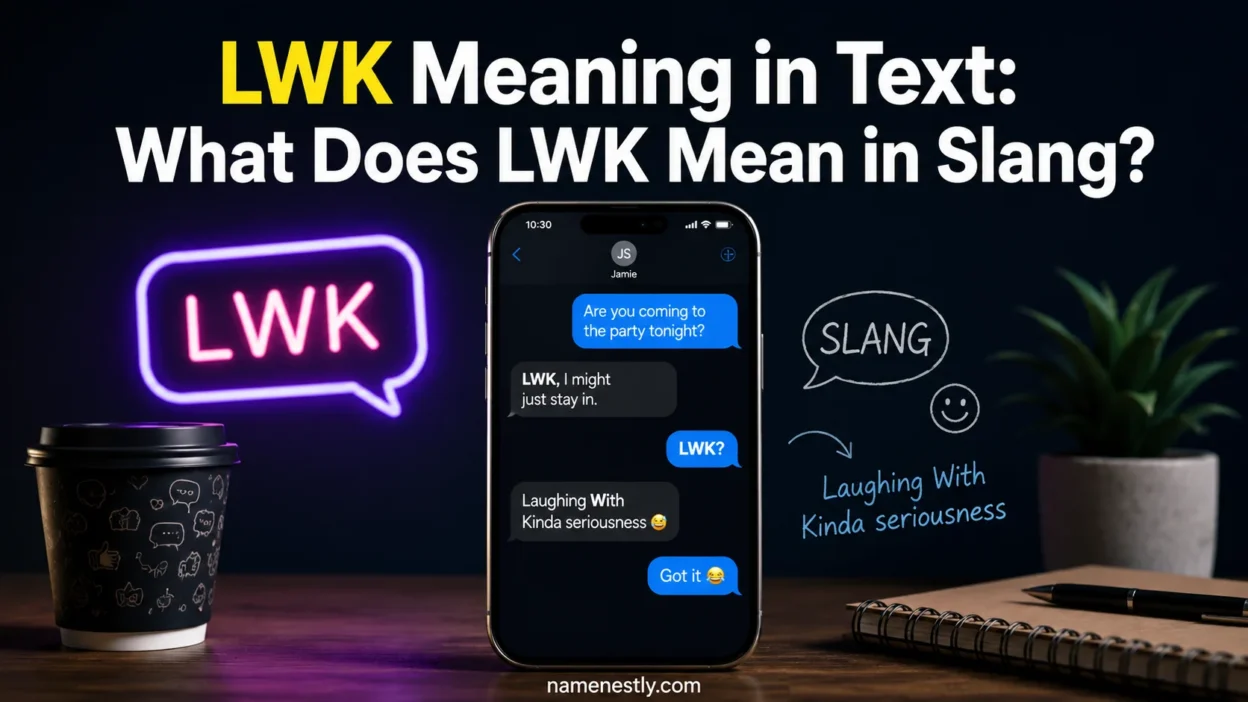
LWK most commonly stands for “low-key” in texting and online conversations. People use it to express feelings, share opinions, or admit something without making it sound too serious. For example, “I lwk like this song” means the person likes the song but expresses that opinion casually.
Understanding LWK becomes easier when you look at the words around it. Sometimes it means “kind of,” while other times it suggests a private feeling or an understated admission. The sender’s tone and the conversation’s context help you determine the intended meaning.
In this guide, you’ll learn what LWK means in text messages, how people use it on social media, what it might mean when a girl or guy sends it, and how to respond naturally.
Quick Answer:
LWK means “low-key” in most casual texting and social media conversations. It’s an abbreviation people use to express a feeling, opinion, or desire in an understated way.
For example:
- “I’m lwk tired.” — I’m kind of tired.
- “I lwk miss you.” — I quietly admit that I miss you, or I miss you more than I’m letting on.
- “This song is lwk fire.” — I think this song is really good, but I’m saying it casually.
- “I lwk want to leave.” — I kind of want to leave.
- “He’s lwk funny.” — I think he’s pretty funny.
The exact interpretation depends on context. LWK can soften a statement, make a confession feel less intense, or suggest that someone doesn’t want to emphasize a feeling too strongly.
Comparison Overview
LWK belongs to the same informal texting vocabulary as abbreviations such as TBH, NGL, FR, and IDK. However, each expression serves a different purpose.
| Slang | Full Meaning | Main Purpose | Example |
| LWK | Low-key | Expresses something casually or subtly | “I lwk love this.” |
| High-key | High-key | Emphasizes a strong or open feeling | “I high-key love this.” |
| TBH | To be honest | Introduces an honest opinion | “TBH, it’s great.” |
| NGL | Not gonna lie | Signals a candid statement | “NGL, I’m impressed.” |
| FR | For real | Shows sincerity or agreement | “That’s true fr.” |
| IDK | I don’t know | Expresses uncertainty | “IDK what to choose.” |
| IMO | In my opinion | Presents a personal viewpoint | “IMO, it’s better.” |
The main difference is that LWK changes the tone of a statement rather than simply introducing an opinion or expressing uncertainty. It often makes a feeling sound less intense, more casual, or slightly guarded.
For instance, “I like him” is a direct statement. “I lwk like him” sounds more tentative or playful, even if the person’s feelings are genuine.
Main Differences Between LWK Meaning in Text
Understanding LWK requires more than memorizing its full form. The abbreviation can change the tone of a sentence without changing its basic message.
LWK vs. Low-Key
Low-key is the complete expression, while LWK is a shortened form used in informal digital communication.
- Full phrase: “I low-key want to go home.”
- Abbreviated version: “I lwk want to go home.”
Both sentences communicate a similar idea. The abbreviation simply saves typing time and fits the casual style of text messages.
However, LWK isn’t as universally standardized as common abbreviations such as LOL or IDK. Some readers recognize it immediately, while others may need the surrounding sentence to understand it.
LWK vs. High-Key
Low-key and high-key often express contrasting levels of emphasis.
| Low-Key | High-Key |
| Suggests a subtle or understated feeling | Emphasizes a feeling openly |
| Can make a statement sound less intense | Makes a statement sound stronger |
| “I lwk want ice cream.” | “I high-key want ice cream.” |
| Often sounds casual or slightly hesitant | Often sounds enthusiastic or direct |
Imagine your friends are choosing a restaurant. You say, “I low-key want pizza.” You’re expressing a preference without making a big deal about it.
If you say, “I high-key want pizza,” you’re emphasizing your craving. The difference comes from the tone rather than a completely different subject.
LWK vs. TBH
TBH means “to be honest.” People use it to introduce an honest opinion, confession, or observation.
For example:
- “TBH, I don’t like that movie.”
- “I lwk don’t like that movie.”
The first sentence emphasizes honesty. The second expresses dislike in a more understated way.
You can also combine the two abbreviations: “TBH, I lwk like that movie.” Here, TBH signals candor while LWK softens the admission.
LWK vs. NGL
NGL means “not gonna lie.” It often introduces a candid statement that the speaker wants to emphasize as honest.
For example, “NGL, that outfit looks great” highlights a straightforward compliment. “That outfit is lwk great” gives the compliment a more casual or understated tone.
The distinction is subtle but useful. NGL focuses on honesty, while LWK focuses on how strongly or openly a thought is expressed.
What Does Low-Key Mean in Texting?
The phrase low-key has several related meanings in everyday English. In texting, it often describes something subtle, understated, private, or less intense than the speaker might otherwise suggest.
People use it to express feelings without making a dramatic announcement. They might also use it to share a preference while keeping the conversation relaxed.
Consider these examples:
- “I’m low-key nervous about tomorrow.”
- “I low-key want to try that restaurant.”
- “She’s low-key the funniest person here.”
- “I’m low-key obsessed with this show.”
Each sentence uses low-key a little differently. The first expresses mild or understated nervousness. The second shares a preference. The third emphasizes someone’s humor in a casual way, while the fourth communicates strong interest despite the understated wording.
This last example reveals an important detail: low-key doesn’t always mean a weak feeling. Someone might say they’re low-key obsessed with a show while watching every episode twice. The phrase can soften the delivery even when the underlying feeling is strong.
Why Do People Shorten Low-Key to LWK?
Texting encourages people to shorten words and phrases, especially in quick conversations with friends. LWK offers a compact way to communicate the same general idea as low-key.
People may use it in:
- Direct messages and private chats.
- Casual conversations with friends.
- Social media comments and captions.
- Gaming chats and online communities.
- Informal conversations about relationships, music, food, or daily life.
However, abbreviation habits vary. Some people type “lowkey” as one word, while others write “low-key” or simply use “LWK.” The full phrase remains easier to understand when you’re talking to someone unfamiliar with texting slang.
Does LWK Always Mean “A Little”?
No. Although LWK can mean “kind of” or “somewhat,” those translations don’t work in every sentence.
Compare these examples:
| Message | Likely Meaning |
| “I’m lwk hungry.” | I’m somewhat hungry. |
| “I lwk miss you.” | I admit that I miss you, perhaps more than I openly show. |
| “She’s lwk carrying the team.” | She’s quietly or unexpectedly doing much of the work. |
| “I’m lwk obsessed with this game.” | I really enjoy this game, expressed casually. |
Notice how the surrounding words affect the meaning. Replacing LWK with “a little” might work in the first example but sound unnatural in the others.
When interpreting a message, focus on the complete sentence rather than translating each abbreviation mechanically.
Read More: Ohio Slang Meaning: What Does Ohio Mean in Text?
Common Meanings of LWK in Text Messages
Although “low-key” is the primary interpretation in casual texting, its meaning shifts slightly with the situation. These distinctions help you understand what someone is trying to communicate.
LWK Meaning: Kind of or Somewhat
One common use of LWK is to soften a statement. It makes a feeling or opinion sound less forceful.
Examples include:
- “I’m lwk hungry.” — I’m kind of hungry.
- “That test was lwk difficult.” — That test was somewhat difficult.
- “I’m lwk excited for Friday.” — I’m feeling excited, but I’m expressing it casually.
- “This place is lwk expensive.” — This place seems a little expensive.
This usage works well when someone wants to share a thought without overstating it. It can also make a message sound relaxed rather than formal.
LWK Meaning: Secretly or Privately
Sometimes LWK suggests that someone has a feeling they haven’t openly admitted. The person might be revealing a small secret or making a playful confession.
For example:
- “I lwk have a crush on him.”
- “She lwk wants you to text her.”
- “I lwk miss our old school.”
- “He lwk enjoys being the center of attention.”
In these sentences, the abbreviation hints at something understated or not fully acknowledged. However, it doesn’t automatically mean the feeling is secret. The surrounding conversation must support that interpretation.
LWK Meaning: An Understated Opinion
People also use LWK when sharing opinions about entertainment, fashion, food, or everyday experiences.
Examples:
- “That restaurant is lwk underrated.”
- “This song is lwk a masterpiece.”
- “Your new haircut is lwk perfect.”
- “That ending was lwk disappointing.”
Here, LWK can make an opinion sound conversational or understated. Sometimes it even adds emphasis by making a strong opinion sound like a casual observation.
Can LWK Have Other Meanings?
LWK may have specialized meanings in particular communities, workplaces, or private conversations. However, those interpretations shouldn’t be treated as standard texting definitions without evidence.
If someone sends “LWK” by itself, you may not have enough information to identify the intended meaning confidently. Check the previous messages, the topic, and the sender’s usual writing style.
When the context remains unclear, asking “What do you mean by LWK?” is perfectly reasonable. A quick question is better than confidently guessing the wrong meaning.
How LWK Is Used in Everyday Text Conversations
The easiest way to understand LWK is to see how it works in realistic exchanges. The following examples show common conversational patterns and their likely meanings.
Using LWK to Express Feelings
People often use LWK when discussing emotions they don’t want to express too intensely.
Example conversation:
Alex: Are you excited about the trip?
Jamie: Yeah, I’m lwk excited!
Jamie is expressing genuine excitement but keeping the response casual. The abbreviation doesn’t mean the trip is unimportant. It simply softens the tone.
Other examples include:
- “I’m lwk stressed about my interview.”
- “I lwk feel bad about what happened.”
- “I’m lwk happy you’re here.”
- “I lwk can’t wait for the weekend.”
These messages communicate emotion without sounding overly dramatic. In some conversations, that softer tone helps people share feelings more comfortably.
Using LWK to Share Opinions
LWK can make opinions sound less confrontational. This is particularly useful when discussing movies, music, food, or other subjective topics.
Example conversation:
Taylor: Did you like the new movie?
Morgan: I lwk thought it was better than the first one.
Morgan shares a preference without presenting it as an absolute judgment. The abbreviation keeps the response informal and open to discussion.
More examples:
- “I lwk prefer the original version.”
- “That restaurant is lwk better than people say.”
- “This album is lwk their best work.”
- “I lwk disagree with that review.”
Remember that LWK doesn’t guarantee politeness. The rest of the sentence still determines whether the message sounds friendly, dismissive, or critical.
Using LWK to Talk About a Crush
Romantic conversations often involve playful hints, uncertainty, and indirect admissions. LWK can help someone express attraction without making a dramatic confession.
Example conversation:
Sam: Do you like Jordan?
Riley: I lwk think they’re cute.
Riley admits some attraction while keeping the response lighthearted. Depending on their relationship, the message could sound shy, playful, or simply casual.
Other examples include:
- “I lwk want him to text me first.”
- “She’s lwk my favorite person.”
- “I lwk get nervous around you.”
- “I lwk hoped you’d come.”
Important: LWK alone doesn’t prove romantic interest. People use it to discuss many subjects, and even a flirtatious message can be playful rather than serious. Look at the whole conversation before drawing conclusions.
Using LWK to Talk About Wants and Preferences
LWK also works when expressing everyday desires.
Examples:
- “I lwk want tacos tonight.”
- “I lwk need a vacation.”
- “I lwk want to buy those shoes.”
- “I lwk feel like staying home.”
These sentences make preferences sound relaxed rather than demanding. A person might use LWK to suggest an idea without insisting that everyone follow it.
LWK Meaning on Social Media
Social media encourages short, expressive language. LWK can fit naturally into captions, comments, and direct messages, although not every platform or community uses it equally.
LWK Meaning on TikTok
On TikTok, LWK may appear in comments about videos, trends, creators, or relatable situations.
For example:
- “I lwk needed to hear this today.”
- “This sound is lwk addictive.”
- “I lwk relate to this too much.”
The abbreviation helps comments sound conversational. However, it shouldn’t be assumed that every viewer will recognize it, especially when the audience includes people with different texting habits.
FAQs:
What Does LWK Stand for in Texting?
LWK most commonly stands for “low-key.” People use it in informal messages to express feelings, preferences, or opinions in an understated or casual way.
Does LWK Mean Low-Key?
Yes. In casual texting and online conversations, low-key is the most common interpretation of LWK. It can suggest “kind of,” “somewhat,” or a feeling expressed without much emphasis.
What Does LWK Mean From a Girl?
When a girl uses LWK, she may be softening an opinion, sharing a preference, or expressing a feeling casually. If she writes “I lwk miss you,” she may be admitting that she misses you. The surrounding conversation helps clarify her intention.
Is LWK the Same as Low-Key?
They generally communicate the same idea. Low-key is the complete phrase, while LWK is an abbreviated form used in informal digital conversations. The abbreviation saves space but may be less familiar to some readers.
What Is the Difference Between LWK and High-Key?
LWK usually communicates something subtly or casually, while high-key emphasizes a feeling or opinion more strongly. For example, “I lwk love this song” sounds understated, whereas “I high-key love this song” expresses stronger enthusiasm.
Conclusion:
LWK means “low-key” in most texting and social media conversations. People use it to express feelings, share opinions, and admit preferences without making their messages sound overly serious. Depending on the context, LWK can mean “kind of,” “somewhat,” or an understated admission. It can appear in conversations about friendships, relationships, entertainment, and everyday experiences.