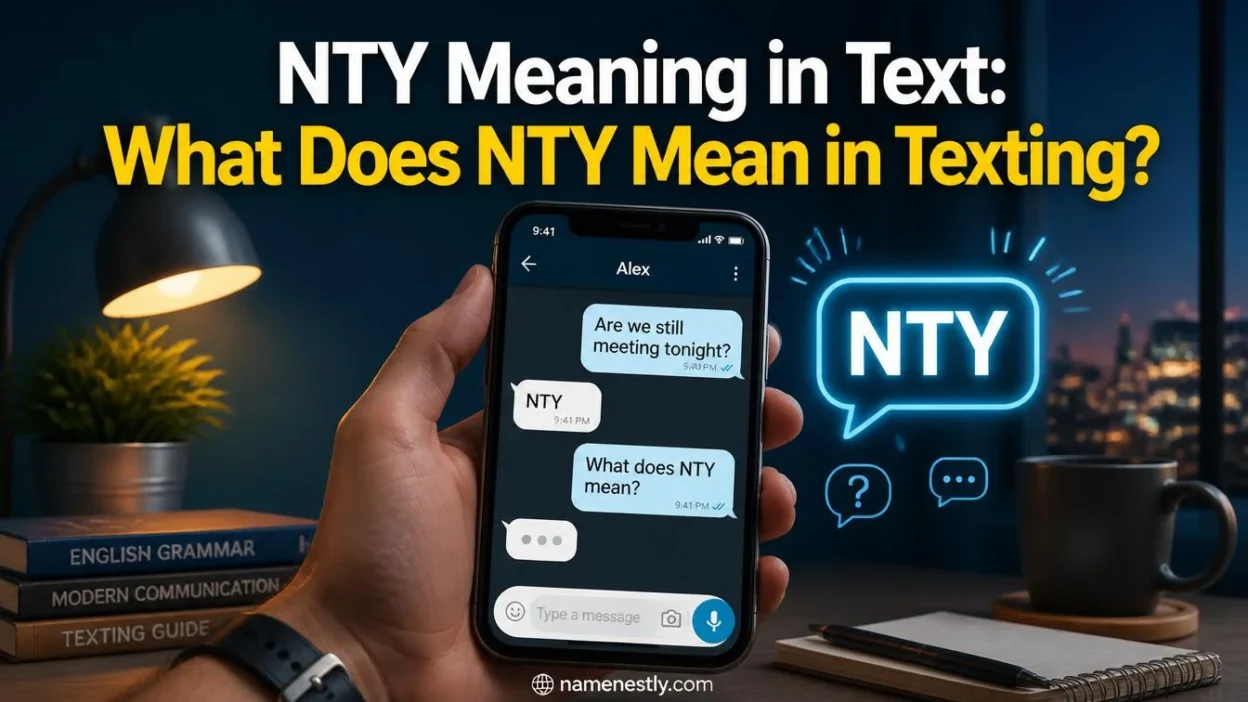
Have you ever received a message that simply says “NTY” and wondered what the other person meant? This short abbreviation appears in text messages, social media conversations, gaming chats, and online discussions. Although it looks simple, its tone can change depending on the situation.
NTY commonly means “No, Thank You.” People use it to decline invitations, refuse offers, reject suggestions, or politely express that they don’t want something. It provides a quick way to say no without typing the entire phrase.
However, NTY doesn’t always sound equally friendly. A message like “NTY, but thanks for asking!” feels warmer than a reply containing only “NTY.” Understanding the surrounding conversation helps you interpret the sender’s intention.
In this guide, you’ll learn what NTY means in text, how people use it, whether it sounds rude, how it differs from similar abbreviations, and how to respond naturally.
Quick Answer:
NTY means “No, Thank You” in text messages and online conversations. It’s a common internet abbreviation people use when declining an offer, invitation, request, or suggestion.
For example:
- Friend: “Want to grab some coffee?”
- You: “NTY, I already had some.”
In this conversation, NTY communicates a simple refusal. The sender doesn’t necessarily feel upset or dislike the person making the offer.
The abbreviation can sound polite, neutral, or slightly abrupt depending on the context. Adding a few friendly words can make the meaning clearer.
Comparison Overview
NTY belongs to a broader group of texting abbreviations that help people communicate quickly. However, each abbreviation serves a different purpose.
| Abbreviation | Full form | Main purpose | Example |
| NTY | No, Thank You | Declining an offer | “NTY, I’m good.” |
| TY | Thank You | Expressing gratitude | “TY for helping!” |
| NP | No Problem | Reassuring someone | “NP, happy to help.” |
| YW | You’re Welcome | Responding to thanks | “YW!” |
| NVM | Never Mind | Withdrawing a request or dismissing something | “NVM, I figured it out.” |
| IDC | I Don’t Care | Expressing indifference | “IDC which movie we watch.” |
| No Thanks | No, Thank You | Declining in plain language | “No thanks, maybe later.” |
The most important distinction is that NTY expresses a refusal, while TY expresses gratitude. Although the two abbreviations look similar, they communicate different messages.
For instance, replying “TY” to an invitation usually acknowledges the invitation or expresses appreciation. Replying “NTY” declines it.
What Does NTY Mean in Texting?
NTY is an internet initialism for “No, Thank You.” An initialism uses the first letters of a phrase, and people generally read those letters individually rather than pronounce them as a regular word.
People use NTY because it saves time and fits naturally into short digital conversations. Instead of writing a complete sentence, someone can communicate a refusal with just three letters.
Consider this exchange:
Alex: “Would you like another slice of pizza?”
Jordan: “NTY, I’m full.”
Jordan declines the offer without making the conversation complicated. The additional explanation also makes the response sound friendly and straightforward.
NTY can communicate several related intentions:
- Declining food, drinks, or other items.
- Turning down invitations and social plans.
- Rejecting an offer or purchase.
- Refusing help when it’s unnecessary.
- Saying no to a suggestion.
- Expressing that something doesn’t interest you.
The abbreviation doesn’t automatically communicate anger, disappointment, or dislike. Those interpretations depend on the surrounding conversation, the relationship between the people, and any additional words.
What Does NTY Stand For?
NTY stands for No, Thank You. Each letter represents the beginning of a word in the original phrase.
- N: No
- T: Thank
- Y: You
The complete phrase combines a refusal with an expression of courtesy. This makes NTY useful when someone wants to decline an offer without sounding unnecessarily harsh.
For example, “NTY, I don’t need another one” communicates that the offer isn’t necessary. It doesn’t automatically mean the recipient dislikes the person offering it.
Is NTY Slang or an Acronym?
NTY is best described as an internet initialism or texting abbreviation. People use it in informal digital communication rather than formal writing.
Technically, an acronym is generally pronounced as a word, while an initialism is pronounced using individual letters. NTY fits the initialism category because its letters represent the phrase “No, Thank You.”
In everyday conversation, however, many people use the broader term acronym for abbreviations of this kind. The distinction matters more in linguistic explanations than in ordinary texting.
You can use NTY in casual messages, but the complete phrase is usually a better choice in professional emails, formal requests, or sensitive conversations.
How Is NTY Used in Text Messages?
NTY appears in situations where someone wants to decline something quickly. The meaning stays largely consistent, but the reason for the refusal changes with the conversation.
NTY for Declining an Invitation
Friends often use NTY when turning down invitations to parties, restaurants, movies, or other activities.
For example:
Friend: “We’re going bowling tonight. Want to come?”
You: “NTY, I have an early start tomorrow.”
The response declines the invitation and gives a brief explanation. This can prevent the other person from assuming the refusal is personal.
You don’t always need to explain why you’re declining. A simple “NTY, maybe next time!” can communicate the same message in a friendly way.
NTY for Refusing an Offer or Suggestion
People also use NTY when someone offers food, assistance, advice, or an alternative.
Example:
Sam: “Want me to pick up lunch for you?”
Taylor: “NTY, I brought something from home.”
Taylor declines the offer while keeping the conversation pleasant. The abbreviation works because both people understand that Sam offered something and Taylor doesn’t need it.
You might also see NTY in conversations about recommendations.
Example:
Friend: “You should try that new horror movie.”
You: “NTY, horror movies aren’t really my thing.”
Here, the response rejects the suggestion rather than criticizing the friend.
NTY for Rejecting a Deal or Trade
NTY is common in informal buying, selling, and trading conversations. Someone might use it to reject a price, decline a proposed exchange, or turn down an unwanted item.
For example:
Seller: “Would you take $20 for it?”
Buyer: “NTY, I’m looking for something cheaper.”
In a gaming community, the same abbreviation might appear when players propose trades.
Player A: “Want to trade your rare skin for mine?”
Player B: “NTY.”
The second player declines the trade. The message doesn’t necessarily mean the offer was unfair or offensive; the player may simply prefer to keep the item.
NTY for Responding to Unwanted Messages
Sometimes people use NTY to communicate a boundary. For example, someone might decline an invitation, an unwanted offer, or a request for personal information.
Example:
Person A: “Can I have your phone number?”
Person B: “NTY.”
In this context, the reply indicates that the person doesn’t want to share their number. A longer explanation isn’t required.
If someone continues pushing after receiving a clear refusal, the issue isn’t the abbreviation’s tone. It’s the other person’s failure to respect the answer.
NTY Meaning on Social Media and Online Platforms
NTY can appear in private messages, public comments, gaming communities, and other online spaces. Its common meaning remains “No, Thank You,” although the context determines exactly what someone is declining.
NTY on Snapchat, Instagram, and TikTok
On social platforms, users often communicate through short replies. NTY fits this style because it delivers a clear response without requiring a long explanation.
For example:
- Someone offers to send you a promotional link, and you reply, “NTY.”
- A friend invites you to an event through a direct message, and you answer, “NTY, maybe next time.”
- Someone recommends a product in a comment, and you respond, “NTY, I already have one.”
The abbreviation doesn’t have a separate established meaning on each of these platforms. Its interpretation still depends on the message being answered.
A useful tip: Read the previous message before interpreting NTY. If someone offered help, the abbreviation probably declines that help. If someone invited you somewhere, it likely declines the invitation.
Read More: PMO Meaning in Text: What Does PMO Mean in Slang?
NTY on WhatsApp and Regular Text Messages
WhatsApp conversations and standard SMS messages often include abbreviations because people want to respond quickly.
NTY can be useful when a friend asks a straightforward question or offers something you don’t need.
Example:
Friend: “Should I bring you a bottle of water?”
You: “NTY, I’ve got one.”
The answer is short but understandable. Adding the reason makes it easier for the friend to know that the offer was unnecessary rather than unwelcome.
In group chats, NTY can also help someone decline a shared plan without sending a long explanation to everyone.
However, if the conversation involves an important decision or a sensitive subject, a complete sentence may prevent confusion.
NTY in Gaming Chats and Online Trading
Gaming conversations often move quickly. Players may use abbreviations to decline invitations, trades, equipment offers, or requests to join a team.
For example:
Player A: “Want to join our squad for the next match?”
Player B: “NTY, I’m logging off.”
The reply communicates a clear refusal and provides a reason.
In trading communities, NTY can help players avoid unnecessary back-and-forth exchanges. Someone who doesn’t want a proposed trade can simply decline.
Keep in mind that abbreviations may have specialized meanings in individual gaming communities. However, without additional context, NTY is generally understood as “No, Thank You.”
Does NTY Sound Rude or Polite?
NTY isn’t inherently rude. It combines a refusal with a polite expression, but its short format can sometimes feel distant or abrupt.
The same three letters can create different impressions depending on the situation.
When NTY Sounds Polite
NTY often sounds polite when someone acknowledges the offer or adds a friendly explanation.
For example:
- “NTY, but I appreciate it!”
- “NTY, I’m all set.”
- “NTY, maybe another time.”
- “NTY, that’s kind of you to offer.”
These responses make the refusal easier to understand. They also show appreciation when the situation calls for it.
You don’t need to add a lengthy explanation. A few extra words can make a noticeable difference.
When NTY Sounds Cold or Dismissive
A standalone “NTY” can sometimes feel abrupt, especially when someone has made a personal or thoughtful offer.
Imagine that a friend spends time planning an outing and asks whether you’d like to join. Receiving only “NTY” might feel less warm than receiving “NTY, but thanks for inviting me!”
Still, a short reply doesn’t prove that someone is angry. They may be busy, distracted, or simply accustomed to brief messages.
Consider these factors before making assumptions:
- Your relationship: Close friends may communicate more casually than new acquaintances.
- The previous message: A simple offer often needs only a short answer.
- The conversation’s tone: Friendly exchanges can make brief responses feel natural.
- The person’s usual style: Some people routinely send short messages.
Avoid treating punctuation or message length as definitive proof of someone’s feelings.
How to Make NTY Sound Friendlier
If you want to decline something without sounding dismissive, add a little context.
Here are several practical alternatives:
| Instead of | Try |
| “NTY.” | “NTY, but thanks!” |
| “NTY” | “No thanks, I’m good.” |
| “NTY.” | “Not this time, maybe later!” |
| “NTY” | “I appreciate the offer, but I’ll pass.” |
| “NTY.” | “Thanks for thinking of me!” |
Choose the version that fits your relationship with the other person. A casual reply works well between friends, while a more complete sentence may suit a professional conversation.
NTY Meaning in Different Conversations
Although NTY usually has the same basic meaning, the situation helps explain what the sender is declining.
| Situation | Example message | What NTY communicates |
| Food | “Want some fries?” — “NTY.” | Declining food |
| Social plans | “Coming to the party?” — “NTY, I’m busy.” | Declining an invitation |
| Shopping | “Interested in buying this?” — “NTY.” | Rejecting an offer |
| Gaming | “Want to trade items?” — “NTY.” | Declining a trade |
| Work | “Need help with that task?” — “NTY, I’ve finished.” | Declining assistance |
| Dating | “Would you like to go out?” — “NTY, but thanks.” | Politely declining romantic interest |
| Personal boundaries | “Can I borrow your phone?” — “NTY.” | Refusing a request |
Notice that the abbreviation itself doesn’t explain why the person said no. The rest of the conversation provides that information.
For example, “NTY, I’m busy” suggests a scheduling issue. Meanwhile, “NTY, I’m not interested” expresses a more direct refusal.
The practical rule is simple: Interpret NTY in relation to the offer or question that came before it.
FAQs:
What Does NTY Mean From a Girl?
NTY generally means “No, Thank You” when a girl uses it in a text message. It can indicate that she is declining an invitation, offer, or suggestion. Her gender doesn’t establish a different meaning, and the message alone doesn’t reveal her feelings toward you.
What Does NTY Mean From a Guy?
When a guy sends NTY, he usually means “No, Thank You.” He might be declining a plan, refusing an offer, or expressing that he doesn’t need something. Consider the conversation rather than assuming the response indicates anger or disinterest in you personally.
Does NTY Mean No Thank You?
Yes. NTY commonly stands for “No, Thank You” in texting and informal online communication. People use it to decline offers, invitations, requests, and suggestions without writing the complete phrase.
Is NTY Rude in Texting?
NTY isn’t inherently rude, but it can sound abrupt without additional context. A reply such as “NTY, but thanks for asking!” often feels warmer. The sender’s relationship with the recipient and the surrounding conversation also influence how the message comes across.
Should I Use NTY in Professional Messages?
You can use NTY in informal workplace chats when everyone understands the abbreviation. However, “No, thank you” or a complete sentence usually works better in formal emails, client communication, and sensitive workplace discussions.
Is NTY the Same as TY?
No. NTY means “No, Thank You,” while TY means “Thank You.” NTY usually declines an offer, whereas TY expresses gratitude. Confusing these abbreviations can change the meaning of a message.
Can NTY Be Used as a Complete Reply?
Yes. NTY can work as a complete response when the offer or question is clear. However, adding a short explanation or friendly phrase can reduce confusion when the situation calls for it.
Conclusion:
NTY commonly means “No, Thank You” in text messages, social media conversations, and online chats. People use it to decline invitations, reject offers, refuse suggestions, and communicate simple boundaries. Although the abbreviation is short, its tone depends on context. A standalone “NTY” can feel abrupt, while “NTY, but thanks for asking!” sounds warmer and more appreciative.