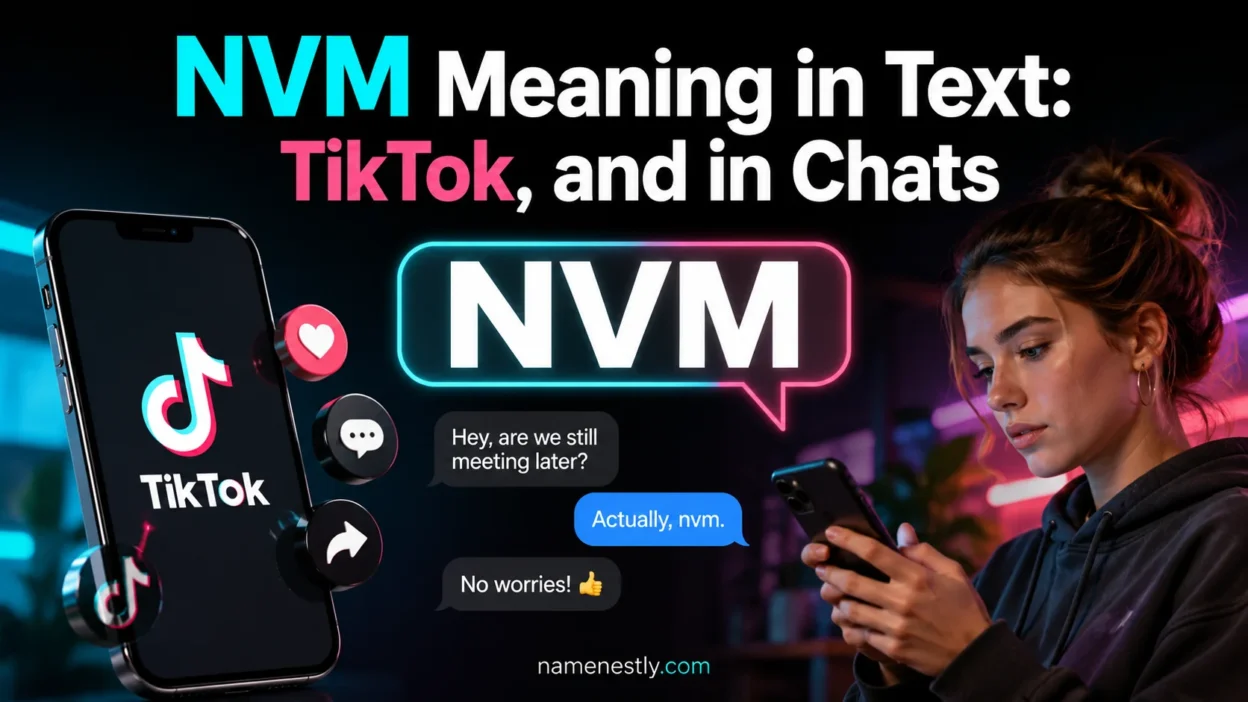
If someone texts you “NVM,” they usually mean “never mind.” People use this common abbreviation when they no longer need an answer, want to cancel a question, or decide that something isn’t important anymore. You’ll often see it in text messages, Snapchat conversations, TikTok comments, Instagram DMs, and online gaming chats.
For example, imagine asking your friend where they bought their shoes. Before they can reply, you find the store yourself and send, “NVM, I found it!” You’ve just used NVM to tell your friend that they don’t need to answer your original question.
However, NVM doesn’t always communicate the same emotion. Sometimes it sounds friendly and casual. In other situations, especially when someone writes “NVM, forget it,” it can sound annoyed or dismissive. Understanding the conversation helps you figure out what the sender really means.
Quick Answer:
NVM means “never mind” in text messages and online conversations. It’s an informal abbreviation people use to dismiss something, withdraw a question, cancel a request, or move on from a topic.
Here are a few common examples:
- “NVM, I figured it out.” — I found the answer myself.
- “NVM, don’t worry about it.” — You don’t need to do anything.
- “NVM, plans changed.” — The earlier plan no longer applies.
- “Oh, NVM!” — Never mind; there’s no need to continue.
- “NVM, it’s fine.” — Let’s drop the subject, although the tone depends on context.
NVM is common in casual digital communication because it saves time and keeps messages short. It’s generally appropriate when texting friends, family members, or people you know well. In formal emails or professional conversations, writing “never mind” or “please disregard my previous message” often sounds clearer.
Comparison Overview
NVM has a straightforward meaning, but people sometimes confuse it with similar texting abbreviations. The following table explains how it differs from other expressions and how people commonly use it.
| Abbreviation | Full Form | Common Meaning | Example |
| NVM | Never mind | Disregard something or drop a topic | “NVM, I found it.” |
| NM | Never mind / Not much | Depends on the conversation | “NM, what about you?” |
| IDK | I don’t know | Expressing uncertainty | “IDK where she went.” |
| IMO | In my opinion | Sharing a personal viewpoint | “IMO, this looks better.” |
| FYI | For your information | Sharing useful information | “FYI, we’re meeting at six.” |
| JK | Just kidding | Showing that a statement was a joke | “JK, I’m not serious.” |
| BRB | Be right back | Temporarily leaving a conversation | “BRB, getting some water.” |
| NGL | Not gonna lie | Introducing an honest opinion | “NGL, that was funny.” |
| TBH | To be honest | Introducing a candid statement | “TBH, I expected more.” |
| WTV | Whatever | Expressing indifference or dismissing a matter | “WTV, choose what you want.” |
The biggest distinction is that NVM usually tells someone to disregard something, while other abbreviations express uncertainty, opinions, or different intentions.
For example, “IDK” means you don’t have an answer. “NVM” often means you no longer need one. That small difference changes the entire message.
Main Differences Between NVM Meaning in Text and Similar Abbreviations
Although NVM is easy to understand, several other abbreviations can appear in similar conversations. Learning their differences helps you read messages accurately and respond naturally.
NVM vs. NM
NVM usually stands for “never mind.” NM can also mean “never mind,” especially when someone uses it to dismiss a question or request.
However, NM commonly means “not much” when someone asks what’s happening.
Example one:
- Person A: “Did you find my headphones?”
- Person B: “NM, I found them.”
Here, NM means “never mind.”
Example two:
- Person A: “What’s up?”
- Person B: “NM, just watching TV.”
Here, NM means “not much.”
The surrounding conversation determines which meaning makes sense. When clarity matters, NVM is often easier to interpret because it directly signals “never mind.”
NVM vs. IDK
NVM and IDK communicate different things, even though both can appear when someone asks a question.
- NVM: You don’t need to answer anymore.
- IDK: You don’t know the answer.
For example:
- Person A: “What time does the store close?”
- Person B: “IDK. Maybe nine?”
- Person A: “NVM, I checked online.”
The second person expresses uncertainty. The first person then withdraws the question because they found the information themselves.
NVM vs. IMO
IMO stands for “in my opinion.” People use it to introduce personal views, recommendations, or judgments.
For example, “IMO, that movie was better than the original” shares an opinion. Meanwhile, “NVM, I already watched the movie” dismisses an earlier question or request.
These abbreviations aren’t interchangeable because they serve different purposes in a conversation.
NVM vs. FYI
FYI means “for your information.” It introduces information that someone may find useful or need to know.
For example:
- “FYI, the meeting starts at 10 a.m.”
- “NVM, the meeting was canceled.”
The first message provides information. The second tells someone that an earlier matter no longer requires attention.
NVM vs. JK
JK stands for “just kidding.” Someone may use it after making a joke, teasing a friend, or revealing that a statement wasn’t serious.
For example, “I’m taking your last slice of pizza. JK!” means the person was joking.
By contrast, “NVM, I don’t want pizza anymore” means the original request or idea no longer matters.
What Does NVM Mean in Text Messages?
In everyday texting, NVM usually means that a person wants to cancel, dismiss, or move past something they mentioned earlier. It works as a quick conversational correction.
Imagine you’re messaging a friend about a school assignment. You ask them to explain a question, but then you read the instructions again and understand everything. Instead of continuing the conversation, you send, “NVM, I got it.”
That message tells your friend they don’t need to spend time explaining the answer.
People commonly use NVM in these situations:
- Finding an answer: “NVM, Google answered my question.”
- Canceling a request: “NVM, I’ll do it myself.”
- Changing plans: “NVM, let’s meet tomorrow instead.”
- Correcting a previous message: “NVM, I sent the wrong date.”
- Ending a discussion: “NVM, we can talk later.”
- Avoiding unnecessary effort: “NVM, don’t bother looking for it.”
NVM can also appear after someone realizes their question was based on incorrect information. For example, a person might ask whether a restaurant is open before noticing that it’s closed on Mondays.
In that situation, “NVM, I just checked the hours” quickly resolves the exchange.
Does NVM Always Mean the Same Thing?
The basic meaning stays consistent, but the intention behind it can change.
Someone who writes “NVM, I found the answer!” probably wants to save you time. Someone who writes “NVM. Forget it.” after an argument might be expressing frustration.
Consider these two examples:
Friendly use: “NVM, I figured it out. Thanks for trying!”
Potentially annoyed use: “NVM. You wouldn’t understand anyway.”
Both messages contain NVM, but the additional words communicate different emotions. The abbreviation alone doesn’t tell you whether the sender feels happy, irritated, embarrassed, or indifferent.
Read More: ONB Meaning in Text: What It Means on Snapchat in 2026
What Does NVM Mean on Snapchat?
On Snapchat, NVM generally means “never mind.” It doesn’t have a separate, universal Snapchat-specific definition. People use it in chats and other casual interactions much as they do in regular text messages.
Snapchat conversations often move quickly. Someone might ask a question, send a follow-up message, and then realize they no longer need an answer.
For example:
- You: “What was the name of that restaurant?”
- Friend: “Which one?”
- You: “NVM, I found it in our old chat.”
Your message tells your friend that the original question has already been resolved.
People may also use NVM when discussing plans, sharing information, or correcting a misunderstanding.
Common Snapchat examples:
- “NVM, I saw your last snap.”
- “NVM, my brother already told me.”
- “Oh NVM, I got the wrong person.”
- “NVM, we can do it tomorrow.”
- “NVM, I figured out what you meant.”
Can NVM Sound Rude on Snapchat?
Yes, depending on the wording and conversation.
A short message such as “NVM” can sometimes feel abrupt because it doesn’t explain why the sender has changed direction. However, some people naturally text in short phrases, so you shouldn’t automatically assume they’re upset.
Compare these messages:
| Snapchat Message | Possible Interpretation |
| “NVM lol, I found it.” | Casual and friendly |
| “NVM, thanks anyway.” | Polite and appreciative |
| “NVM.” | Neutral, abrupt, or dismissive |
| “NVM, forget it.” | Potentially frustrated |
| “NVM 😂 I figured it out.” | Likely playful or relaxed |
These interpretations aren’t fixed rules. Your previous conversation, the sender’s usual texting style, and any additional messages can provide more useful clues.
What Does NVM Mean on TikTok and Instagram?
NVM generally keeps its standard meaning across social media platforms. The main difference is where people use it and what they’re discussing.
NVM Meaning on TikTok
On TikTok, people may use NVM in comments, direct messages, and conversations about videos or trends. The abbreviation helps them withdraw a question or acknowledge that they’ve found an answer.
For example, someone might comment, “What’s the name of this song?” After identifying the music, they could edit their comment or add another reply saying, “NVM, found it!”
Other examples include:
- “NVM, someone already explained this.”
- “NVM, I watched the full video.”
- “NVM, the answer is in the caption.”
- “NVM, I misunderstood the trend.”
The meaning remains “never mind.” The video or discussion simply provides the context.
NVM Meaning on Instagram
Instagram users commonly use NVM in direct messages when they change their minds or no longer need help.
For example, suppose you message a friend asking where they bought a jacket. Before they respond, you discover the brand in the photo’s caption.
You might send, “NVM, I found the brand!”
This saves both people time and avoids an unnecessary exchange.
NVM can also appear in group chats when someone cancels a suggestion or corrects a previous statement. If you’re discussing weekend plans, for example, “NVM, Saturday works better” signals a change in plans.
NVM on WhatsApp, Discord, and Other Platforms
The same basic meaning applies to WhatsApp, Facebook Messenger, Discord, and many online gaming chats.
| Platform | Example | Intended Meaning |
| “NVM, Mom already told me.” | No further answer is needed | |
| Facebook Messenger | “NVM, I sent it to the wrong person.” | Disregard the earlier message |
| Discord | “NVM, I fixed the settings.” | The problem is resolved |
| Online gaming chat | “NVM, I found the map.” | The requested help is unnecessary |
| Group chat | “NVM, the event got moved.” | The earlier plan has changed |
Platform differences rarely change the abbreviation’s meaning. The conversation itself matters much more than the app you’re using.
How People Use NVM in Different Situations
NVM becomes easier to understand when you look at the reason someone sends it. Here are the most common situations, with examples showing how the abbreviation works in natural conversations.
When Someone Finds an Answer
This is one of the clearest uses of NVM.
A person asks a question, then finds the answer before anyone responds. They use NVM to cancel the request and prevent others from wasting time.
Example:
- Alex: “Do you know where the homework file is?”
- Jordan: “Not sure. Let me check.”
- Alex: “NVM, I found it in the class folder.”
Alex no longer needs Jordan’s help because the problem is already solved.
When Someone Changes Their Mind
NVM can signal that a person has abandoned an idea or decided to do something differently.
Example:
- Mia: “Should we order burgers tonight?”
- Sam: “Sure, I’m hungry.”
- Mia: “NVM, let’s make pasta instead.”
Mia isn’t necessarily upset. She has simply changed her preference.
However, if someone repeatedly cancels plans, the other person may need additional information to understand what’s happening. NVM explains the immediate change, but it doesn’t always explain the reason.
When Someone Cancels a Question
Sometimes people ask questions before checking information they already have.
For example, you might ask a friend for a meeting time and then notice the schedule in your calendar.
Example:
- You: “What time is the appointment?”
- Friend: “I think it’s at three.”
- You: “NVM, it’s already in my calendar.”
Here, NVM means that the question no longer needs an answer.
FAQs:
What Does NVM Stand for in Texting?
NVM stands for “never mind.” People use it when they want to withdraw a question, cancel a request, correct an earlier message, or move on from a topic.
For example, “NVM, I found my keys” tells the recipient that help finding the keys is no longer necessary.
What Does NVM Mean on Snapchat?
On Snapchat, NVM usually means “never mind.” People use it in chats to cancel questions, update plans, or explain that they no longer need an answer.
It doesn’t have a separate universal meaning exclusive to Snapchat.
Does NVM Mean Someone Is Mad?
No. NVM doesn’t automatically mean someone is angry or upset.
A message such as “NVM, I figured it out!” sounds straightforward. However, “NVM, forget it” may sound frustrated depending on the situation and the sender’s usual communication style.
What Does NVM Mean From a Girl or a Guy?
NVM generally means “never mind,” regardless of who sends it. The abbreviation doesn’t have a different standard definition based on gender.
To understand the sender’s intention, consider the conversation, wording, and circumstances rather than making assumptions about the person.
What Is the Difference Between NVM and NM?
NVM usually stands for “never mind.” NM can also mean “never mind,” but it commonly means “not much” in response to questions such as “What’s up?”
For example, “NM, just relaxing” usually means “not much.” In contrast, “NVM, I found it” means “never mind.”
Conclusion:
NVM means “never mind” in text messages, Snapchat chats, TikTok comments, Instagram DMs, and other casual online conversations. People use it to dismiss a question, cancel a request, correct a message, or move on from something that no longer matters. Although the abbreviation has a consistent basic meaning, its tone can change with context. “NVM, I found it!” usually sounds friendly, while “NVM, forget it” may sound dismissive or frustrated.