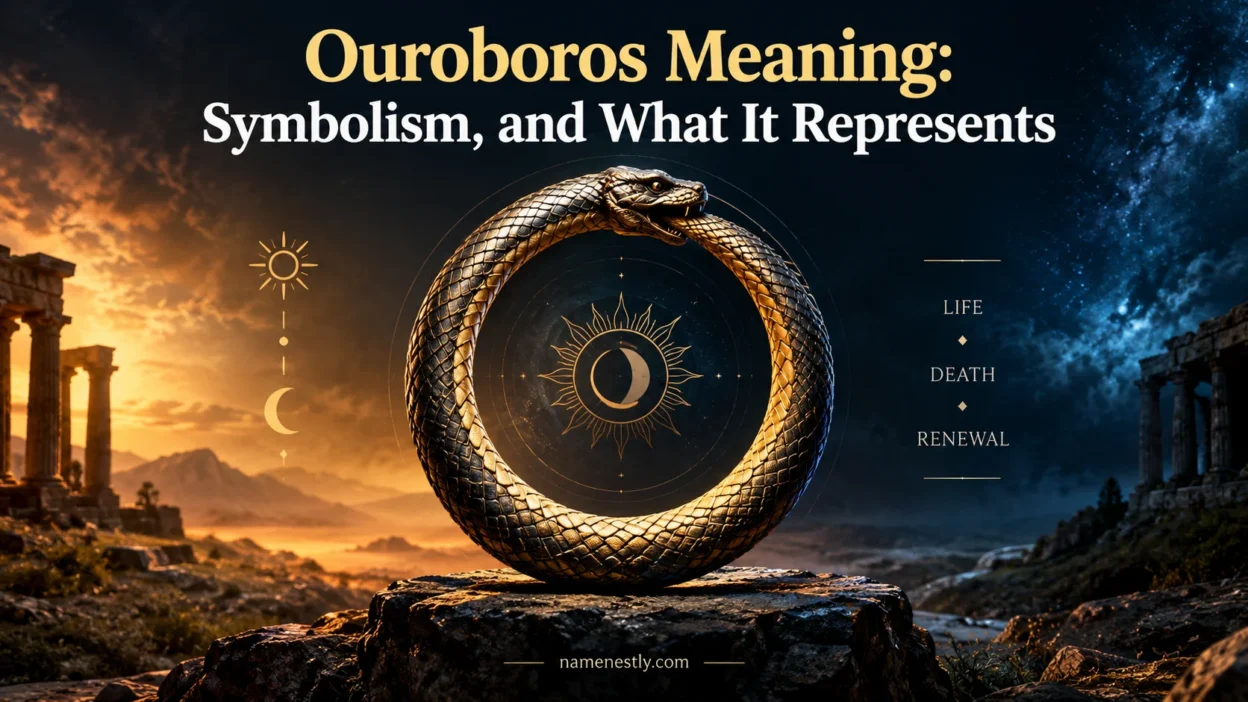
The ouroboros meaning centers on cycles, renewal, eternity, transformation, and the relationship between beginnings and endings. The symbol shows a serpent or dragon forming a circle by biting or swallowing its own tail. At first glance, it looks like a simple creature chasing itself. Look closer, however, and the image becomes a compact visual statement about existence itself.
The ouroboros has appeared in Egyptian, Greek, Gnostic, alchemical, philosophical, and psychological traditions. Its meaning has never been completely fixed. Different cultures and writers have used the circular serpent to express different ideas, including cosmic cycles, regeneration, unity, self-containment, and the tension between creation and destruction.
Today, people often encounter the ouroboros in tattoos, jewelry, fantasy art, literature, games, and spiritual symbolism. Modern uses sometimes simplify its historical meanings. Understanding its history makes the symbol much more interesting.
Quick Answer
The ouroboros means an endless cycle in which an ending can become a new beginning. Its circular form commonly represents eternity, renewal, repetition, transformation, and wholeness. In alchemical traditions, it became strongly associated with transformation and unity. Later psychological interpretations, especially those influenced by Carl Jung, connected it with psychic development and the integration of opposing forces.
The word itself comes from Greek οὐροβόρος, commonly transliterated as ouroboros or ouróboros. It literally relates to the idea of a tail-eater.
There isn’t one universal definition. Its exact meaning depends on the historical tradition and context in which the symbol appears.
Comparison Overview
| Context | Ouroboros Meaning |
| Ancient Egyptian imagery | Cycles, renewal, cosmic order, and regeneration |
| Greek tradition | Cyclicality and philosophical symbolism |
| Gnostic traditions | Cosmic unity, eternity, and the world or soul |
| Alchemy | Transformation, unity, regeneration, and the Great Work |
| Jungian psychology | Psychic development, wholeness, and the circular nature of transformation |
| Modern spirituality | Renewal, interconnectedness, and personal transformation |
| Tattoos | Personal growth, resilience, eternity, or recurring life cycles |
| Popular culture | Mystery, immortality, cycles, power, or transformation |
The important point is that these meanings overlap without being identical. A modern tattoo interpretation shouldn’t automatically be presented as an ancient Egyptian belief.
Main Differences Between Ouroboros Meaning
The ouroboros meaning changes depending on the tradition, although several themes repeatedly appear.
| Interpretation | Core Idea | Main Context |
| Eternity | Existence continues without a visible endpoint | Religious and philosophical symbolism |
| Cycles | Events repeat or return to earlier states | Cosmology and philosophy |
| Renewal | Destruction can lead to regeneration | Spiritual and symbolic traditions |
| Transformation | One state changes into another | Alchemy and modern symbolism |
| Unity | Seemingly separate forces belong to one whole | Alchemy and philosophy |
| Self-containment | The beginning and end exist within the same structure | Symbolic and philosophical readings |
| Wholeness | Opposing elements form an integrated whole | Jungian interpretation |
These interpretations explain why the symbol remains useful across very different settings. Its shape does much of the symbolic work.
What Does Ouroboros Mean?
The simplest ouroboros meaning comes from its visual structure.
A serpent eats its own tail and forms a closed circle. There is no obvious starting point. There is also no obvious ending point. The head eventually meets the tail, while the tail becomes part of the creature itself.
That unusual structure naturally suggests continuity.
The symbol can therefore represent a process that continually feeds into itself. An ending doesn’t necessarily erase what came before. Instead, it can become the starting point for another phase.
This makes the ouroboros especially powerful as a symbol of:
- Cycles
- Renewal
- Rebirth
- Eternity
- Transformation
- Wholeness
- Self-containment
- Unity
- Life and death
- Creation and destruction
The exact emphasis depends on context.
For example, someone using an ouroboros tattoo after overcoming a difficult period might see it as a symbol of renewal. An alchemical manuscript might use the same basic image to express transformation and unity.
The History and Origin of the Ouroboros
The history of the ouroboros stretches across several intellectual and religious traditions. It wasn’t created as a modern logo with one carefully defined meaning.
Ancient Egyptian material provides some of the earliest important precedents for the imagery. Later Greek and Hellenistic traditions gave the symbol a recognizable name and helped transmit it into philosophical and esoteric literature.
One particularly important early alchemical image appears in the Chrysopoeia of Cleopatra, traditionally associated with the alchemist Cleopatra of Alexandria. The surviving manuscript tradition is later than the work’s presumed antiquity. The famous image depicts a serpent forming a circle and includes the Greek phrase “hen to pan,” meaning “the all is one.”
That phrase captures one of the symbol’s most enduring themes: apparent separation can exist within a larger unity.
The Earliest Known Ouroboros Imagery
Ancient Egyptian symbolism contains serpent imagery associated with cosmic cycles and regeneration. The Egyptian world already placed enormous symbolic importance on snakes, solar cycles, death, rebirth, and the ordered movement of the cosmos.
However, it’s important to avoid a common oversimplification.
Not every ancient Egyptian serpent image was an ouroboros.
For example, the Egyptian serpent deity Mehen has a distinctive role in Egyptian religious imagery. Mehen appears as a protective serpent associated with the solar god during the nighttime journey. That imagery relates to circular and protective concepts, but Mehen should not simply be labeled an ouroboros.
The historical record contains several serpent traditions that later readers have connected with ouroboric symbolism.
The Ouroboros in Greek Tradition
The Greek term ouroboros describes the tail-eating creature. Greek and Hellenistic intellectual traditions became important channels for the symbol’s later development.
The symbol’s circular structure fitted naturally with philosophical discussions about cycles, unity, nature, and the relationship between beginnings and endings.
Over time, writers and artists could use the image without relying on one fixed interpretation. Its flexibility became one of its greatest strengths.
The Ouroboros in Gnostic Traditions
The ouroboros also appears in texts and imagery associated with Gnostic traditions.
Some Gnostic interpretations connected the serpent with cosmic boundaries, eternity, and the relationship between the material world and spiritual realities. A famous later description presents an enormous serpent or dragon enclosing the world.
These traditions were diverse, however. Gnosticism wasn’t a single uniform religion with one standardized doctrine.
That matters when discussing the symbol. A particular Gnostic text can provide evidence for one interpretation without proving that every Gnostic group understood the ouroboros in the same way.
Ouroboros Meaning in Ancient Egypt
The Egyptian connection remains one of the most frequently discussed parts of ouroboros history.
Ancient Egyptian religious thought placed strong emphasis on renewal and recurring cosmic order. The daily journey of the sun offered an obvious symbolic model. The sun disappeared, traveled through the night, and returned again.
Serpents could also carry several meanings. They could represent danger, protection, royal authority, regeneration, or divine power depending on the deity and context.
The ouroboros fits naturally into this broader symbolic environment because its body creates a continuous boundary.
Still, historical precision matters. The modern claim that “the Egyptians invented the ouroboros and gave it one exact meaning” goes further than the evidence supports.
A better interpretation recognizes a long development of serpent and cyclical imagery.
Ouroboros Meaning in Alchemy
Alchemy gave the ouroboros some of its most influential symbolic associations.
Alchemists worked with metals, minerals, chemicals, heat, distillation, dissolution, purification, and transformation. Their writings also contained dense symbolic language that mixed practical experimentation with philosophical, religious, and cosmological ideas.
Within this environment, the ouroboros became a powerful image of transformation through cycles.
The creature consumes itself, yet the process doesn’t simply end. The circle continues.
That makes the symbol an effective representation of the alchemical idea that one substance or state can be transformed into another.
The Ouroboros as a Symbol of Transformation
Alchemy often focused on processes rather than static states.
A substance could be dissolved, purified, separated, recombined, heated, cooled, distilled, or transformed. The ouroboros captures this sense of movement within apparent repetition.
The symbolism can therefore be summarized as:
dissolution → transformation → renewal → continuation
The exact sequence varied across alchemical texts. There was no single standardized alchemical recipe represented by every ouroboros.
Read More: Autosexual Meaning: What Does Autosexual Mean?
“The One Is All” and Alchemical Symbolism
The famous ouroboros image associated with the Chrysopoeia of Cleopatra contains the phrase hen to pan, usually translated as “the all is one.”
That phrase provides a remarkably concise explanation of one major ouroboric theme.
The creature is both the eater and the eaten. It contains both the beginning and the ending. Its boundary is also its center of action.
The image therefore lends itself to ideas about unity, totality, and self-contained existence.
Ouroboros Meaning in Psychology
The ouroboros became especially important in modern psychological discussions through Carl Jung’s work on alchemy and symbolism.
Jung studied alchemical literature extensively and interpreted many alchemical images through the lens of analytical psychology. He saw alchemical symbolism as a valuable record of psychological projections and transformation.
His interpretation doesn’t mean that ancient alchemists secretly practiced modern psychology. Instead, Jung developed a psychological reading of their symbolic language.
Carl Jung and the Ouroboros
Jung treated the ouroboros as an important archetypal image associated with an early, undifferentiated psychic state.
In his broader theory, psychological development involves differentiation and integration. The individual gradually develops a more complex relationship between conscious awareness and unconscious material.
The ouroboros provides a striking image for a state in which distinctions haven’t fully separated.
The symbol is therefore connected with ideas of wholeness before differentiation and later psychological integration.
Jung’s interpretation belongs to analytical psychology. It shouldn’t be confused with an established scientific finding about the universal meaning of symbols.
Ouroboros and the Idea of Wholeness
The ouroboros doesn’t divide the serpent into separate pieces.
The head, body, and tail belong to one continuous form. That makes it an intuitive image for wholeness.
In Jungian interpretations, this becomes particularly significant because psychological growth involves bringing different parts of the personality into a more integrated relationship.
The symbol can therefore represent a movement from fragmentation toward greater internal unity.
What Does the Ouroboros Symbolize?
The symbol’s most important themes become clearer when examined separately.
Cycles and Repetition
The ouroboros is fundamentally circular.
Its shape suggests that processes can return to earlier points rather than moving only in a straight line. Seasons change and return. Day follows night. Life produces new life. Many natural processes operate through recurring patterns.
The ouroboros turns this recurring structure into a single image.
Death and Rebirth
The serpent’s self-consumption creates an obvious connection between destruction and renewal.
The symbol doesn’t necessarily mean literal resurrection. Instead, it often expresses a broader idea: one stage can end while another begins.
That makes the ouroboros meaningful during major transitions.
A person leaving an old career, rebuilding after hardship, or entering a new stage of life might use the symbol to represent that transition.
Eternity and Infinity
The closed circle naturally suggests endlessness.
However, eternity and infinity aren’t exactly the same concept.
Infinity describes something without an endpoint or limit. Eternity commonly refers to existence without temporal beginning or end. Cyclicality describes repeated movement through stages.
The ouroboros can suggest all three, but its strongest visual idea is usually cyclical continuity.
Transformation and Personal Growth
Modern interpretations often use the ouroboros to represent personal transformation.
The symbol works particularly well because growth rarely happens as a straight line. People often revisit old problems with greater understanding. Lessons return in new forms. Previous identities may give way to new ones.
In that sense, the ouroboros can symbolize change that contains traces of what came before.
Unity of Opposites
The ouroboros brings opposing ideas into one image:
- Beginning and ending
- Creation and destruction
- Life and death
- Consumption and creation
- Individuality and totality
- Movement and stillness
The point isn’t necessarily that these opposites become identical. Rather, the symbol suggests that they can belong to one larger process.
Ouroboros Meaning in Different Cultures and Traditions
The symbol’s history crosses cultural boundaries, but its meanings shouldn’t be flattened into one universal definition.
| Tradition | Important Associations |
| Ancient Egyptian context | Renewal, cosmic cycles, serpentine power |
| Hellenistic Greek context | Cycles, unity, philosophical symbolism |
| Gnostic traditions | Eternity, cosmic enclosure, spiritual symbolism |
| Alchemy | Transformation, unity, regeneration |
| Jungian psychology | Wholeness, psychic development, integration |
| Modern symbolism | Personal transformation, resilience, continuity |
This comparison shows why the ouroboros remains difficult to define with one sentence.
Its form stays recognizable while its interpretation changes.
Ouroboros Meaning in Spirituality
Modern spiritual communities often use the ouroboros to represent interconnectedness.
The image can suggest that life doesn’t move through isolated events. Instead, experiences connect with one another. Endings create conditions for new beginnings.
Some people also interpret the ouroboros as a reminder that destruction isn’t always purely negative. Sometimes an old structure must disappear before a new one can develop.
That interpretation appears frequently in contemporary spiritual and personal-growth contexts.
It shouldn’t automatically be attributed to every ancient religious tradition.
Ouroboros Meaning in Mythology
Serpents appear in mythologies around the world, but the ouroboros is more specific than general serpent symbolism.
Snakes can symbolize wisdom, danger, fertility, protection, death, healing, or transformation depending on the tradition.
The ouroboros adds one distinctive feature: self-consumption in a closed cycle.
That feature shifts the symbolism toward recurrence and continuity.
This is why comparisons with other mythological serpents can be useful, but they shouldn’t erase cultural differences.
Ouroboros Meaning in Different Contexts
The symbol takes on additional meanings when people use it personally.
FAQs:
What does the ouroboros symbolize?
The ouroboros commonly symbolizes cycles, renewal, eternity, transformation, and wholeness. Its circular structure makes beginning and ending appear connected.
Is the ouroboros a symbol of eternity?
Yes, eternity is one established interpretation of the ouroboros. Its closed circular form suggests continuity without a visible endpoint. However, cyclicality and renewal are often just as important as endless existence.
What does the ouroboros mean spiritually?
In modern spiritual contexts, the ouroboros often represents interconnectedness, renewal, transformation, and recurring stages of existence. Different traditions interpret it differently.
What does an ouroboros tattoo mean?
An ouroboros tattoo can represent personal transformation, resilience, renewal, eternity, or life’s recurring cycles. The meaning usually depends on the person and accompanying artwork.
Is the ouroboros Egyptian or Greek?
The answer requires historical nuance. Ancient Egyptian imagery contains important early serpent-cycle motifs, while the word ouroboros is Greek. The recognizable symbol developed through multiple historical traditions rather than belonging exclusively to one culture.
Conclusion:
The ouroboros meaning is powerful because the symbol says a great deal without using many elements. A serpent bites its own tail, forms a circle, and turns an apparent contradiction into a visual cycle.
Across different traditions, it has been connected with eternity, renewal, transformation, unity, regeneration, and wholeness. Alchemists gave the image particularly strong associations with transformation and totality. Later thinkers, including Carl Jung, developed psychological interpretations that connected the symbol with psychic development and integration.