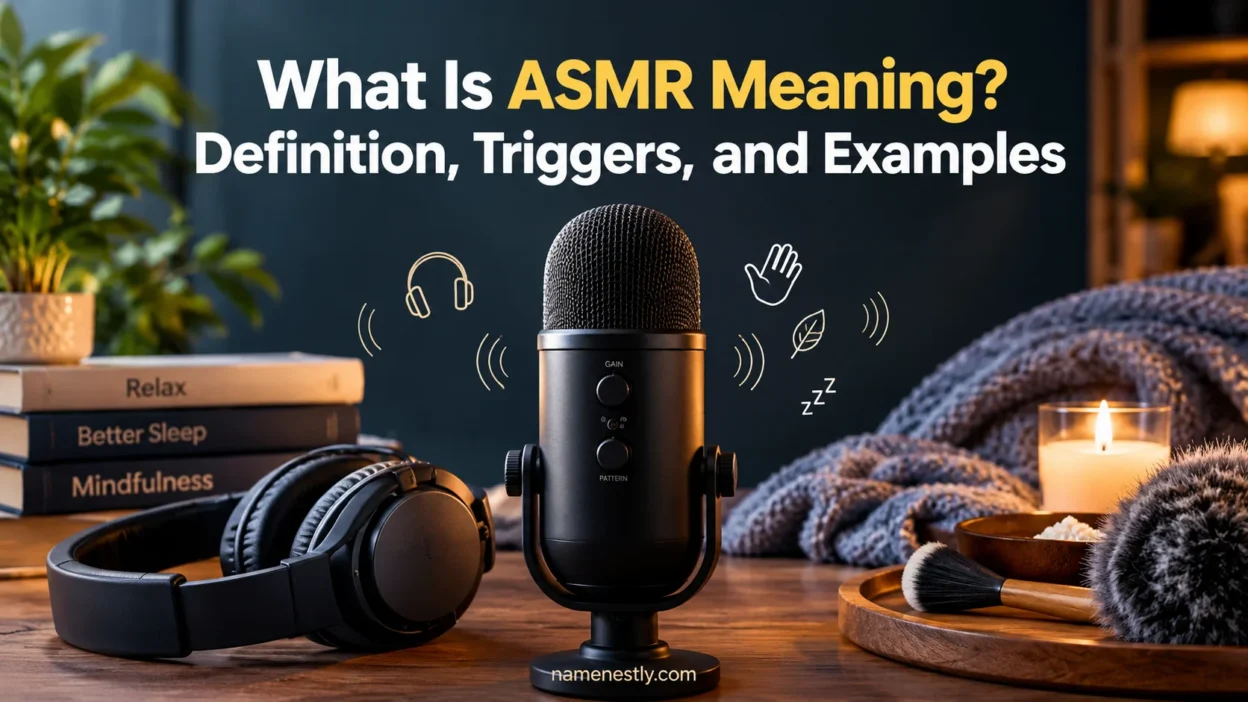
Have you ever heard a soft whisper, gentle tapping, or slow page-turning and suddenly felt a pleasant tingle? That unusual sensation has a name: ASMR.
The term ASMR stands for Autonomous Sensory Meridian Response. It describes a pleasant sensory experience that some people feel after specific sounds, visuals, movements, or forms of personal attention. The sensation often begins around the scalp and can spread toward the neck, shoulders, or back.
For some people, ASMR feels deeply calming. Others describe a warm, fuzzy, or tingling sensation that helps them relax before sleep. Meanwhile, some people don’t experience ASMR at all.
ASMR has also become a major part of internet culture. Millions of people watch videos featuring whispering, tapping, brushing, role-play, eating sounds, and other carefully produced triggers. Scientific research has started examining why these experiences affect some people so strongly.
Quick Answer
ASMR means Autonomous Sensory Meridian Response. It refers to a pleasant tingling or calming sensation that some people experience in response to particular audio, visual, or personal-attention triggers.
Common ASMR triggers include:
- Whispering
- Soft speaking
- Tapping
- Scratching
- Page turning
- Hair brushing
- Gentle hand movements
- Personal-attention role-play
- Repetitive sounds
- Quiet object handling
The sensation commonly starts around the head or scalp. It may then move toward the neck, shoulders, or upper back.
ASMR isn’t something everyone experiences. Research has found that people who identify as ASMR experiencers can show measurable physiological changes while watching ASMR content. One laboratory study involving 112 volunteers found that ASMR experiencers showed reduced heart rate and increased skin conductance while watching ASMR videos.
Comparison Overview
ASMR can sound similar to several other experiences, especially chills and ordinary relaxation. However, these experiences aren’t identical.
| Experience | Typical Description | Common Trigger | Main Characteristic |
| ASMR | Pleasant tingling and calmness | Whispering, tapping, personal attention | Often begins around the scalp |
| Musical chills | Shivers or goosebumps | Powerful music or emotional moments | Often connected with excitement |
| Relaxation | Reduced tension and calmness | Rest, meditation, quiet surroundings | Doesn’t necessarily involve tingling |
| Frisson | Strong emotional shiver response | Music, art, emotional events | Often produces goosebumps |
| Ordinary sensory pleasure | Enjoyment from a sound, sight, or touch | Many different stimuli | Doesn’t require a distinct tingling response |
One important distinction is that ASMR often combines calmness with physiological arousal. Research has found reduced heart rate alongside increased skin conductance in ASMR experiencers. That combination makes ASMR more complex than simple relaxation.
Main Differences Between What Is ASMR Meaning
The phrase “what is ASMR meaning” usually points to one basic question: What does ASMR actually describe?
The answer becomes clearer when you separate three related ideas: ASMR itself, ASMR triggers, and ASMR content.
ASMR is the sensory experience.
An ASMR trigger is something that can produce that experience.
An ASMR video is content designed to create or encourage those sensations.
For example, whispering isn’t ASMR by itself. Whispering becomes an ASMR trigger when it produces the characteristic response in someone who experiences ASMR.
This distinction matters because people often use the word “ASMR” to describe both the sensation and the videos associated with it.
What Does ASMR Stand For?
ASMR stands for Autonomous Sensory Meridian Response.
Each word contributes something to the full term:
| Word | Meaning in the ASMR Term |
| Autonomous | The response can happen without deliberate control |
| Sensory | The experience involves sensory perception |
| Meridian | Used in the coined term to suggest a peak or high point |
| Response | The sensation occurs as a reaction to a trigger |
The phrase sounds highly scientific. However, ASMR isn’t a formal medical diagnosis or recognized disease.
The name emerged from online communities trying to describe an experience that lacked a widely accepted term. Jennifer Allen coined the term Autonomous Sensory Meridian Response in 2010. Academic interest followed later, with early peer-reviewed research appearing in 2015.
What Does ASMR Feel Like?
ASMR can feel different from person to person. Still, many experiencers describe a recognizable pattern.
The sensation often starts as a light tingling around the scalp. It may then travel down the neck and upper spine. Some people experience the sensation more strongly around their shoulders or arms.
Alongside tingling, people commonly describe:
- Deep relaxation
- Pleasant warmth
- Sleepiness
- Calmness
- Reduced mental tension
- A feeling of comfort
- Gentle waves of tingling
- Increased focus on the immediate sensory experience
Not every person experiences every sensation.
Some people mainly notice tingles. Others experience relaxation without obvious tingling. Research also suggests that ASMR can involve both calming and activating elements rather than being purely sedating.
How Does ASMR Work?
Researchers still don’t have a complete explanation for how ASMR works.
The strongest evidence suggests that ASMR involves a combination of sensory processing, attention, emotional response, and social perception.
Specific sounds or movements may capture attention while creating a feeling of safety or personal connection. That combination could help explain why seemingly ordinary actions become powerful triggers.
For example, someone brushing hair in a slow and careful manner might produce no reaction in one person. Another person could experience immediate tingles from the same movement.
This difference is important. The trigger doesn’t automatically produce ASMR. The person’s response matters.
Research also shows that personal preference can influence the relaxation effect. A 2023 study examining preferred ASMR videos found that individual preferences played an important role in the experience.
What Triggers ASMR?
ASMR triggers are the sounds, movements, situations, or interactions that can produce an ASMR response.
Triggers vary considerably. One person’s perfect trigger might irritate someone else.
Common ASMR Sound Triggers
Sound remains one of the biggest parts of ASMR content.
Popular examples include:
- Whispering
- Soft speaking
- Tapping
- Scratching
- Page turning
- Paper crinkling
- Keyboard typing
- Pen clicking
- Brushing
- Gentle mouth sounds
- Quiet object handling
- Repetitive mechanical sounds
The appeal often comes from repetition and predictability. A steady tapping pattern can create a surprisingly immersive sensory experience.
Visual ASMR Triggers
ASMR doesn’t always depend on sound.
Some people respond to visual movements such as:
- Slow hand movements
- Folding objects
- Drawing
- Painting
- Writing
- Sorting items
- Carefully examining objects
- Repetitive hand gestures
- Watching someone perform a detailed task
Visual triggers can become especially effective when paired with quiet sounds.
Personal Attention Triggers
Personal attention represents another major ASMR category.
Common examples include:
- Haircuts
- Hair brushing
- Makeup application
- Skincare demonstrations
- Eye examinations
- Medical role-play
- Spa scenarios
- Quiet one-on-one conversations
- Careful face or head movements
These scenarios can simulate close interpersonal attention. Research has suggested that simulated interaction with the viewer may contribute to why certain ASMR videos work for responders.
Why Do People Watch ASMR Videos?
People watch ASMR content for different reasons.
For many viewers, relaxation sits at the center of the experience. Others specifically seek ASMR when preparing for sleep.
Common reasons include:
- Relaxing after a stressful day
- Preparing for bedtime
- Creating a quiet environment
- Enjoying tingling sensations
- Reducing everyday tension
- Passing time
- Focusing on repetitive sounds
- Exploring different sensory experiences
The experience can be surprisingly personal. Someone may enjoy tapping while finding whispering annoying. Another person may prefer role-play videos and dislike repetitive object sounds.
There isn’t one universal ASMR formula.
ASMR for Sleep
ASMR has become especially popular as a bedtime activity.
People often choose soft-spoken or whispering videos because the slow pace can create a calming environment. Repetitive sounds may also give the mind something predictable to focus on.
Some research supports an association between ASMR and improved relaxation or mood. A large 2021 study involving 1,037 adults examined responses to ASMR videos across groups with insomnia and depression symptoms. Participants generally reported increased relaxation and improved mood after watching the video, with stronger effects among people who experienced ASMR.
However, ASMR shouldn’t be treated as a guaranteed treatment for insomnia.
A relaxing video may help one person wind down while doing little for another. Sleep problems can have many causes, and ASMR research remains relatively young.
Is ASMR Good for You?
Research suggests that ASMR can produce short-term relaxation and positive emotional effects in people who experience it.
That doesn’t mean ASMR works as a medical treatment for everyone.
A 2018 PLOS ONE study found that ASMR videos produced pleasant affect and tingling among ASMR experiencers. The laboratory portion also found a measurable reduction in heart rate alongside an increase in skin conductance.
These findings are interesting because they show that ASMR isn’t necessarily just an imagined sensation.
Still, researchers continue investigating the longer-term effects.
Potentially Reported Effects of ASMR
Studies and participant reports have associated ASMR with:
- Relaxation
- Positive mood
- Temporary stress reduction
- Feelings of calmness
- Sleep-related relaxation
- Pleasant tingling
- A sense of interpersonal connection
These effects shouldn’t be presented as guaranteed health benefits. Individual responses vary, and ASMR research hasn’t established it as a replacement for professional treatment.
Read More: Ouroboros Meaning: Symbolism, and What It Represents
What Does Science Say About ASMR?
Scientific research into ASMR is relatively recent.
Before researchers began studying it, most information came from online communities and personal reports. Scientists first had to determine whether ASMR represented a consistent experience that could be studied experimentally.
Research now provides evidence that ASMR can involve measurable physiological changes.
One notable 2018 study included 112 volunteers, split between 56 ASMR experiencers and 56 non-ASMR controls. Researchers measured heart rate and skin conductance while participants watched ASMR and control videos.
Among ASMR participants, the researchers observed an average heart-rate reduction of about 3.41 beats per minute during ASMR videos. They also observed increased skin conductance.
That result doesn’t prove that ASMR treats a medical condition. Instead, it provides evidence that the experience corresponds with measurable physiological changes.
Another study involving 91 participants investigated pupil responses during ASMR. It found no significant group differences in average pupil diameter, showing that not every proposed physiological marker produces a clear ASMR signature.
That distinction matters. Good science doesn’t require every experiment to produce the same result.
ASMR vs. Chills: What’s the Difference?
ASMR and chills can feel similar, but they aren’t necessarily the same phenomenon.
Music-induced chills, sometimes called frisson, often occur during emotionally powerful music or dramatic experiences. They may involve goosebumps, shivering, excitement, or a sudden emotional surge.
ASMR usually has a different trigger pattern.
Whispering, tapping, gentle movements, and simulated personal attention are much more typical ASMR triggers.
Physiological research also points toward differences. ASMR has been associated with reduced heart rate alongside increased skin conductance. Musical chills, by contrast, have commonly been associated with increased heart rate.
Simple Example
Imagine hearing your favorite song during an emotional chorus.
You suddenly get goosebumps.
That’s closer to musical chills.
Now imagine someone quietly whispering while turning book pages beside you. You feel a pleasant scalp tingle and become deeply relaxed.
That’s more characteristic of ASMR.
ASMR vs. ASMRtist
An ASMRtist is a person who creates ASMR content.
The term combines “ASMR” with “artist.” ASMRtists commonly produce videos designed around specific triggers.
Their content can include:
- Whispering
- Role-play
- Tapping
- Personal attention
- Eating sounds
- Object manipulation
- Hair brushing
- No-talking videos
- Sleep-focused sessions
Creators often build entire channels around particular trigger categories.
Some focus on realistic role-play. Others specialize in sound-focused recordings. The quality of microphones and recording techniques also matters because tiny sounds can become central to the experience.
What Are the Most Popular Types of ASMR?
ASMR content covers a surprisingly wide range of formats.
| ASMR Type | Typical Content | Why People May Enjoy It |
| Whispering | Quiet spoken words | Soft auditory stimulation |
| Tapping | Tapping objects with fingers | Repetitive rhythmic sounds |
| Role-play | Simulated personal attention | Feeling of interpersonal interaction |
| No-talking ASMR | Sounds without speech | Minimal verbal stimulation |
| Hair brushing | Brushing or grooming sounds | Gentle repetitive sensory input |
| Eating ASMR | Food-related sounds | Detailed close-up audio |
| Object sounds | Handling everyday items | Texture and repetition |
| Sleep ASMR | Slow sounds and soft voices | Bedtime relaxation |
| Visual ASMR | Slow hand movements | Repetitive visual stimulation |
There is no single “correct” form of ASMR.
The best trigger depends entirely on the individual response.
Is ASMR the Same as ASMR Videos?
No.
This distinction is one of the easiest ways to understand the ASMR meaning.
ASMR is the experience.
ASMR videos are content designed to encourage that experience.
Someone can experience ASMR without watching an online video.
For example, a quiet haircut might trigger ASMR naturally. A person could also experience tingles while listening to someone whisper in real life.
Videos simply make these triggers easier to reproduce and access.
Common Misconceptions About ASMR
ASMR has developed a few misconceptions because the phenomenon is relatively unusual.
ASMR Is Just Whispering
Whispering is one popular trigger. It isn’t the definition of ASMR.
Tapping, brushing, hand movements, role-play, and other experiences can also trigger ASMR.
Everyone Gets ASMR Tingling
Not everyone experiences ASMR.
Some people respond strongly to certain triggers. Others feel nothing. Some people simply dislike the sounds.
That variation is normal.
ASMR Is Only for Sleep
Sleep is one common reason people watch ASMR.
However, people also use it for relaxation, sensory enjoyment, mood improvement, and quiet background stimulation.
FAQs:
What does ASMR stand for?
ASMR stands for Autonomous Sensory Meridian Response. It describes a pleasant sensory response that some people experience after specific sounds, visuals, or forms of personal attention.
What does ASMR mean?
ASMR refers to a calming or tingling sensory experience. It commonly begins around the scalp and can spread toward the neck, shoulders, or back.
What does ASMR feel like?
People commonly describe ASMR as tingling, warmth, relaxation, calmness, or sleepiness. The exact sensation varies from person to person.
Why does ASMR make me tingle?
Certain sensory or social triggers may activate a response involving attention, emotional processing, and sensory perception. Researchers are still working to explain the precise mechanisms behind the tingling.
Is ASMR good for sleep?
ASMR may help some people relax before bedtime. Research has found improved relaxation and mood after ASMR exposure, particularly among people who experience ASMR. However, it shouldn’t be considered a guaranteed treatment for insomnia.
Conclusion:
The simplest ASMR meaning is a pleasant sensory response triggered by particular sounds, sights, movements, or forms of personal attention. ASMR isn’t simply whispering. It isn’t automatically about sleep. It also isn’t something everyone experiences.
For people who do experience it, the sensation can involve tingling, calmness, warmth, relaxation, and sometimes sleepiness. Scientific studies have found measurable physiological changes during ASMR, including reduced heart rate and increased skin conductance among identified ASMR experiencers.