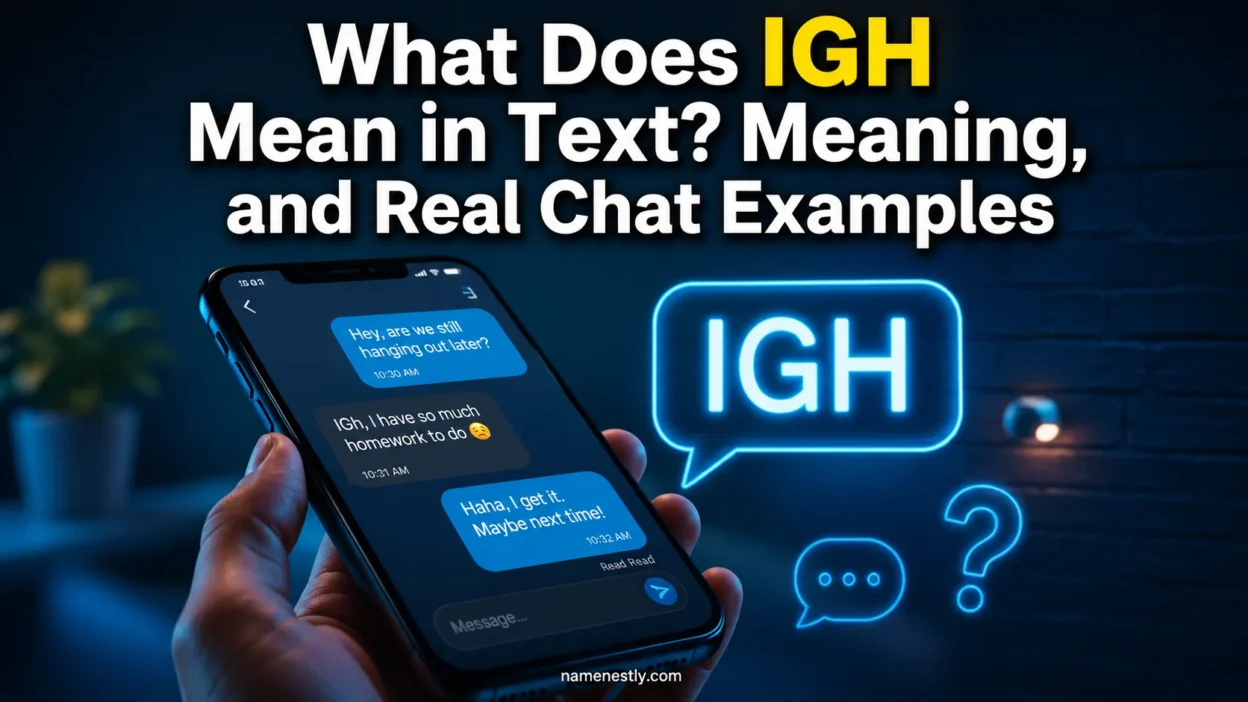
When you receive an unfamiliar abbreviation in a text message, figuring out its meaning can feel confusing. IGH is one of those short expressions that may leave you wondering what someone actually means.
You might see it in a Snapchat conversation, an Instagram comment, or a casual message from a friend. However, understanding IGH requires looking at the surrounding conversation rather than assuming it always carries one meaning.
In this guide, you’ll learn what IGH means in text, how people use it, how it differs from similar slang expressions, and how to respond when someone sends it. You’ll also see practical examples that make its meaning easier to understand.
Quick Answer:
IGH doesn’t have one universally established meaning in texting. It may appear as an informal spelling, typo, personal abbreviation, or context-specific expression. Some people may intend “ight,” a casual slang form of “alright,” but IGH itself isn’t a standard, widely recognized equivalent.
For example:
- Person A: Are we still meeting tonight?
- Person B: Igh, see you there.
In this example, the sender may intend “ight” or “alright.” However, you shouldn’t assume that interpretation applies to every message containing IGH.
The surrounding words, conversation, and sender’s usual texting habits help reveal the intended meaning.
Comparison Overview
IGH is an informal texting expression associated with “alright” or “okay.” It belongs to the same family of shortened spellings as “aight” and “ight.” People generally use it to acknowledge messages, accept suggestions, or respond to everyday plans.
However, its tone can change depending on the situation. A friendly conversation may make IGH sound relaxed and agreeable. During an argument, the same short reply might suggest frustration or reluctance.
| Text Expression | Meaning | Common Usage |
| IGH | Alright or okay | Casual texting |
| IGHT | Alright or okay | Informal conversations |
| Aight | Alright | Slang and spoken-style texting |
| Alright | Okay or acceptable | Everyday communication |
| OK | Agreement or acknowledgment | Casual and professional messages |
| Bet | Sure or agreed | Informal conversations |
| K | Okay | Very short replies |
The main difference involves spelling, tone, and familiarity. IGH is less standardized than ordinary words such as “okay” and “alright.”
Main Differences Between What Does IGH Mean in Text
Understanding IGH becomes easier when you compare it with other expressions people use in digital conversations. Although several slang terms communicate agreement, they don’t always carry identical emotional tones.
Here are the main differences worth knowing.
IGH vs. IGHT
IGH and IGHT are closely related informal spellings. Both can communicate “alright” or “okay” in casual conversations.
The main difference is their spelling. IGHT includes the final letter T while IGH leaves it out.
For example:
- IGH: “Igh, I’ll call you later.”
- IGHT: “Ight, I’ll call you later.”
Both messages communicate acceptance or acknowledgment. The sender’s personal texting habits usually determine which spelling they prefer.
IGH vs. Aight
Aight is a familiar informal spelling of “alright.” It appears in casual speech, music, entertainment, and everyday digital conversations.
IGH is a more compressed spelling associated with the same expression.
For example:
- Aight: “Aight, let’s get going.”
- IGH: “Igh, let’s go.”
Both can express agreement. However, aight is more recognizable to many English speakers.
IGH vs. Alright
Alright is a conventional English expression that people use in everyday communication. It can indicate agreement, acceptance, or that something is satisfactory.
IGH is much more informal.
Consider these examples:
- Alright: “Alright, I’ll finish the assignment tonight.”
- IGH: “Igh, I’ll finish it tonight.”
The first version works in a wider range of situations. The second belongs primarily in casual conversations.
IGH vs. OK
OK is one of the most widely recognized ways to acknowledge information or agree with someone.
IGH carries a similar basic meaning but has a more slang-oriented spelling.
For example:
- OK: “Okay, I’ll see you tomorrow.”
- IGH: “Igh, see you tomorrow.”
You can use OK in professional messages and everyday conversations. IGH is better suited to relaxed chats.
IGH vs. Bet
Bet is another popular expression in informal texting. People often use it to communicate agreement, confidence, or willingness to follow through.
However, bet can sound more enthusiastic or assertive than IGH.
For example:
- Person A: “Let’s play basketball after school.”
- Person B: “Bet!”
Here, bet communicates enthusiasm and agreement.
Now consider:
- Person A: “Let’s play basketball after school.”
- Person B: “Igh.”
The second response sounds more neutral or relaxed. The difference depends on the sender’s usual communication style.
What Does IGH Stand For?
Unlike traditional abbreviations such as LOL, BRB, and IDK, IGH generally doesn’t represent a phrase formed from separate initial letters.
Instead, it works as an informal shortened spelling associated with “alright.”
This distinction matters because people sometimes assume every combination of capital letters must have a separate full form.
For example:
- LOL means “laughing out loud.”
- BRB means “be right back.”
- IDK means “I don’t know.”
- IGH is commonly used as a shortened form related to “alright.”
Therefore, when someone asks what IGH stands for, the most useful explanation is that it represents a casual spelling rather than a conventional initialism.
Is IGH an Acronym or an Abbreviation?
IGH is better described as an informal shortened spelling than a traditional acronym.
An acronym uses initial letters to create a new word or expression. NASA is a familiar example.
An abbreviation shortens an existing word or phrase. IGH fits the informal shortened-spelling category more closely.
This also explains why you shouldn’t automatically assign a separate word to every letter.
How Is IGH Used in Text Messages?
People use IGH in different conversational situations. Its most common role is to provide a quick acknowledgment without writing a complete sentence.
The following examples show how the expression works in everyday messaging.
IGH for Agreement
One common use involves agreeing with another person’s suggestion.
Suppose your friend suggests meeting after school. You might reply with IGH to show that the plan works for you.
Example conversation:
Alex: Want to grab something to eat after class?
Sam: Igh, sounds good.
Here, Sam accepts the suggestion without making the conversation unnecessarily long.
IGH to Confirm Plans
IGH can also acknowledge arrangements involving time, location, or activities.
For instance:
Mia: We’re leaving at 8 tomorrow morning.
Jake: IGH, I’ll be ready.
In this example, Jake confirms that he understands the arrangement.
The expression works because both people already understand what they’re discussing.
IGH as a Quick Reply
Sometimes people don’t need a detailed response. A short acknowledgment keeps the conversation moving.
For example:
Friend: Send me the pictures when you get home.
You: Igh.
The reply communicates understanding. It doesn’t necessarily suggest excitement or a strong emotional reaction.
IGH When Accepting Instructions
People may use IGH after receiving simple instructions or reminders.
Consider this conversation:
Mom: Don’t forget to lock the door.
You: Igh, I won’t forget.
Here, IGH communicates acknowledgment and acceptance.
IGH in Group Chats
Group conversations often move quickly because several people contribute messages simultaneously.
Short expressions help participants respond without interrupting the discussion.
For example:
Ryan: Everyone should join the game at 9.
Chris: Igh.
Daniel: Bet, I’ll be there.
Chris acknowledges the plan while Daniel responds with a more enthusiastic agreement.
IGH When Someone Gives You Information
IGH can acknowledge information without requiring another question or explanation.
For example:
Friend: The restaurant closes at 10 tonight.
You: Igh, thanks for letting me know.
The response indicates that you’ve received the information.
IGH Meaning on Different Social Media Platforms
IGH doesn’t have a separate official definition for every social media platform. Its basic slang meaning generally stays consistent across messaging services.
However, the setting can influence how people interpret the expression.
IGH Meaning on Snapchat
On Snapchat people use short expressions in direct messages, snaps, and group conversations.
IGH may appear when someone accepts an invitation, acknowledges a message, or responds to a suggestion.
Example:
Friend: You coming over tonight?
You: Igh, give me 20 minutes.
Here, IGH means “alright” or “okay.”
You shouldn’t assume that the expression has a special Snapchat-only meaning. It generally follows the same informal usage found elsewhere.
IGH Meaning on Instagram
Instagram agrega respuestas a MD desde Inicio, mensajes silenciosos y más – Qore
On Instagram IGH may appear in direct messages, story replies, and comments.
People often use abbreviated expressions when responding quickly to friends or followers.
Example:
Person A: Check out my latest post.
Person B: Igh, I’ll check it out.
The sender acknowledges the request and indicates willingness to follow through.
IGH Meaning on TikTok
Is TikTok Brain Rot Real? The Percentage of Affected Users
On TikTok users communicate through comments, private messages, and live chat.
IGH may appear as a casual acknowledgment or response to someone’s suggestion.
Example:
User A: We should try this challenge together.
User B: Igh 😂
The response suggests agreement in a relaxed setting.
Remember that comments often lack the context available in private conversations. A short expression can therefore be harder to interpret.
IGH Meaning on WhatsApp
Seniorenhandys mit WhatsApp Unterstützung im Test 2025
On WhatsApp people use shortened expressions in individual messages and group chats.
IGH can serve as a quick reply when someone shares information or makes plans.
Example:
Friend: I’ll pick you up at 7.
You: Igh, see you then.
The meaning is straightforward: “Alright, see you then.”
IGH Meaning in Regular Text Messages
IGH isn’t limited to social media applications. You may also encounter it through ordinary SMS conversations.
For example:
Person A: I’ll send you the address later.
Person B: Igh, thanks.
The sender uses IGH to acknowledge the message.
Across these platforms, the surrounding conversation matters more than the application itself.
Read More: ONB Meaning in Text: What Does ONB Mean in Texting?
What Does IGH Mean From a Guy or Girl?
IGH generally carries the same basic meaning regardless of who sends it. A guy or girl may use it to say “alright,” “okay,” or “fine.”
However, the emotional tone can depend on the relationship and situation.
When a Guy Texts IGH
A guy might send IGH after accepting a plan, acknowledging information, or responding to a casual suggestion.
For example:
You: Are we still going to the movies?
Him: Igh, what time?
This response suggests that he’s accepting the plan.
A single IGH doesn’t establish whether he’s interested, annoyed, excited, or uninterested. Look at the rest of the conversation before drawing conclusions.
When a Girl Texts IGH
A girl may use IGH in the same way during casual conversations.
For example:
You: I’ll message you when I reach home.
Her: Igh, take care.
Here, the expression simply acknowledges your message.
The sender’s gender doesn’t create a different slang definition. Personal texting habits and conversational context matter more.
What Does IGH Mean in Different Situations?
Although IGH usually communicates agreement or acknowledgment, its tone can shift with the conversation. Understanding these differences helps you avoid misreading someone’s intention.
IGH as a Friendly Response
When someone sends IGH during a relaxed conversation, they’re often agreeing without adding unnecessary words.
Example:
Friend: Let’s get pizza after work.
You: Igh, I’m hungry anyway.
The response sounds casual and friendly. The sender accepts the suggestion and adds a little personality.
IGH as a Neutral Response
Sometimes IGH simply acknowledges information without expressing strong feelings.
Example:
Person A: Your appointment is at 3 PM.
Person B: Igh, thanks.
There’s no obvious excitement or frustration here. The sender simply confirms receiving the information.
IGH as a Reluctant Response
In certain situations, IGH can suggest that someone accepts something without feeling particularly enthusiastic.
Example:
Person A: We have to wake up at 5 AM tomorrow.
Person B: Igh…
The response may suggest disappointment or reluctance. However, the sender could simply be tired or busy.
IGH During an Argument
A short reply during a disagreement can sometimes feel dismissive.
Example:
Person A: You never listen when I’m explaining something.
Person B: Igh.
Here, the response may sound impatient or uninterested. However, one message alone cannot confirm the sender’s emotions.
IGH When Ending a Conversation
People sometimes use brief acknowledgments when they have nothing else to add.
Example:
Friend: I’ll talk to you tomorrow.
You: Igh, goodnight.
The expression helps close the conversation naturally.
How to Respond When Someone Texts IGH
Your response should depend on what the other person means. Since IGH usually communicates acknowledgment or agreement, you don’t need to overthink every occurrence.
Here are some natural ways to reply.
When Someone Agrees With Your Plan
If someone accepts your invitation, continue the conversation or confirm the details.
Example:
You: Want to meet at the coffee shop?
Them: Igh.
You: Cool, I’ll see you at 6.
Other suitable replies include:
- Sounds good!
- See you there.
- Perfect, let’s do it.
- Bet, I’ll be ready.
- Cool, talk soon.
When Someone Acknowledges Your Message
If someone uses IGH after receiving information, a simple response usually works.
Example:
You: I’ll send you the details tonight.
Them: Igh.
You: Thanks!
You can also respond with:
- No problem.
- Got you.
- Appreciate it.
- Okay, talk later.
When Someone Sounds Uninterested
If IGH appears during an emotional or serious conversation, consider the surrounding messages.
For example:
You: Are you upset about what happened yesterday?
Them: Igh.
This response doesn’t clearly answer your question. Rather than guessing, ask something direct.
You could say:
- Everything okay?
- Did something bother you?
- Are you sure you’re fine?
- Want to talk about it?
A calm follow-up usually works better than assuming the worst.
FAQs:
What does IGH mean in text messages?
IGH usually means “alright” or “okay” in text messages. People use it as a shortened informal response when agreeing with someone, accepting a suggestion, or acknowledging information.
Does IGH mean alright or I guess?
IGH is commonly associated with “alright” rather than “I guess.” Its connection to informal spellings such as aight and ight makes “alright” the more established interpretation.
What does IGH mean from a guy?
When a guy texts IGH, he generally means “okay,” “alright,” or “fine.” He might be accepting your suggestion, confirming plans, or acknowledging something you said. The expression alone doesn’t reveal his feelings or intentions.
What does IGH mean from a girl?
A girl may use IGH to communicate agreement or acknowledgment in casual conversations. Its meaning doesn’t change based on gender. The surrounding messages help you understand her intended tone.
Is IGH the same as IGHT?
IGH and IGHT are closely related informal spellings associated with “alright.” Both can communicate agreement or acknowledgment. The main difference is their spelling and individual texting preferences.
Conclusion:
Understanding what IGH means in text doesn’t have to be complicated. The expression is commonly associated with “alright,” “okay,” or “fine” in informal digital conversations. People use it to accept invitations, confirm plans, acknowledge information, and keep everyday chats moving. You’ll likely encounter it in Snapchat messages, Instagram DMs, TikTok conversations, WhatsApp groups, and regular text messages.