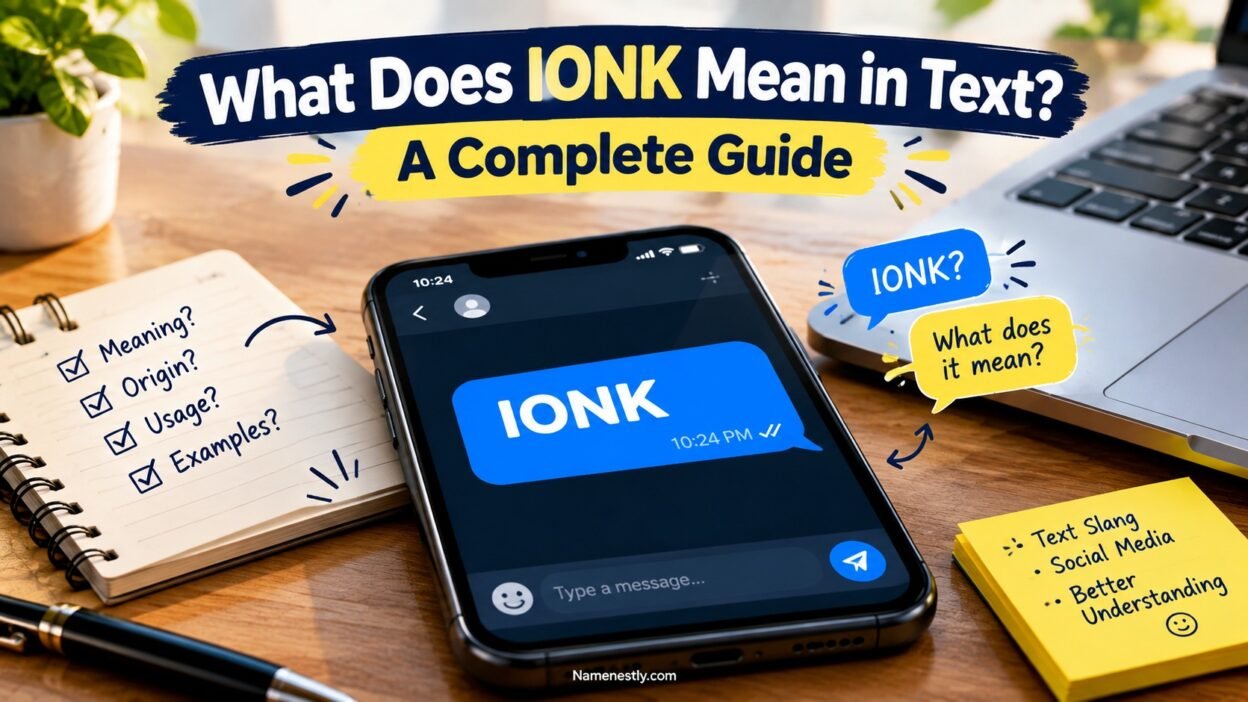
If someone sends you “IONK” in a text, the meaning can look confusing at first. It resembles several common texting shortcuts, yet the abbreviation isn’t as familiar as IDK, IDC, or TBH.
In casual online conversations, IONK generally means “I don’t know.” People use it as a shortened texting expression when they want to say they don’t have an answer or aren’t sure about something. It belongs to the informal style of internet slang where people shorten phrases to type faster.
You may see IONK in text messages, chats, comments, or private messages. Its meaning usually becomes obvious when you read the surrounding sentence. For example, someone might write, “IONK what happened”, which means “I don’t know what happened.”
Quick Answer
IONK usually means “I don’t know” in text and online conversations.
People use it when they don’t know something, aren’t certain about an answer, or want to respond casually without typing the full phrase.
For example:
“IONK where she went.”
This means:
“I don’t know where she went.”
IONK works best in casual conversations with friends, family members, or people who already understand texting slang. It isn’t a good choice for professional emails, formal documents, applications, or business communication.
One important point stands out: IONK isn’t as universally recognized as IDK. If the recipient doesn’t know the abbreviation, writing “I don’t know” will prevent confusion.
Comparison Overview
| Text abbreviation | Meaning | Common purpose | Formal use |
| IONK | I don’t know | Casual uncertainty | No |
| IDK | I don’t know | Saying you don’t know | No |
| IDC | I don’t care | Showing indifference | No |
| TBH | To be honest | Giving an honest opinion | Usually no |
| IMO | In my opinion | Sharing an opinion | Usually no |
| IK | I know | Showing knowledge | No |
| IKR | I know, right? | Agreement or shared reaction | No |
| WDYM | What do you mean? | Asking for clarification | No |
The closest comparison is IDK, because both expressions communicate a lack of knowledge or certainty.
The major difference is familiarity. IDK has become widely recognized across texting and social media, while IONK is less standardized and may require more context.
For that reason, you shouldn’t assume every reader will immediately understand IONK.
Main Differences Between IONK Meaning in Text
The main difference between IONK and other texting abbreviations comes down to usage and recognition.
IONK and IDK can communicate the same basic idea, but IDK has much broader recognition. IONK tends to appear in highly casual digital communication where users freely shorten spoken phrases.
Consider these examples:
- “IDK what he wants.”
- “IONK what he wants.”
- “I don’t know what he wants.”
All three sentences communicate uncertainty. The first sounds like standard internet shorthand. The second feels less familiar and more context-dependent. The third works almost everywhere.
This distinction becomes important when you’re communicating with someone you don’t know well. A friend might understand IONK instantly, while a coworker could wonder whether you made a typo.
What Does IONK Mean in Text?
IONK means “I don’t know” in casual texting.
The abbreviation expresses uncertainty, missing information, or a lack of knowledge. Someone may use it when they genuinely don’t know an answer or simply don’t want to provide a definite response.
For example:
“IONK what time they’ll arrive.”
The person is saying:
“I don’t know what time they’ll arrive.”
Another example might be:
“IONK why he did that.”
Here, the writer doesn’t understand someone’s behavior or doesn’t have enough information to explain it.
The expression can therefore replace “I don’t know” in many informal situations.
What Does IONK Stand For?
In its common texting usage, IONK stands for “I don’t know.”
It functions as a compact alternative to the familiar phrase. Like many online abbreviations, its purpose centers on speed and casual communication rather than formal language rules.
You might find it in conversations where people already use shortened expressions such as:
- IDK
- IDC
- IMO
- IKR
- TBH
- BTW
- WYD
- WDYM
The exact capitalization doesn’t necessarily matter. Someone could write IONK, ionk, or occasionally mix capitalization within a message.
Why Does IONK Look Different From IDK?
At first glance, IONK can seem strange because IDK already represents “I don’t know.”
That’s because texting slang doesn’t always develop through one standardized system. Different communities create shortcuts based on pronunciation, typing habits, and existing online language.
The “ion” portion can resemble the informal pronunciation of “I don’t” in some speech patterns. Adding “k” connects the expression to “know.”
This makes IONK feel more like a phonetic or conversational abbreviation than a carefully constructed acronym.
IONK Meaning in Chat and Social Media
On social media, IONK can function as a quick conversational response.
Someone might use it in a direct message when they don’t know the answer:
Friend: “What time are we leaving?”
You: “IONK yet.”
Or it could appear in a comment:
“IONK why everyone is mad about this.”
The tone usually remains relaxed. The abbreviation doesn’t automatically express anger, sarcasm, excitement, or sadness.
Instead, the surrounding words create most of the emotional tone.
Compare:
“IONK lol.”
with:
“IONK why you keep doing this.”
The first sounds lighthearted. The second could sound frustrated depending on the larger conversation.
IONK in Private Messages
Private messages provide one of the most natural settings for IONK.
People often shorten phrases when messaging friends because they don’t need formal grammar or polished wording.
For example:
- “IONK tbh.”
- “IONK what to tell you.”
- “IONK where he is.”
- “IONK if that’s true.”
- “IONK why she left.”
These examples all express uncertainty while keeping the conversation quick.
IONK in Comments
Comments can also contain informal abbreviations.
Someone might write:
“IONK how this got so many likes.”
The commenter isn’t necessarily confused about the platform. They may simply be expressing surprise about the popularity of a post.
That distinction matters because “I don’t know” can sometimes express uncertainty without requesting an answer.
How to Use IONK in a Text
Use IONK when you’re having a casual conversation and want to express uncertainty quickly.
It fits naturally before questions, explanations, or statements about something you don’t understand.
Common patterns include:
| Pattern | Example |
| IONK + what | “IONK what happened.” |
| IONK + why | “IONK why he left.” |
| IONK + where | “IONK where they went.” |
| IONK + if | “IONK if she’ll come.” |
| IONK + when | “IONK when it starts.” |
| IONK alone | “IONK.” |
The abbreviation doesn’t require a special grammatical structure. It simply replaces the longer phrase “I don’t know.”
When IONK Sounds Natural
IONK works particularly well when you’re texting someone who already uses internet slang.
For example:
“IONK what movie we should watch.”
That’s perfectly understandable in a casual chat.
However, writing the full phrase makes more sense when communicating with a teacher, employer, customer, client, or unfamiliar audience.
IONK Examples in Text Messages
Realistic examples make the meaning much easier to recognize.
Example 1: Casual Conversation
Alex: “Do you know where Jake is?”
Sam: “IONK. He left earlier.”
Here, IONK directly means “I don’t know.”
Example 2: Asking for Information
“IONK what time the store closes.”
The writer doesn’t have the information and isn’t necessarily asking the recipient to provide it.
Example 3: Expressing Uncertainty
“IONK if that’s actually true.”
In this example, IONK communicates doubt rather than complete ignorance.
Example 4: Social Media Conversation
“IONK why this video suddenly went viral.”
The speaker doesn’t understand why the video became popular.
Example 5: Friendly Texting
“IONK what we’re doing tonight 😂.”
The emoji adds a playful tone. Without it, the same abbreviation could sound more neutral.
What Does IONK Mean From a Guy?
If a guy sends IONK, the abbreviation normally still means “I don’t know.”
It doesn’t have a special male-specific meaning.
However, the situation surrounding the message can change what he intends emotionally. For example:
“IONK, maybe we should just chill tonight.”
This could communicate uncertainty about plans.
On the other hand:
“IONK why you’re asking me that.”
could sound defensive or confused.
Don’t interpret romantic interest, disinterest, sarcasm, or annoyance from IONK alone. Look at the complete conversation instead.
His previous messages, punctuation, emojis, and the topic will usually provide much stronger clues.
What Does IONK Mean From a Girl?
When a girl uses IONK in a text, it generally carries the same meaning: “I don’t know.”
The abbreviation itself doesn’t become gender-specific.
For example:
“IONK what we’re supposed to do now.”
means the same thing regardless of who sends it.
If you’re trying to understand the emotional meaning behind a message, examine the rest of the conversation. A single abbreviation rarely provides enough information to determine someone’s attitude.
Does IONK Mean She Doesn’t Care?
Not necessarily.
“I don’t know” and “I don’t care” communicate completely different ideas.
For example:
- IONK what happened. → The person lacks information.
- IDC what happened. → The person doesn’t care about it.
Confusing these two can create an awkward conversation quickly.
Is IONK a Slang Word or an Abbreviation?
IONK is best understood as an informal texting abbreviation or shorthand expression.
It belongs to the broader family of internet language that includes acronyms, initialisms, shortened words, and phonetic spellings.
Strictly speaking, people don’t always use the terms slang, acronym, and abbreviation interchangeably.
An acronym typically forms a pronounceable word from initial letters. An initialism uses letters that people generally pronounce individually. Texting shorthand can follow neither pattern perfectly.
IONK functions primarily as informal digital shorthand.
That classification matters less in everyday conversation, though. Most people simply recognize it as a casual way to write “I don’t know.”
IONK vs. Similar Texting Abbreviations
IONK vs. IDK
IONK and IDK generally communicate “I don’t know.”
The key difference involves familiarity and usage.
IDK is one of the most widely recognized texting abbreviations. Almost anyone familiar with internet slang will likely understand it.
IONK is less universal.
If your goal is maximum clarity, IDK has the advantage.
IONK vs. IDC
These abbreviations express different attitudes.
IONK = I don’t know
IDC = I don’t care
Consider:
“IONK where he went.”
The speaker doesn’t have the information.
Now compare:
“IDC where he went.”
The speaker doesn’t consider the information important.
That one-letter difference can completely change the tone.
IONK vs. TBH
TBH means “to be honest.”
People use it before an honest opinion or statement.
For example:
“TBH, I don’t like it.”
IONK doesn’t introduce honesty. It communicates uncertainty or lack of knowledge.
IONK vs. IMO
IMO means “in my opinion.”
It signals a personal viewpoint:
“IMO, the first movie was better.”
IONK instead signals that the speaker doesn’t know something.
These expressions can even appear together:
“IMO, it’s the better option, but IONK.”
Read More: 201+ Cool And Catchy Funny Duo Names in 2026
IONK Meaning on Different Platforms
IONK doesn’t fundamentally change meaning from one major platform to another. The surrounding culture can influence how frequently people use it.
IONK on Snapchat
Snapchat conversations often favor quick, informal language.
You might see:
“IONK what you’re talking about 😭.”
The phrase remains a casual way to express uncertainty or confusion.
IONK on TikTok
TikTok comments frequently use compressed internet language.
Someone could comment:
“IONK how y’all found this so fast.”
Here, the writer expresses surprise and uncertainty.
IONK on Instagram
Instagram DMs and comments can also contain IONK.
For example:
“IONK if I should post this.”
The speaker isn’t certain about posting something.
IONK in Regular Text Messages
Traditional phone messaging may contain IONK as well.
Friends often use shorthand because texting encourages quick responses.
The important factor isn’t the app itself. It’s the informality of the conversation.
How to Respond When Someone Says IONK
Your response depends on what the person means in context.
If someone says:
“IONK what time it starts.”
you could simply provide the time if you know it.
If they say:
“IONK.”
you might ask:
“Want me to check?”
When the abbreviation creates confusion, asking a direct question works best.
Useful Responses to IONK
- “No worries.”
- “I’ll check.”
- “Want me to find out?”
- “That’s okay.”
- “Same here.”
- “What do you think?”
- “Do you want to figure it out together?”
Your response should address the actual conversation rather than the abbreviation itself.
Common Mistakes When Using IONK
Although IONK is simple, several misunderstandings can happen.
Assuming Everyone Knows It
Not everyone recognizes less-common texting abbreviations.
If your audience includes older readers, professionals, or unfamiliar contacts, use clearer wording.
Confusing IONK With IDK
Both can express the same basic message. However, they’re not equally familiar.
If someone asks what IONK means, explaining it as “I don’t know” provides the clearest answer.
Confusing IONK With IDC
This mistake changes the entire meaning.
Remember:
IONK = lack of knowledge
IDC = lack of concern
Using IONK in Formal Writing
Avoid it in professional settings.
Don’t write:
“IONK when the report is due.”
in a formal email.
Instead, write:
“I’m not sure when the report is due.”
The second version sounds professional and leaves little room for misunderstanding.
Is IONK Appropriate for Formal Conversations?
Generally, no.
IONK belongs to casual digital communication. Formal writing requires clarity and consistency, especially when communicating important information.
Avoid IONK in:
- Business emails
- Job applications
- Academic assignments
- Official letters
- Customer service messages
- Legal documents
- Professional reports
- Workplace announcements
Instead, choose a phrase that matches your situation.
| Casual | More appropriate formal alternative |
| IONK | I don’t know |
| IDK | I’m not sure |
| IDC | I don’t have a preference |
| IMO | In my opinion |
| TBH | To be honest |
| BTW | By the way |
The goal isn’t to eliminate casual language. It’s to match your language to your audience.
Why Do People Use IONK in Texting?
Texting rewards speed.
People often communicate from phones while walking, working, traveling, or multitasking. Shortened expressions reduce typing effort and keep conversations moving.
There’s also a social reason.
Internet shorthand can make a message feel relaxed and familiar. Writing “IONK” may feel more conversational than carefully typing every word.
Common Reasons People Use IONK
- Speed: It takes fewer characters.
- Convenience: Short phrases are easier to type.
- Casual tone: It fits relaxed conversations.
- Digital culture: Online communities frequently shorten expressions.
- Conversation flow: Short replies keep chats moving quickly.
Think of texting shorthand like spoken shortcuts. People rarely speak every sentence in a perfectly formal way. Digital conversations often mirror that relaxed style.
FAQs:
What does IONK mean in texting?
IONK usually means “I don’t know” in texting. It expresses uncertainty or indicates that the sender doesn’t have the requested information.
What does IONK stand for?
IONK commonly stands for “I don’t know.” People use it as informal digital shorthand in casual conversations.
Is IONK slang?
IONK is generally considered informal texting shorthand or internet slang. It isn’t appropriate for most formal writing.
What does IONK mean on Snapchat?
On Snapchat, IONK generally means “I don’t know.” The abbreviation may appear in chats, replies, or casual conversations.
What does IONK mean on TikTok?
On TikTok, IONK can mean “I don’t know” when users use it in comments, captions, or messages. Context determines the tone.
Conclusion:
IONK generally means “I don’t know” in text and online conversations. It provides a quick, casual way to express uncertainty or a lack of information. You’ll most likely encounter it in texts, DMs, social media comments, and informal chats. The abbreviation can replace phrases such as “I don’t know,” “I’m not sure,” or “I have no idea,” depending on the surrounding conversation.