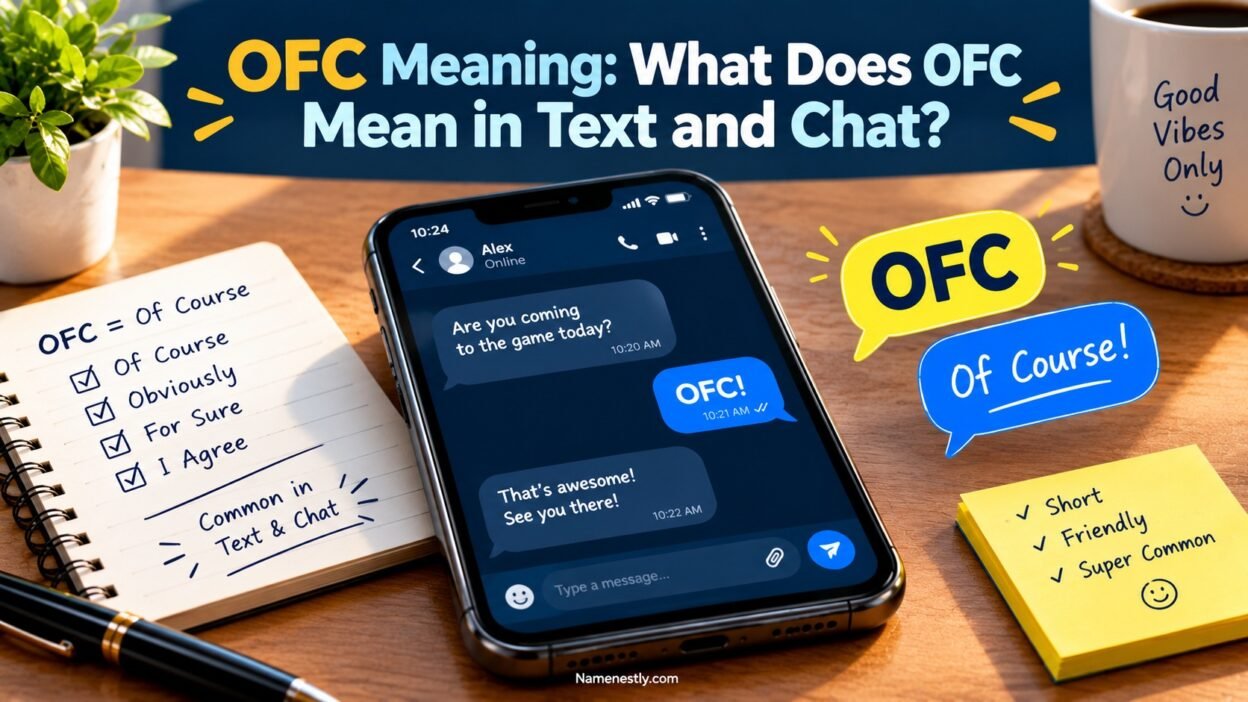
Online conversations move quickly. People often shorten common phrases to save time and keep messages casual. OFC is one of those abbreviations you’ll see across texts, social media comments, gaming chats, and group conversations.
If someone sends you “OFC!” they usually mean “of course.” The expression can show agreement, certainty, willingness, or an answer to something that seems obvious. However, the exact feeling can change with punctuation, context, and the relationship between the people chatting.
Understanding OFC meaning becomes especially useful when you encounter internet slang outside your usual conversations. A short reply such as “ofc” may look confusing at first, yet its meaning becomes straightforward once you know the context.
Quick Answer:
OFC means “of course.” People mainly use it as informal internet slang in text messages, social media, gaming chats, and online conversations.
For example:
- “Are you coming with us?” — “OFC!”
- “Can you help me?” — “OFC.”
- “OFC I remember.”
- “You can join OFC.”
Depending on the conversation, OFC can communicate yes, definitely, certainly, naturally, or obviously. It usually carries a friendly or casual tone, although a short “OFC.” can sometimes sound dry or dismissive.
The abbreviation doesn’t normally represent a different phrase. In everyday online slang, OFC almost always means “of course.”
Comparison Overview
OFC is closely related to several expressions people use when agreeing or confirming something. Still, these terms don’t always create the same impression.
| Expression | Main Meaning | Typical Tone | Common Use |
| OFC | Of course | Casual | Texting and social media |
| Of course | Certainly / naturally | Neutral | Casual and formal settings |
| Definitely | Without doubt | Confident | Agreement or certainty |
| Sure | Yes / okay | Casual | Requests and plans |
| Obviously | Clearly / naturally | Confident or blunt | Statements and explanations |
| Absolutely | Completely / certainly | Strong | Enthusiastic agreement |
| Yep | Yes | Very casual | Quick replies |
The biggest difference comes from tone and formality. “Of course” works in almost any setting, while “OFC” feels distinctly digital and informal.
Main Differences Between OFC Meaning
When people discuss OFC meaning, they usually focus on its basic definition. However, its practical meaning can shift slightly depending on how someone uses it.
OFC = Of Course remains the core definition. The surrounding words determine whether it sounds enthusiastic, neutral, sarcastic, or dismissive.
For example, compare these messages:
- “OFC!! I’d love to come.” — enthusiastic agreement
- “OFC.” — simple confirmation
- “OFC 🙄” — potentially sarcastic
- “OFC you can ask me.” — reassuring agreement
- “OFC I knew that.” — potentially confident or sarcastic
Therefore, don’t interpret the abbreviation by itself. Look at the entire message before deciding what the sender intends.
What Does OFC Mean in Text?
In texting, OFC means “of course.” People use it as a faster alternative to typing the complete phrase.
Imagine a friend asks, “Can I borrow your notes?” A natural response might be “OFC!” The sender isn’t trying to sound formal. They’re simply saying, “Of course!”
OFC often works as a standalone response. It can also appear inside a longer sentence.
Common Texting Examples
- “Are you still coming?” — “OFC!”
- “Can I call you later?” — “OFC.”
- “Do you want pizza?” — “OFC 😂”
- “OFC I’ll be there.”
- “You can come with us OFC.”
- “OFC that’s my favorite movie.”
The abbreviation works particularly well when both people already understand casual internet shorthand.
What Does OFC Stand For?
OFC stands for “of course.”
The abbreviation comes from the initial letters of the phrase:
- O = Of
- F = For
- C = Course
Although “of” and “course” form the phrase, online abbreviations aren’t always created through strict linguistic rules. OFC has become recognizable shorthand through repeated use in digital communication.
The phrase “of course” itself generally communicates agreement, certainty, or something considered natural or expected.
For example, if someone asks, “Would you like to come to the party?” replying “of course” expresses enthusiastic agreement.
OFC Meaning in Different Contexts
The basic definition stays consistent across platforms. However, the conversational purpose can change depending on where you see it.
OFC in Text Messages
Texting is probably the most common environment for OFC. Friends use it when answering questions, confirming plans, or agreeing with suggestions.
Example:
“Are you free tomorrow?”
“OFC! What’s up?”
Here, OFC means “of course” and communicates a willing yes.
OFC on Social Media
You might see OFC in Instagram comments, TikTok conversations, Snapchat messages, or other social platforms.
Someone might comment:
“OFC she won the challenge 😂”
In this example, OFC suggests that the outcome seemed expected.
OFC in Gaming
Gamers often use abbreviations because fast communication matters during matches.
For example:
“Can you cover me?”
“OFC.”
The player is essentially saying, “Of course, I can.”
Gaming conversations frequently contain shorthand such as GG, AFK, BRB, LOL, and OFC. These abbreviations keep communication quick without interrupting gameplay.
OFC in Online Conversations
Discord servers, group chats, forums, and private messages also use OFC regularly.
It can express agreement without requiring a long response. That makes it particularly useful when the conversation already provides enough context.
How to Use OFC in a Sentence
You can place OFC in several positions depending on the message.
At the beginning:
“OFC I’ll help you.”
As a standalone reply:
“Can you join us?”
“OFC!”
At the end:
“You can come with us OFC.”
Inside casual conversation:
“OFC I remember what happened.”
The most natural placement often depends on the rhythm of the conversation. In short replies, OFC usually appears by itself or near the beginning.
OFC Sentence Examples
| Message | What OFC Communicates |
| “OFC I’ll come.” | Willing agreement |
| “You can join OFC.” | Casual confirmation |
| “OFC she knows.” | Certainty |
| “OFC!” | Strong agreement |
| “OFC 😂” | Playful agreement |
| “OFC 🙄” | Possible sarcasm |
OFC Text Examples You’ll Actually See
Real conversations often use OFC in very short exchanges. The meaning becomes obvious from the question preceding it.
Example 1:
Friend: “Can you send me the picture?”
You: “OFC!”
Here, OFC means yes, I can.
Example 2:
Friend: “Are you watching the game tonight?”
You: “OFC 😂”
The emoji adds enthusiasm and makes the response feel playful.
Example 3:
Friend: “Do you remember Sarah?”
You: “OFC I remember her.”
Here, OFC emphasizes certainty.
Example 4:
Friend: “Can I sit with you?”
You: “OFC. Come over.”
This sounds welcoming and reassuring.
OFC Meaning in Different Tones
One fascinating part of online slang involves tone. The letters don’t carry emotion by themselves. Punctuation, emojis, capitalization, and surrounding words help create the intended feeling.
Friendly OFC
“OFC! Come with us.”
This sounds welcoming and enthusiastic.
Neutral OFC
“OFC, no problem.”
This simply confirms agreement.
Enthusiastic OFC
“OFC!!! I’ve been waiting for this!”
Multiple exclamation marks increase excitement.
Playful OFC
“OFC 😂”
The emoji adds humor or friendliness.
Sarcastic OFC
“OFC you remembered.”
Depending on context, this could mean the opposite of genuine praise.
Dry OFC
“OFC.”
A period can make an otherwise friendly abbreviation feel more serious or detached.
This doesn’t mean punctuation always changes the meaning. Instead, it can influence how the message feels.
OFC vs. Of Course
The difference between OFC and “of course” mostly concerns style rather than meaning.
| Feature | OFC | Of Course |
| Meaning | Of course | Of course |
| Formality | Informal | Neutral |
| Length | Short | Longer |
| Texting | Very common | Common |
| Professional writing | Usually avoided | Appropriate |
| Social media | Common | Common |
| Tone | Casual | Neutral or conversational |
If you’re chatting with a friend, OFC feels natural. If you’re writing a formal email, application, report, or business message, spell out “of course.”
For example, this works well in a casual conversation:
“OFC I can help.”
A professional message would usually sound better as:
“Of course, I can help.”
The meaning stays the same. The communication style changes.
Read More: What Does IONK Mean in Text? A Complete Guide
OFC vs. Other Similar Text Abbreviations
Several words can replace OFC in certain situations. However, their meanings aren’t perfectly interchangeable.
OFC vs. Definitely
Definitely expresses strong certainty.
“Are you coming?”
“Definitely.”
OFC can express the same basic agreement but often sounds more casual.
“Are you coming?”
“OFC!”
OFC vs. Sure
Sure usually means yes, okay, or agreed.
“Can you help me?”
“Sure.”
OFC can sound more confident or obvious:
“Can you help me?”
“OFC!”
OFC vs. Obviously
Obviously means something appears clear or self-evident.
However, it can sometimes sound blunt or condescending.
“Obviously, she knows.”
OFC generally feels friendlier:
“OFC she knows.”
OFC vs. Absolutely
Absolutely often adds stronger enthusiasm.
“Do you want to go?”
“Absolutely!”
OFC can also show strong agreement, although it often feels more relaxed.
“Do you want to go?”
“OFC!”
Is OFC Formal or Informal?
OFC is informal internet slang.
You’ll commonly see it in:
- Text messages
- Social media comments
- Private messages
- Gaming chats
- Group chats
- Discord conversations
- Casual online communities
It usually doesn’t belong in formal writing. Avoid using OFC in situations where professional language matters.
For example, don’t write:
“OFC, I’ll send the report today.”
A more professional version would be:
“Of course, I’ll send the report today.”
The abbreviation isn’t grammatically wrong. It simply belongs to a different communication register.
Is OFC Rude?
OFC isn’t inherently rude. Most people use it casually and positively.
Still, context can change its emotional impact.
Compare:
“OFC!! 😊”
with:
“OFC.”
The first response sounds warm and enthusiastic. The second could feel blunt if the conversation is sensitive.
Tone becomes even more important when OFC appears alongside sarcasm.
For example:
“OFC you listened to me this time.”
That sentence could be genuine. It could also be a sarcastic remark after someone ignored previous advice.
Therefore, consider the relationship, topic, punctuation, and previous messages before interpreting the tone.
How to Reply to OFC in Text
Your response depends on what the other person means by OFC.
If they agree with your request, you can simply continue the conversation.
Friendly Responses
- “Thanks!”
- “Awesome!”
- “Perfect.”
- “Appreciate it!”
- “Great, see you then.”
- “Haha, I knew you’d say yes.”
If someone responds with enthusiastic OFC, you don’t need to match their abbreviation. A normal conversational reply works perfectly.
OFC Meaning on Social Media and Messaging Apps
OFC appears across many digital platforms because its meaning doesn’t depend on a particular app.
You might encounter it in:
- Instagram comments
- Snapchat chats
- TikTok comments
- WhatsApp conversations
- Facebook Messenger
- Discord servers
- Gaming chats
- Group messages
The platform can influence slang habits, but OFC generally retains the same meaning: “of course.”
For example, someone might comment:
“OFC this song is still popular.”
Another person might send:
“OFC 😂”
Both use the abbreviation to express agreement or certainty.
OFC Capitalization and Variations
People write OFC in several forms:
- OFC
- ofc
- Ofc
All three usually mean “of course.”
Capitalization generally doesn’t change the definition. It often reflects someone’s typing habits or the style of the conversation.
OFC
Uppercase can make the abbreviation more noticeable or emphatic.
“OFC!”
ofc
Lowercase often feels relaxed and casual.
“ofc lol”
Ofc
Mixed capitalization sometimes appears naturally at the beginning of a sentence.
“Ofc I can help.”
Online language has fewer rigid capitalization rules than formal writing. That’s why you’ll see these variations frequently.
Why Do People Use OFC Instead of “Of Course”?
The main reason is speed. Digital conversations encourage short responses, especially when people communicate frequently throughout the day.
Typing three letters takes less effort than typing an entire phrase. Over time, repeated expressions naturally develop shorter forms.
OFC also signals an informal communication style. When someone writes “OFC 😂,” the abbreviation fits the relaxed environment better than an overly formal sentence.
This pattern appears throughout internet language. People commonly shorten phrases because digital communication rewards speed and familiarity.
FAQs:
What does OFC mean in texting?
OFC means “of course” in texting. People use it to express agreement, certainty, or a positive response to a question.
What does OFC stand for?
OFC stands for “of course.” It’s a common abbreviation used in informal digital communication.
Is OFC slang?
Yes. OFC is informal internet slang and texting shorthand. People commonly use it in casual conversations, social media, gaming chats, and messages.
Is OFC rude?
No. OFC isn’t inherently rude. However, punctuation and context can make it sound blunt, sarcastic, or dismissive.
Can you use OFC in a professional message?
It’s better to avoid OFC in professional communication. Write “of course” instead when communicating with clients, employers, teachers, or colleagues in formal settings.
Conclusion:
OFC means “of course.” It’s a short, widely understood abbreviation used primarily in casual online communication. You can use it to show agreement, certainty, willingness, or an answer that seems obvious. Its meaning stays simple, yet its tone can shift depending on punctuation, emojis, and context.