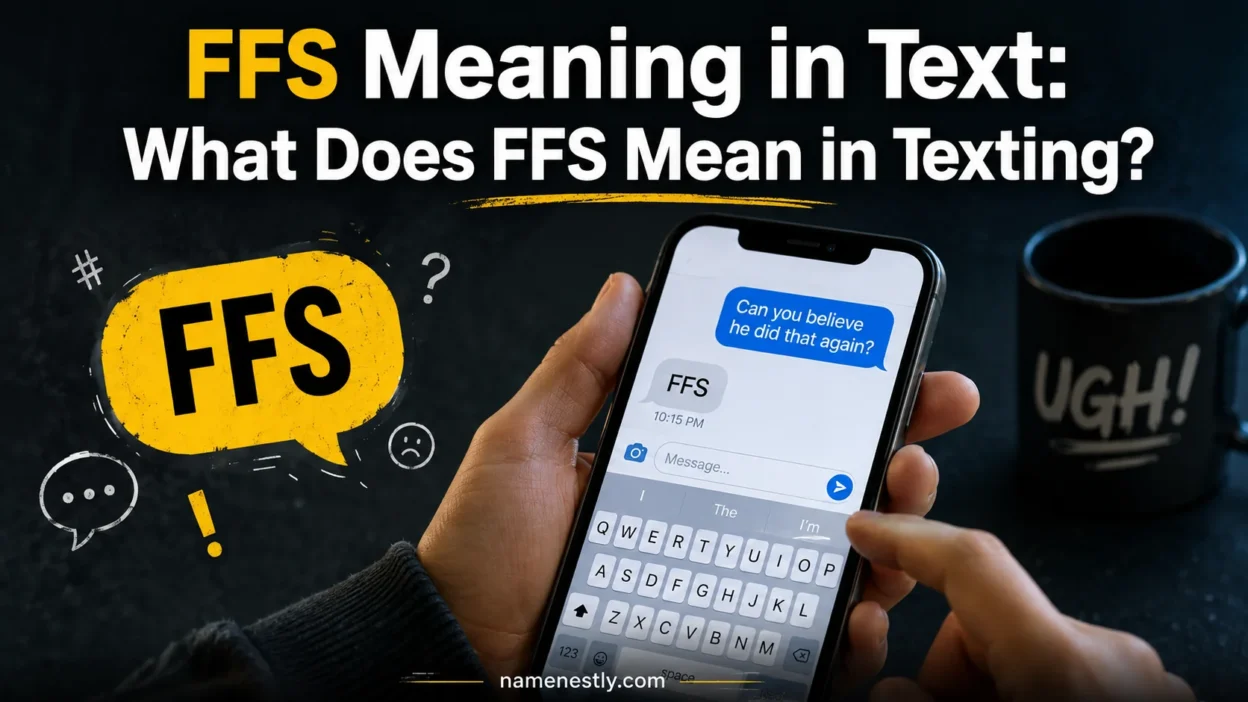
If someone sends “FFS” in a text, you might wonder whether they’re angry, joking, or simply frustrated. This short abbreviation carries a surprisingly strong emotional punch.
FFS usually means “for fuck’s sake.” People use it to show annoyance, frustration, disbelief, impatience, or exasperation. The exact tone depends heavily on the situation and the relationship between the people chatting.
You may see FFS in text messages, social media comments, gaming chats, group conversations, forums, and direct messages. Because it contains profanity, however, it belongs mainly in casual communication.
Understanding FFS meaning in text becomes much easier when you look at the sentence around it. “FFS, I forgot my keys” sounds frustrated with a situation. “You did that again? FFS.” sounds more critical or annoyed toward another person.
Quick Answer
FFS means “for fuck’s sake” in text and online conversations. It expresses frustration, irritation, impatience, disbelief, or exasperation.
For example:
“FFS, I missed the bus again.”
Here, FFS shows frustration about missing the bus. It doesn’t necessarily mean the person is furious. The speaker could simply feel annoyed by another frustrating mistake.
The abbreviation is informal and contains profanity, so it usually fits conversations with friends rather than professional or formal settings.
| FFS Meaning | Common Emotion | Example |
| For fuck’s sake | Frustration | “FFS, my phone died.” |
| For fuck’s sake | Annoyance | “FFS, stop doing that.” |
| For fuck’s sake | Disbelief | “FFS, you actually did it?” |
| For fuck’s sake | Impatience | “FFS, how long is this going to take?” |
| For fuck’s sake | Exasperation | “FFS, not again.” |
Comparison Overview
FFS belongs to a wider group of internet abbreviations that communicate strong emotions quickly. However, each one carries a slightly different tone.
| Abbreviation | Meaning | Typical Emotion | Profanity |
| FFS | For fuck’s sake | Frustration or exasperation | Yes |
| WTF | What the fuck | Surprise, confusion, disbelief | Yes |
| WTH | What the heck | Surprise or confusion | No |
| OMG | Oh my God | Surprise or excitement | No |
| SMH | Shaking my head | Disappointment or disbelief | No |
| ISTG | I swear to God | Emphasis or frustration | No |
| JFC | Jesus fucking Christ | Strong frustration or shock | Yes |
The biggest difference comes from what the speaker wants to communicate. FFS usually reacts to an irritating situation, repeated mistake, or frustrating event.
For example, someone might write “WTF?” after receiving shocking news. They might write “FFS” after dealing with the same problem for the fifth time.
Main Differences Between FFS Meaning in Text
The meaning of FFS in text stays fairly consistent, but its emotional force changes with context. A short message can sound playful between close friends yet harsh in another conversation.
FFS as Frustration
The most common use of FFS involves frustration.
Someone might type:
“FFS, the internet stopped working again.”
The speaker isn’t necessarily angry at another person. They’re reacting to an annoying problem.
This use often appears after something goes wrong unexpectedly. It works almost like a verbal sigh.
FFS as Annoyance
FFS can also signal direct annoyance.
“FFS, can you stop clicking that?”
Here, the abbreviation strengthens the request. Without it, the sentence sounds more neutral. Adding FFS makes the speaker’s irritation obvious.
FFS as Disbelief
Sometimes FFS expresses disbelief rather than straightforward anger.
“FFS, you actually bought another one?”
The speaker may find the situation ridiculous or difficult to believe. Tone and context determine whether the comment feels playful or genuinely critical.
FFS as Exasperation
Exasperation happens when someone feels worn down by repeated problems.
“FFS, not another meeting.”
In this example, the abbreviation communicates emotional exhaustion with the situation.
What Does FFS Stand For?
FFS stands for “for fuck’s sake.”
The full expression is an exclamation used to emphasize frustration, irritation, impatience, or disbelief. Online users commonly shorten it to three letters because abbreviations make fast conversations easier.
The phrase itself contains the profanity “fuck.” Therefore, FFS isn’t considered completely clean or family-friendly slang.
Still, the abbreviation often feels less intense than writing the entire phrase. That’s one reason people use it frequently in casual digital communication.
Think of FFS as an emotional pressure-release valve. Instead of writing a long explanation about your frustration, three letters can communicate the mood immediately.
FFS Meaning in Texting
In texting, FFS usually functions as an emotional reaction.
Unlike abbreviations such as BRB or TTYL, it doesn’t primarily save time by shortening a routine phrase. Instead, it compresses an emotional expression into a few characters.
For example:
- “FFS, I locked myself out.”
- “You forgot again? FFS.”
- “FFS 😂 that was close.”
- “FFS, why does this keep happening?”
- “I just deleted the wrong file. FFS.”
Each example communicates frustration, yet the intensity varies.
The surrounding words, punctuation, emojis, and relationship between the speakers all influence the interpretation.
FFS Meaning in Chat and Social Media
You can encounter FFS across many informal online spaces.
Text Messages
Friends may use FFS when reacting to everyday frustrations. The abbreviation feels natural in fast-moving conversations.
Group Chats
Group chats often produce playful or exaggerated uses of FFS. Someone may type it after a friend posts something ridiculous.
Social Media
People sometimes use FFS in comments or posts when reacting to frustrating news, annoying behavior, or absurd situations.
Gaming Chats
Gamers may use FFS after losing a match, experiencing lag, making a mistake, or watching a teammate repeat an error.
Online Forums
FFS also appears in informal discussions where users want to emphasize irritation or disbelief.
Because digital communication removes much of the facial expression and vocal tone found in face-to-face conversations, abbreviations like FFS can act as quick emotional signals.
Read More: What Does YW Mean in Text? Meaning, Uses, and Examples
FFS Meaning in Different Contexts
Context changes the way FFS sounds. The same three letters can range from humorous annoyance to genuine anger.
When Someone Is Annoyed
“FFS, why did you leave the door open?”
This sounds like direct irritation.
When Someone Is Frustrated
“FFS, my computer crashed before I saved the file.”
The frustration targets the situation rather than another person.
When Someone Is Surprised
“FFS, you won the whole thing?”
Here, the speaker may express disbelief rather than anger.
When Someone Is Impatient
“FFS, are we leaving or not?”
The abbreviation adds urgency and irritation.
When Something Seems Ridiculous
“FFS 😂 this group chat is getting wild.”
An emoji can soften the expression and make it feel more playful.
FFS Examples in Text Messages
Realistic examples make the meaning easier to recognize because FFS depends so much on context.
| Text Message | Likely Meaning | Tone |
| “FFS, I forgot my wallet.” | Frustration with oneself | Mildly frustrated |
| “FFS, not again.” | Annoyance about repetition | Exasperated |
| “FFS, why won’t this work?” | Frustration with a problem | Irritated |
| “You did that again? FFS.” | Annoyance toward someone | Stronger |
| “FFS 😂 I can’t believe that happened.” | Amused disbelief | Playful |
| “FFS, hurry up.” | Impatience | Direct |
| “FFS, I just missed the train.” | Frustration | Disappointed |
| “FFS, that’s ridiculous.” | Strong disagreement or irritation | Critical |
Notice how the abbreviation doesn’t automatically tell you who or what caused the frustration. You need the rest of the message to understand that part.
Is FFS Rude?
FFS can sound rude because it contains profanity.
Whether someone considers it offensive depends on the audience, relationship, and situation.
Among close friends, FFS may feel completely ordinary. In a workplace conversation, the same abbreviation could sound unprofessional.
For example:
Friend: “FFS, I forgot the tickets again 😂”
This may come across as humorous self-frustration.
However:
Coworker: “FFS, you missed the deadline again.”
That version sounds much more confrontational.
The difference isn’t the abbreviation itself. Context supplies the emotional temperature.
Is FFS a Bad Word?
FFS isn’t a standalone swear word in the traditional sense. However, it abbreviates a phrase that contains profanity.
Because “fuck” is widely recognized as a strong swear word, FFS can still count as profanity in many settings.
Its appropriateness depends on the environment.
Usually Appropriate in Casual Settings
- Private conversations with close friends
- Informal group chats
- Some gaming communities
- Casual social media conversations
- Humorous conversations among people comfortable with profanity
Usually Better to Avoid in Formal Settings
- Job applications
- Professional emails
- Academic assignments
- Customer service messages
- Formal presentations
- Workplace communication where profanity isn’t accepted
When you’re unsure about the audience, a cleaner expression is safer.
When Should You Use FFS?
FFS works best when the conversation already allows informal language.
You might use it when:
- A minor problem repeatedly happens.
- You’re annoyed with your own mistake.
- Something unexpectedly goes wrong.
- You’re reacting to ridiculous behavior.
- A situation tests your patience.
- You’re joking with someone who understands your tone.
- You’re reacting dramatically for comedic effect.
For example, a friend who knows your humor may understand:
“FFS, I left my coffee on the roof of the car again.”
The statement communicates frustration while also making the mistake sound funny.
When Should You Avoid FFS?
Some situations call for cleaner language.
Avoid FFS when you’re communicating with someone who may find profanity offensive. You should also avoid it when professionalism matters more than casual expression.
Consider alternatives in:
- Business emails
- Interviews
- Schoolwork
- Customer complaints
- Official documents
- Workplace messages
- Conversations with unfamiliar people
Instead of writing:
“FFS, this isn’t working.”
A professional message could say:
“I’m frustrated because this still isn’t working.”
The second version communicates the problem without unnecessary profanity.
Polite Alternatives to FFS
You don’t always need profanity to express frustration. Several alternatives can carry a similar emotional meaning.
| FFS | Politer Alternative | Tone |
| FFS | Seriously? | Annoyed |
| FFS | Come on! | Frustrated |
| FFS | Oh, come on | Exasperated |
| FFS | For goodness’ sake | Mild frustration |
| FFS | What the heck? | Surprise |
| FFS | Seriously, again? | Disbelief |
| FFS | This is frustrating | Direct but professional |
| FFS | You’ve got to be kidding | Disbelief |
“Come on!” is especially useful because it can express annoyance without sounding harsh.
Likewise, “Seriously?” works in many casual and professional conversations.
FFS vs Similar Texting Abbreviations
FFS shares some emotional territory with several popular texting abbreviations. However, the expressions aren’t interchangeable in every situation.
FFS vs WTF
FFS generally expresses frustration or exasperation.
WTF usually expresses surprise, confusion, disbelief, or shock.
Compare:
“FFS, my internet went down again.”
The speaker feels frustrated.
“WTF, why is there a cow in the parking lot?”
The speaker feels confused or shocked.
Both contain profanity. Their emotional focus differs.
FFS vs OMG
OMG means “oh my God.”
It commonly expresses surprise, excitement, shock, or amazement. FFS usually carries more frustration.
“OMG, you got the job!”
This sounds excited.
“FFS, I forgot about the interview.”
This sounds frustrated.
FFS vs SMH
SMH means “shaking my head.”
People use it to express disappointment, disbelief, frustration, or disapproval.
“SMH, you forgot your keys again.”
This sounds disappointed.
“FFS, you forgot your keys again.”
This sounds more emotionally charged and irritated.
FFS vs ISTG
ISTG means “I swear to God.”
It can emphasize a statement, promise, warning, or frustration.
“ISTG, this is the third time.”
The speaker emphasizes seriousness.
“FFS, this is the third time.”
The speaker emphasizes frustration.
FFS vs JFC
JFC usually means “Jesus fucking Christ.”
Like FFS, it contains profanity and can express strong frustration, shock, or disbelief.
JFC often sounds more intense or dramatic. FFS usually works as an exasperated reaction to an annoying situation.
How to Respond When Someone Says FFS
The best response depends on the person’s tone.
If someone seems genuinely frustrated, acknowledge what happened instead of escalating the situation.
For example:
“Yeah, that’s frustrating. Hopefully it gets fixed soon.”
If the person uses FFS jokingly, a playful response might fit better:
“😂 Seriously, what are the odds?”
If they’re clearly angry at you, stay calm and address the actual issue.
“I understand you’re frustrated. I’ll fix it.”
You don’t need to mirror their profanity. Matching the emotional intensity can sometimes turn a small problem into a bigger argument.
How Punctuation Changes FFS
Punctuation can subtly change how FFS feels.
“FFS”
A plain abbreviation can sound mildly annoyed or conversational.
“FFS!”
The exclamation mark adds intensity.
“FFS, seriously?”
This sounds strongly exasperated.
“FFS 😂”
The emoji can make the phrase feel humorous or self-deprecating.
“You did what? FFS.”
This can sound shocked, annoyed, or judgmental.
Capitalization also matters less than context. People may write ffs, FFS, or Ffs in casual digital conversations. The underlying meaning generally remains the same.
Case Study: Understanding FFS Through Context
Consider three messages that use the same abbreviation.
Example One: Frustration With Yourself
“FFS, I forgot my password again.”
Here, the writer expresses frustration with their own mistake.
Example Two: Annoyance Toward Another Person
“FFS, you left the door unlocked again.”
Now the frustration points toward another person’s behavior.
Example Three: Playful Reaction
“FFS 😂 you actually wore that shirt?”
The emoji and conversational context can turn the phrase into teasing rather than serious anger.
The letters stay the same. The emotional meaning shifts with context.
That’s one of the most important things to understand about FFS meaning in text.
FAQs:
What does FFS mean in text?
FFS usually means “for fuck’s sake.” People use it to express frustration, annoyance, impatience, disbelief, or exasperation.
What does FFS stand for?
FFS stands for “for fuck’s sake.” It’s an informal abbreviation commonly used in texting and online communication.
Is FFS a swear word?
FFS abbreviates a phrase containing the swear word “fuck.” Therefore, many people consider it profanity or inappropriate language in formal settings.
Is FFS rude?
It can be rude depending on the context. Friends may use it casually, while the same expression can sound aggressive in professional or unfamiliar conversations.
What does FFS mean on Snapchat?
On Snapchat, FFS generally means “for fuck’s sake.” Users typically use it to express annoyance, frustration, disbelief, or humorous exasperation.
Conclusion:
FFS means “for fuck’s sake” and usually expresses frustration, annoyance, impatience, disbelief, or exasperation. Its meaning remains straightforward, but its tone depends on context. A message like “FFS, I missed the bus” expresses personal frustration. Meanwhile, “You did that again? FFS” can sound more critical. Because FFS contains profanity, it’s best suited to informal conversations where the audience understands that style of language.