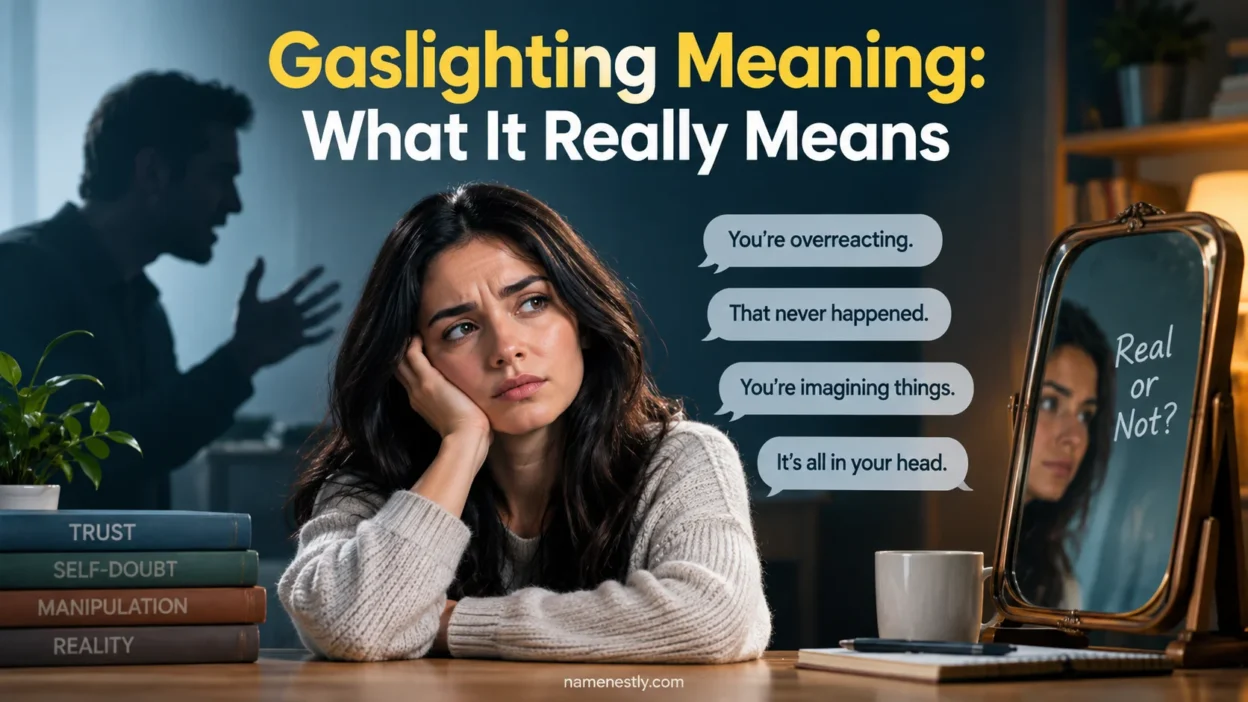
Gaslighting can make a person question something as basic as their own memory. One moment, you feel certain about what happened. The next, someone insists that you imagined it, misunderstood it, or remembered it completely wrong.
That confusion explains why the term gaslighting has become so common. However, people often use it too loosely. A disagreement, forgotten detail, or ordinary lie doesn’t automatically qualify as gaslighting.
The real issue involves a pattern of behavior that undermines someone’s confidence in their own perception, memory, judgment, or understanding of events. Once you understand that difference, the term becomes much easier to recognize and use accurately.
Quick Answer
Gaslighting means manipulating someone into questioning their own memory, perception, judgment, or understanding of reality. The behavior often involves denying events, rewriting conversations, minimizing legitimate concerns, shifting blame, or repeatedly insisting that another person’s recollection is wrong.
For example, imagine you clearly remember someone making a hurtful comment. When you bring it up later, they repeatedly insist they never said it. They might then tell you that you’re too sensitive and always misremember conversations.
One disagreement doesn’t prove gaslighting. A repeated pattern of undermining someone’s confidence in their own perception is much more significant.
Comparison Overview
| Behavior | What It Means | Typical Example |
| Gaslighting | Undermining someone’s perception or memory | “That never happened. You’re imagining it.” |
| Lying | Giving deliberately false information | “I didn’t take the money.” |
| Disagreement | Having different opinions or memories | “I remember that conversation differently.” |
| Manipulation | Influencing someone through deceptive or unfair tactics | Using guilt to get someone to agree |
| Misremembering | Recalling an event incorrectly | “I thought we agreed to meet Friday.” |
| Dismissal | Rejecting someone’s feelings or concerns | “You’re making this a bigger deal than it is.” |
These behaviors can overlap. Still, they aren’t interchangeable.
A person can lie without gaslighting someone. Two people can genuinely remember an event differently without either person manipulating the other. Context and repeated behavior matter.
Main Differences Between Gaslighting Meaning
The biggest distinction involves what the behavior attacks.
A lie usually concerns a particular fact. Gaslighting can go further by making someone question whether they can trust their own memory or judgment at all.
For example, saying, “I didn’t send that message,” is a denial. If evidence proves the person sent it, they may have lied.
But if they repeatedly respond with statements such as, “You imagined the entire conversation,” “You always make things up,” and “You can’t trust your memory,” the interaction can move toward gaslighting.
The difference becomes clearer when you look at the pattern:
- Lying: “I didn’t do it.”
- Disagreement: “I remember it differently.”
- Manipulation: “I’ll make you feel guilty unless you agree.”
- Gaslighting: “You’re imagining what happened, and your memory can’t be trusted.”
What Does Gaslighting Mean?
In everyday language, gaslighting describes a pattern of psychological manipulation that causes someone to doubt their own perception or recollection.
The person experiencing it may begin asking:
- “Did I really remember that correctly?”
- “Maybe I’m overreacting.”
- “Was I actually wrong?”
- “Did I misunderstand what they said?”
- “Why can’t I remember things properly?”
- “Maybe the problem really is me.”
That internal uncertainty represents an important part of the concept.
Gaslighting doesn’t require someone to forget every detail. In fact, the person may remember an event quite clearly at first. Repeated denial, contradiction, blame, and dismissal can gradually weaken their confidence.
Gaslighting Is Usually About a Pattern
One questionable statement isn’t enough to label an interaction gaslighting.
People forget things. Memories aren’t perfect. Conversations can become confusing. Two honest people can remember the same event differently.
The stronger warning sign appears when someone repeatedly undermines your ability to trust your own perception, especially when doing so benefits them or helps them avoid accountability.
Why the Term Gets Misused
Social media has made “gaslighting” a popular word for almost any frustrating disagreement.
Someone who says, “I don’t remember saying that,” isn’t necessarily gaslighting you. They might genuinely have forgotten.
Likewise, someone who disagrees with your interpretation isn’t automatically manipulating you.
Accurate use of the term requires more than conflict. It requires attention to patterns, context, evidence, and the effect of the interaction.
Where Did the Term Gaslighting Come From?
The modern word comes from the title of a 1938 British stage play, Gas Light. The story was later adapted into films, including the 1940 British film Gaslight and the famous 1944 American film of the same name.
The story centers on a husband whose behavior causes his wife to question her perception of reality.
One memorable element involves changes to the home’s gas lighting. When his wife notices the lights changing, he attempts to convince her that she’s imagining things.
That fictional scenario eventually inspired the psychological term gaslighting.
The Origin of the Word Gaslighting
The term didn’t begin as casual slang.
It emerged from a story about systematic psychological manipulation. The core idea remained consistent: make another person distrust what they perceive and remember.
Over time, psychologists, journalists, writers, and the general public adopted the term to describe similar patterns outside the fictional story.
How the Meaning Changed Over Time
Today, people use gaslighting in many contexts, including:
- Romantic relationships
- Families
- Friendships
- Workplaces
- Social groups
- Online communities
- Public communication
The broader use has made the word more familiar. However, that popularity also creates confusion.
Not every form of dishonesty qualifies as gaslighting.
How Gaslighting Works
Gaslighting often develops gradually rather than appearing in one dramatic moment.
A person may first deny a small event. Later, they challenge your memory of a conversation. Eventually, you may start checking your own recollection before trusting it.
Denying What Happened
One common tactic involves flatly denying an event.
“That never happened.”
Sometimes the denial concerns something minor. In other cases, it involves an important argument, promise, accusation, or action.
The concern becomes stronger when the person repeatedly denies events despite credible evidence or previous acknowledgment.
Rewriting Events
Another pattern involves changing the story after something happens.
A person might originally agree to something. Later, they claim the conversation never occurred.
They may also describe their behavior differently each time you discuss it.
This creates confusion because you’re no longer discussing only the original event. You’re also defending your memory of the conversation.
Read More: What Does TBH Mean in Text? Meaning, Uses, and Examples
Undermining Memory and Perception
Statements such as these can undermine someone’s confidence:
- “You remember everything wrong.”
- “You always imagine things.”
- “You’re confused again.”
- “You can’t trust your memory.”
- “That’s not what you saw.”
Again, context matters. A single comment isn’t enough to establish a pattern.
Shifting Blame
Gaslighting can also involve turning the original issue back onto the person raising it.
For example:
Person A: “You promised you’d call me.”
Person B: “You always pressure me. That’s why I don’t want to talk to you.”
The original question has disappeared. Now Person A is defending their personality instead.
Repeating the Pattern
Repetition can make manipulation particularly damaging.
When the same person repeatedly denies events, changes explanations, attacks your memory, and shifts blame, you may eventually stop trusting your own judgment.
That’s where gaslighting becomes more than an ordinary argument.
Common Gaslighting Phrases
Certain phrases frequently appear in conversations involving gaslighting. However, no phrase automatically proves someone is gaslighting you.
| Phrase | Possible Function |
| “That never happened.” | Denies an event |
| “You’re imagining things.” | Challenges perception |
| “You’re too sensitive.” | Dismisses an emotional response |
| “You always remember things wrong.” | Undermines memory |
| “You’re making a big deal out of nothing.” | Minimizes concerns |
| “Everyone thinks you’re the problem.” | Creates social self-doubt |
| “I only did that because of you.” | Shifts responsibility |
| “You’re crazy.” | Attacks credibility |
| “I never said that.” | Denies previous communication |
The surrounding circumstances matter more than the phrase itself.
For instance, someone might honestly say, “I never said that,” because they genuinely don’t remember saying it. A pattern of repeated denial combined with attacks on your ability to remember creates a different situation.
Real-Life Examples of Gaslighting
Real-life examples make the gaslighting meaning easier to understand because the behavior often appears subtle.
Gaslighting in Romantic Relationships
Imagine a partner repeatedly insults you during arguments.
Later, you mention the behavior.
Instead of discussing the comment, they say:
“I never said that. You always twist everything I say.”
The next time something similar happens, the same response follows.
After months of this pattern, you might start recording conversations or questioning your own memory before raising concerns.
That repeated erosion of confidence matters.
Healthy conflict allows both people to discuss what happened, acknowledge uncertainty, and correct mistakes.
Gaslighting Between Family Members
Family relationships can create complicated situations because people share long histories.
A parent, sibling, or relative might repeatedly deny events that another family member clearly remembers.
For example, someone may say:
“That never happened in our family. You make everything sound worse.”
One disagreement about childhood memories doesn’t establish gaslighting. Memories naturally change over time.
However, repeatedly dismissing someone’s experiences while insisting they cannot trust their own memory can become harmful.
Gaslighting in Friendships
Friendship gaslighting can appear when someone repeatedly denies hurtful behavior.
Suppose a friend makes insulting jokes about you in front of others. When you mention it later, they respond:
“You know I was joking. You’re always looking for something to be offended by.”
If this happens repeatedly, the issue isn’t simply one joke.
The larger pattern involves making you question whether your emotional response is legitimate.
Gaslighting at Work
Workplace situations can become especially difficult because conversations often involve instructions, deadlines, responsibilities, and accountability.
Imagine a manager gives an employee a verbal instruction. Later, the manager denies giving it and claims the employee misunderstood everything.
One incident could reflect poor communication.
But repeated behavior can become more concerning when someone consistently changes expectations and then insists that the previous instructions never existed.
Keeping accurate records of important workplace communication can help establish what actually happened.
Gaslighting Online
Digital conversations create their own challenges.
People can selectively quote messages, remove context, deny public statements, or insist that documented exchanges never occurred.
Screenshots and timestamps can sometimes provide useful context. However, even digital evidence needs careful interpretation because screenshots can omit surrounding conversations.
The goal isn’t to “win” every disagreement. It’s to establish facts as accurately as possible.
Signs You May Be Experiencing Gaslighting
Gaslighting can be difficult to identify while you’re experiencing it.
You may notice changes in yourself before recognizing the behavior.
Common signs include:
- You constantly question your memory.
- You repeatedly apologize without understanding what you did wrong.
- You feel confused after ordinary conversations.
- You check messages to confirm what someone previously said.
- You increasingly distrust your own decisions.
- You feel responsible for another person’s actions.
- You avoid raising legitimate concerns.
- You frequently hear that you’re “too sensitive.”
- You feel mentally exhausted after arguments.
- You depend heavily on another person’s version of events.
- You feel like every conversation somehow becomes your fault.
None of these signs independently proves gaslighting.
They become more meaningful when they appear alongside a repeated pattern of denial, contradiction, blame, and reality distortion.
Gaslighting vs. Lying, Manipulation, and Disagreement
These terms overlap, but they describe different behaviors.
Gaslighting vs. Lying
A lie involves deliberately presenting something untrue as true.
Gaslighting may include lying, but it goes beyond the false statement by attacking someone’s confidence in their own perception.
Gaslighting vs. Manipulation
Manipulation covers a much wider range of behaviors.
Someone can manipulate another person through guilt, pressure, flattery, threats, or deception without questioning their reality.
Gaslighting represents one particular form of psychological manipulation.
Gaslighting vs. Disagreement
Disagreement is normal.
Two people can remember an event differently while both honestly believe their version.
Healthy disagreement leaves room for uncertainty:
“I remember it differently, but let’s check what happened.”
Gaslighting tends to close that door by repeatedly insisting that the other person’s perception is inherently unreliable.
Why Do People Gaslight Others?
There isn’t one universal reason.
People may use gaslighting-like behavior to avoid responsibility, maintain control, protect their reputation, or influence another person’s decisions.
Desire for Control
A person who controls how an event gets interpreted may gain power within a relationship.
If you stop trusting your judgment, you may become more dependent on their version of events.
Avoiding Responsibility
Accountability can feel uncomfortable.
Instead of acknowledging harmful behavior, someone may deny the event entirely or redirect blame.
Protecting Their Image
Some people strongly resist admitting mistakes.
Rather than saying, “I was wrong,” they may construct an alternative explanation that makes them appear innocent.
Maintaining Power in a Relationship
Repeated reality-denying behavior can create an unhealthy imbalance.
One person becomes the supposed authority on what happened. The other becomes increasingly uncertain.
Learned or Repeated Behavior
Some harmful communication patterns can become habitual.
That doesn’t make the behavior harmless. It simply means you shouldn’t automatically assume you know someone’s psychological diagnosis or private motives.
Effects of Gaslighting on a Person
Repeated manipulation can affect more than one argument.
Self-Doubt
You may begin questioning memories that once felt obvious.
Loss of Confidence
When your judgment gets challenged repeatedly, decision-making can become harder.
Anxiety and Confusion
Constantly trying to determine what actually happened can become mentally exhausting.
Difficulty Making Decisions
If you don’t trust your own judgment, even small choices may feel risky.
Emotional Exhaustion
Arguments can consume significant mental energy when every conversation turns into a debate about reality.
Reduced Trust in Your Own Judgment
This may become one of the most damaging effects.
You might start asking another person whether your feelings, memories, or decisions are valid.
Social Isolation
In some situations, manipulation can discourage someone from discussing events with friends or family.
That isolation can make it harder to gain an outside perspective.
Gaslighting and Mental Health
Gaslighting can create significant emotional distress. However, it shouldn’t become a catch-all explanation for every memory problem, disagreement, or emotional reaction.
Memory can change naturally. Stress can affect concentration. Anxiety can influence how people interpret situations. Different people can remember the same event differently.
That doesn’t mean someone’s experience should be dismissed.
If repeated manipulation has seriously affected your confidence, relationships, or daily life, talking with a qualified mental health professional can provide an outside perspective and practical support.
FAQs:
What does gaslighting mean in simple words?
Gaslighting means repeatedly manipulating someone into doubting their own memory, perception, judgment, or understanding of events.
What is an example of gaslighting?
A person repeatedly denies something they said or did and insists that you imagined it, especially when they use the denial to make you distrust your own memory.
Is gaslighting a form of lying?
Gaslighting can involve lying, but the concepts aren’t identical. Gaslighting specifically involves undermining someone’s confidence in their perception or judgment.
How can you tell if someone is gaslighting you?
Look for repeated patterns rather than one statement. Frequent denial, reality distortion, blame shifting, and attacks on your memory can be warning signs.
Can gaslighting happen in a healthy relationship?
Occasional misunderstandings can happen in healthy relationships. A repeated pattern of manipulating someone’s perception isn’t healthy communication.
Conclusion:
Understanding gaslighting meaning starts with one important distinction: not every disagreement is gaslighting. People forget things. Memories differ. Miscommunication happens. Even honest people sometimes deny something because they genuinely remember it differently. The concern grows when a repeated pattern causes someone to question their own memory, perception, judgment, or sense of reality.