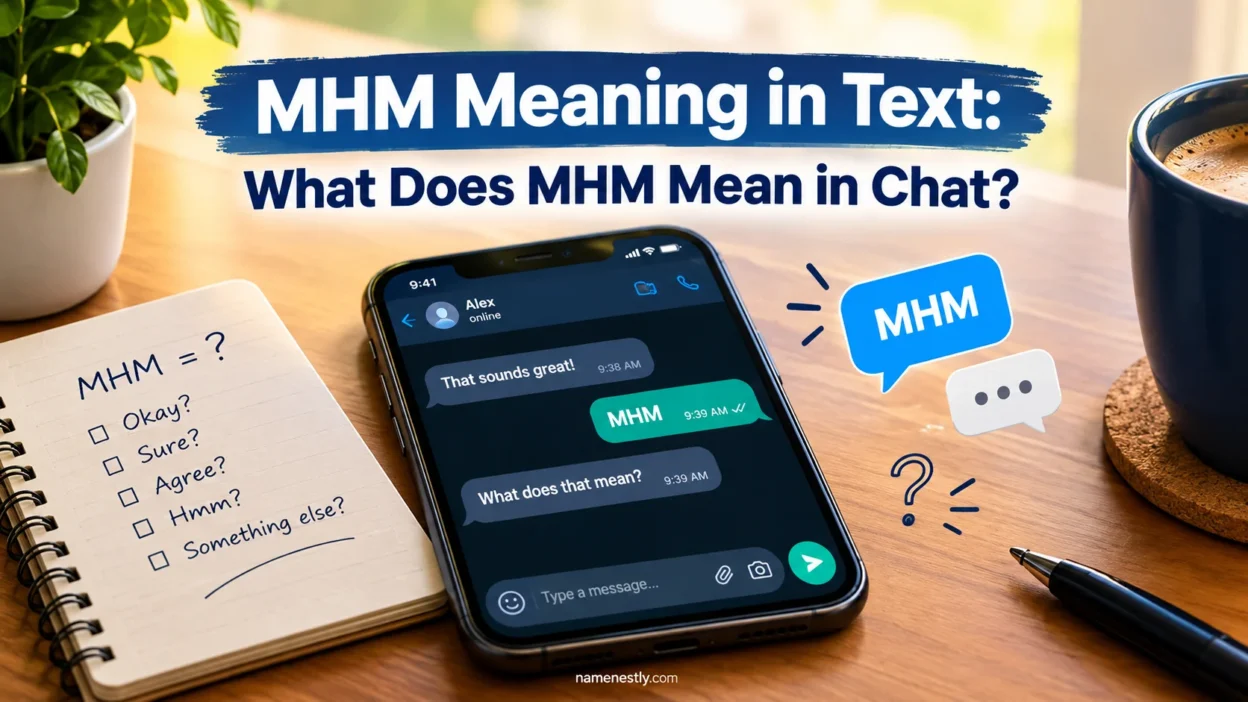
If someone replies “mhm” to your message, they’re usually saying yes, agreeing with you, or showing that they’re listening. It looks simple, but its exact meaning can shift with the conversation, punctuation, and tone.
You’ll often see mhm in text messages, social media DMs, comments, and casual online chats. Unlike many texting abbreviations, it usually isn’t an acronym with a fixed full form. Instead, it represents a conversational sound similar to “mm-hmm.”
For example, if someone asks, “Are you coming with us?” a reply like “mhm” normally means “yes.” However, if someone responds with “Mhm…” after a long explanation, the same expression might suggest hesitation, doubt, or restrained acknowledgment.
Quick Answer
MHM usually means “yes,” “yeah,” “I agree,” or “I’m listening” in text messages. It’s an informal conversational response that people use to acknowledge something without writing a longer reply.
The exact feeling depends on context. A cheerful “mhm!” can show enthusiastic agreement, while “mhm.” may sound brief or somewhat distant.
In most everyday conversations, though, mhm is simply a casual way to say:
- Yes
- Yeah
- I agree
- That’s right
- I understand
- I’m listening
- Okay, I acknowledge that
It’s also worth remembering that mhm isn’t normally an acronym. It represents a spoken conversational sound, commonly written as “mm-hmm.”
Comparison Overview
The easiest way to understand MHM meaning in text is to compare it with similar responses. Although these expressions overlap, they can create noticeably different impressions.
| Text expression | Common meaning | Typical tone |
| Mhm | Yes, yeah, agreement | Casual and neutral |
| Mm-hmm | Yes, I agree, listening | Conversational |
| Hmm | Thinking, uncertainty, consideration | Reflective |
| Yeah | Yes, agreement | Casual |
| Yep | Yes | Friendly and informal |
| Yup | Yes | Very casual |
| Okay | Acknowledgment or acceptance | Neutral |
| Sure | Agreement or willingness | Casual |
| Yes | Direct agreement | Clear and straightforward |
| K | Okay | Very brief and context-dependent |
The important distinction involves mhm versus hmm. They may look similar, yet they usually perform different conversational jobs.
Mhm generally communicates agreement or acknowledgment. Hmm more often communicates thought, uncertainty, curiosity, or hesitation.
For example:
“You’re coming tonight, right?”
“Mhm.”
Here, the response generally means yes.
Now consider:
“I think we should cancel the trip.”
“Hmm…”
That response suggests the person is thinking about the idea, not necessarily agreeing with it.
Main Differences Between MHM Meaning in Text
The meaning of mhm changes mainly through context, punctuation, and conversational purpose. It can represent agreement in one message and simple acknowledgment in another.
MHM as “Yes”
The most common use of mhm is a simple affirmative response.
Someone might ask:
“Did you finish the assignment?”
“Mhm.”
In this situation, mhm means “yes” or “I did.”
It works much like saying “yeah” during a face-to-face conversation. The speaker doesn’t need to provide additional information because the question only requires confirmation.
MHM as “I Agree”
People also use mhm when they agree with another person’s statement.
For example:
“That movie was actually pretty good.”
“Mhm.”
Here, the response communicates agreement without repeating the entire opinion.
This makes mhm useful during fast conversations. It acknowledges the other person’s statement while keeping the exchange moving.
MHM as “I’m Listening”
Sometimes mhm doesn’t necessarily mean strong agreement. Instead, it tells the other person that the message has been heard.
Imagine someone explaining a complicated situation:
“First I called the office, then they told me to email the manager.”
“Mhm.”
“Then the manager finally replied.”
In this context, mhm can mean “I’m following you” or “Go ahead.”
That distinction becomes important because acknowledgment isn’t always the same as agreement.
MHM as Confirmation
A person can also use mhm to confirm information.
For example:
“Your meeting starts at six, right?”
“Mhm.”
The response confirms the information.
You could replace it with “yes,” “correct,” or “yeah.” However, mhm sounds more relaxed and conversational.
MHM as a Short Response
Sometimes people simply don’t have much to add.
Suppose someone writes:
“I’m going to grab some food.”
A reply of:
“Mhm.”
may simply acknowledge the statement.
In this case, interpreting it as enthusiastic agreement would probably go too far. It may only mean “okay, I heard you.”
What Does MHM Mean in Chat?
In chat, mhm functions much like a spoken response. It allows people to acknowledge messages quickly without interrupting the conversational rhythm.
Because texting lacks vocal cues, readers often interpret the expression through the surrounding messages.
Consider these examples:
“You know I was right.”
“Mhm.”
This could mean “yes, you were right.”
Now consider:
“I’m sorry I forgot again.”
“Mhm…”
The second version can sound more restrained. The writer may acknowledge the apology without expressing warmth or forgiveness.
Therefore, MHM meaning in chat isn’t determined by the letters alone.
The conversation around it matters.
MHM Meaning on Social Media
You can find mhm across casual social-media conversations, including direct messages, comments, group chats, and replies.
Its basic meaning generally remains the same. The platform doesn’t automatically give the expression a completely different definition.
However, social-media culture can make the tone more expressive.
For example:
- mhm — casual acknowledgment
- MHM! — stronger agreement or excitement
- mhm lol — relaxed acknowledgment with a playful tone
- mhm… — possible hesitation or doubt
- mhm? — uncertainty or questioning tone
- mhm 🙂 — warmer acknowledgment
These interpretations aren’t fixed rules. People develop personal texting habits, and different conversations can create different meanings.
How MHM Is Used in Text Messages
Text messages make mhm particularly useful because it provides a quick conversational signal.
Instead of typing a complete sentence, someone can respond with one small expression and still show that they received the message.
MHM Between Friends
Friends often use mhm casually when agreeing or acknowledging something.
“That restaurant is expensive.”
“Mhm, seriously.”
Here, mhm reinforces the speaker’s point.
MHM Between Couples
Partners may use it during relaxed conversations.
“You’re still picking me up, right?”
“Mhm ❤️”
The surrounding emoji changes the emotional impression. The expression itself remains a simple affirmative response.
MHM in Family Conversations
Family members might use it when confirming everyday information.
“Dinner is ready.”
“Mhm, coming.”
Here, the response indicates acknowledgment and understanding.
MHM in Group Chats
In group chats, mhm can acknowledge a statement without taking over the conversation.
For example:
“We should meet at 7.”
“Mhm.”
“Works for me.”
The first response indicates agreement or acknowledgment. The second makes explicit acceptance clearer.
Read More: LMAO Meaning in Chat: What Does LMAO Mean in Text?
Examples of MHM in Text Conversations
Realistic examples make the meaning much easier to understand.
Example: Simple Agreement
Alex: Are you free tomorrow?
Sam: Mhm.
Alex: Great, let’s meet after lunch.
Here, mhm means yes.
Example: Confirming Information
Alex: The deadline is Friday, right?
Sam: Mhm.
Alex: Perfect. I’ll finish it tonight.
Here, mhm means correct or yes.
Example: Showing You’re Listening
Alex: I talked to my teacher about the problem.
Sam: Mhm.
Alex: She said I can submit it tomorrow.
Here, the response signals that Sam is following the story.
Example: Minimal Acknowledgment
Alex: I’m going to sleep now.
Sam: Mhm.
This doesn’t necessarily express agreement. It may simply mean “okay” or “I heard you.”
Example: Hesitant Tone
Alex: You really think that’s a good idea?
Sam: Mhm…
The ellipsis makes the response less confident. It could suggest uncertainty or reluctance.
Does MHM Mean Yes or No?
In ordinary texting, mhm generally means yes rather than no.
It commonly confirms a question, agrees with a statement, or acknowledges something positively.
For example:
“Did you call her?”
“Mhm.”
The natural interpretation is yes.
However, the word doesn’t always express enthusiastic agreement. Sometimes it simply means “I hear you.”
That distinction can create confusion.
Imagine someone says:
“So you understand what I mean?”
A reply of “mhm” could mean “yes, I understand.”
It doesn’t necessarily mean the person strongly agrees with the underlying opinion.
Why Context Matters
Text-based conversations don’t provide the vocal information available during speech. A person can say “mhm” warmly, sarcastically, reluctantly, or casually.
Written messages have to approximate those differences through:
- Punctuation
- Capitalization
- Emojis
- Extra words
- Message timing
- Previous conversation
- Relationship between the people
So, when you see mhm, read the surrounding conversation before assigning a strong emotional meaning.
Is MHM Rude or Dismissive?
Mhm isn’t inherently rude. Millions of casual conversations use short acknowledgment responses without any negative intention.
Still, a one-word response can sometimes feel dismissive.
Compare:
“Mhm.”
with:
“Mhm, I totally agree!”
The first response provides little emotional information. The second clearly communicates agreement.
Similarly:
“Yeah, exactly!”
sounds more engaged than:
“Mhm.”
If someone sends a detailed message and receives only “mhm,” they might interpret the reply as low-effort. That interpretation depends heavily on the relationship and the usual communication style between the two people.
When MHM Can Sound Dismissive
It may feel dismissive when:
- Someone sends a long emotional message.
- The conversation requires a thoughtful response.
- The person repeatedly answers with one-word replies.
- The punctuation makes the response sound unusually firm.
- Earlier messages already suggest frustration.
However, a short reply alone doesn’t prove that someone intends to be rude.
Texting habits differ widely.
MHM With Different Punctuation
Punctuation can dramatically influence how mhm feels.
“Mhm.”
A period can make the response feel firm, final, or neutral.
“Are you coming?”
“Mhm.”
It still usually means yes. However, the period may make the message feel less playful.
“Mhm!”
An exclamation mark adds energy.
“You liked the movie?”
“Mhm!”
This version sounds more enthusiastic.
“Mhm?”
A question mark changes the function.
“You wanted the blue one?”
“Mhm?”
This can indicate uncertainty or ask the other person to clarify.
“Mhm…”
An ellipsis creates a different atmosphere.
“You believe him?”
“Mhm…”
Depending on context, this could suggest hesitation, skepticism, discomfort, or an unfinished thought.
“Mhm lol”
Adding another expression softens the short response.
“You’re really going to do that?”
“Mhm lol.”
The lol can make the message feel playful or less serious.
MHM vs. Mm-Hmm vs. Hmm
These expressions deserve a closer look because people frequently confuse them.
Mhm and mm-hmm generally represent the same conversational sound. The spelling differs, but both commonly express agreement or acknowledgment.
Hmm, however, usually serves another purpose.
| Expression | Typical function | Example interpretation |
| Mhm | Agreement or acknowledgment | “Yes, I agree.” |
| Mm-hmm | Agreement or active listening | “Yes, I’m listening.” |
| Hmm | Thinking or uncertainty | “Let me think.” |
| Mhm… | Agreement with possible hesitation | “Yes… but I’m unsure.” |
| Hmm? | Request for repetition or clarification | “What did you say?” |
The spelling isn’t always consistent across users. Some people may write mmhm, mm-hm, mm-hmm, or mhm to represent roughly the same spoken response.
Is MHM an Acronym?
Generally, MHM is not an acronym in ordinary texting.
An acronym normally forms from the initial letters of multiple words. For example, LOL comes from “laugh out loud.”
MHM works differently.
It represents a vocal response similar to “mm-hmm.” People use that sound conversationally to express agreement, acknowledgment, or listening.
That’s why searches for an official MHM full form can become confusing. There isn’t one universal expansion that applies to ordinary texting.
In a specific professional or organizational context, MHM could represent something completely different. Context determines whether the letters function as a texting expression, abbreviation, or organization-specific initialism.
FAQs:
What does MHM mean in texting?
MHM usually means “yes,” “yeah,” “I agree,” or “I’m listening.” It represents a casual conversational response similar to “mm-hmm.”
Does MHM mean yes?
Yes, mhm commonly means yes. It can also mean acknowledgment or agreement without expressing strong enthusiasm.
Is MHM the same as hmm?
No. Mhm generally signals agreement or acknowledgment, while hmm commonly signals thought, uncertainty, hesitation, or consideration.
Is MHM rude in texting?
Not inherently. Mhm is a normal casual response, although a very short reply can sometimes feel dismissive depending on the conversation.
What does MHM mean from a girl?
It usually means yes, agreement, acknowledgment, or active listening. The sender’s gender doesn’t create a universal alternate definition.
Conclusion:
MHM meaning in text usually comes down to “yes,” “yeah,” “I agree,” or “I’m listening.” It offers a quick way to acknowledge another person’s words without writing a full sentence. The expression can also carry subtle differences. “Mhm” may sound neutral, while “mhm!” feels more enthusiastic. Meanwhile, “mhm…” can suggest hesitation or uncertainty.