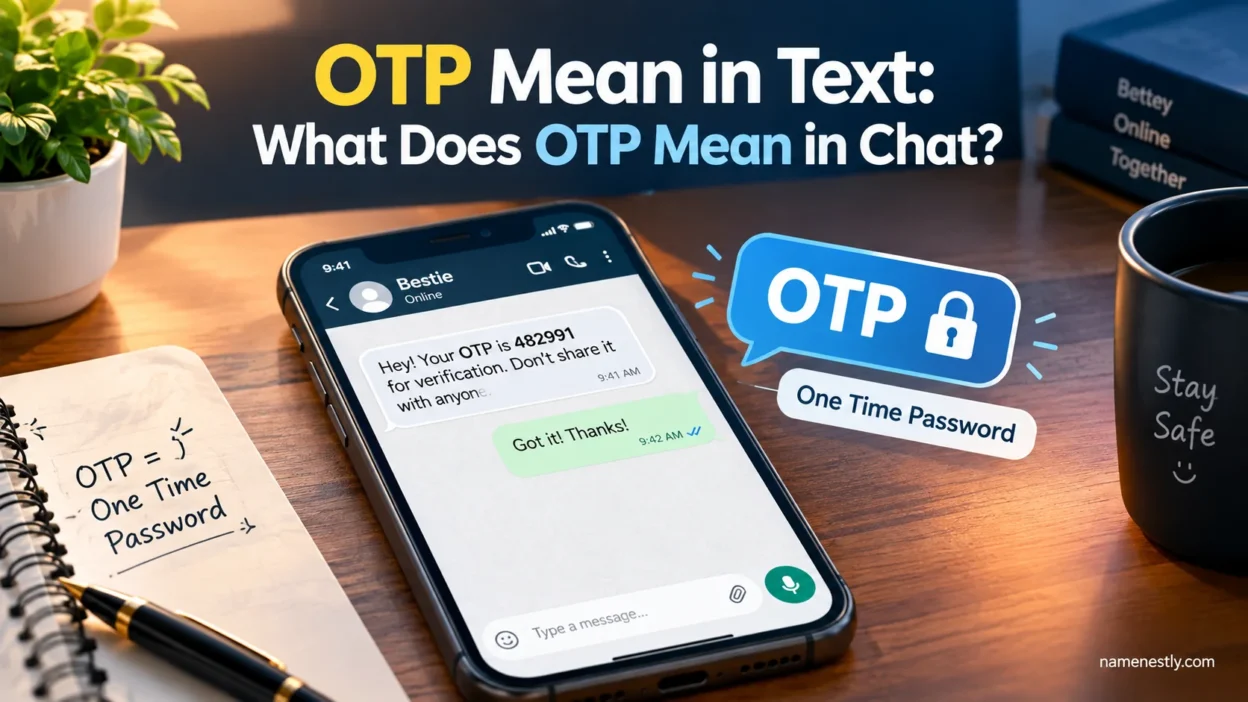
If someone sends you “Did you get the OTP?”, they probably aren’t talking about a favorite fictional couple. However, if someone says “They’re my OTP,” the meaning changes completely. This tiny abbreviation has two very different meanings in modern online communication.
The most common meaning in security-related conversations is One-Time Password. People use this term when discussing login verification, banking, payments, account access, and two-factor authentication. In fandom communities, however, OTP usually means One True Pairing. Fans use it to describe a fictional couple they especially support or love.
Understanding OTP mean in text therefore requires more than memorizing one definition. You need to look at the surrounding conversation. A message about a verification code points toward security. A discussion about characters, romance, anime, television shows, or fanfiction points toward fandom terminology.
This guide explains both meanings in detail. It also covers examples, social media usage, related abbreviations, and practical ways to determine which definition someone intended.
Quick Answer:
OTP in text usually means either “One-Time Password” or “One True Pairing.” The context tells you which meaning applies.
When the conversation involves banking, payments, account verification, login codes, or security, OTP usually means One-Time Password.
For example:
“I can’t log in because I haven’t received the OTP.”
Here, OTP refers to a temporary verification code.
When the conversation involves fictional characters, couples, movies, television shows, anime, books, or fandoms, OTP usually means One True Pairing.
For example:
“Those two are my OTP!”
Here, the person is talking about a favorite fictional pairing.
A simple rule makes the distinction easier:
| Conversation topic | Meaning of OTP |
| Banking | One-Time Password |
| Login verification | One-Time Password |
| Online payment | One-Time Password |
| Account security | One-Time Password |
| Anime fandom | One True Pairing |
| TV shows | One True Pairing |
| Movies | One True Pairing |
| Fanfiction | One True Pairing |
| Fictional romance | One True Pairing |
Comparison Overview
The two meanings share the same abbreviation, but they belong to completely different areas of communication. One relates to digital security, while the other comes from fandom culture.
| Feature | One-Time Password | One True Pairing |
| Full meaning | One-Time Password | One True Pairing |
| Main area | Cybersecurity and authentication | Fandom and popular culture |
| Typical use | Verification code | Favorite fictional couple |
| Common setting | Banking, websites, apps | Anime, movies, books, TV |
| Example | “Enter the OTP.” | “They’re my OTP.” |
| Meaning of “my OTP” | Usually uncommon in this sense | Favorite pairing |
| Related terms | 2FA, MFA, verification code, PIN | Ship, shipping, canon, fanfiction |
| Nature | Technical/security term | Informal fandom expression |
The surrounding words usually make the intended meaning obvious. If someone asks whether you received an OTP, they’re probably referring to a code. If someone asks about your favorite OTP, they’re probably asking about a fictional pairing.
Main Differences Between OTP Mean in Text
The biggest difference comes from context. One meaning describes a temporary security credential. The other describes a preferred fictional relationship.
OTP as One-Time Password
A One-Time Password is a temporary code used to verify someone’s identity or authorize an action.
You might receive one when you:
- Log into an account
- Confirm a new device
- Reset a password
- Approve an online payment
- Verify a phone number
- Confirm certain account changes
- Complete an authentication step
The code usually has a limited validity period or becomes unusable after successful use. Depending on the service, it might contain numbers or a mixture of letters and numbers.
For example:
“The website sent an OTP to my phone.”
The speaker isn’t asking about slang. They’re referring to a verification credential.
OTP as One True Pairing
In fandom language, One True Pairing describes a fictional couple that a fan particularly supports.
Someone might say:
“They’ve always been my OTP.”
This means the speaker strongly favors that pairing.
The characters don’t necessarily need to be romantically involved in the official story. Fans can support relationships that exist in canon, relationships that remain implied, or even relationships created through fan interpretation.
This meaning commonly appears in discussions about:
- Anime
- Manga
- TV shows
- Movies
- Books
- Video games
- Comics
- Fanfiction
- Online fandom communities
The phrase often carries emotional enthusiasm. Saying someone is your OTP usually communicates more than simple recognition of a fictional relationship.
What Does OTP Mean in Text Messages?
In ordinary text messages, OTP can mean either definition. You need to examine what the conversation discusses.
Consider these two messages:
“The bank sent me an OTP.”
This clearly points toward One-Time Password.
Now compare:
“I can’t believe they finally became canon. They’re my OTP!”
This clearly points toward One True Pairing.
The abbreviation doesn’t change. The context does.
That distinction matters because blindly interpreting every OTP as a password can create confusion. Likewise, interpreting every OTP as a fictional couple would make little sense in a banking conversation.
OTP Meaning in Social Media
Social media has helped expand the fandom meaning of OTP. Users often discuss fictional relationships in short posts where abbreviations make communication faster.
You may encounter phrases such as:
- “My OTP forever.”
- “Who’s your OTP?”
- “I still ship this OTP.”
- “This is the best OTP.”
- “That scene made me love this OTP.”
- “My childhood OTP is back.”
- “I need more content about this OTP.”
In these examples, OTP means One True Pairing.
The term frequently appears alongside ship or shipping. A “ship” refers to a relationship that fans support. “Shipping” describes the act of supporting or imagining that relationship.
For example, someone might say:
“I started shipping them after season two. Now they’re my OTP.”
The speaker has moved from simply noticing the relationship to strongly identifying with the pairing.
However, the security meaning also appears across social platforms. A person might post:
“My OTP isn’t arriving.”
In that case, the surrounding conversation could reveal that they’re waiting for an account verification code.
OTP Meaning in Different Contexts
Context provides the strongest clue when you’re unsure about OTP mean in text.
| Context | Likely meaning | Example |
| Banking | One-Time Password | “Enter the OTP to continue.” |
| Online payment | One-Time Password | “The payment requires an OTP.” |
| Account login | One-Time Password | “I didn’t receive my OTP.” |
| Phone verification | One-Time Password | “Check your phone for the OTP.” |
| Password reset | One-Time Password | “Use the OTP to verify your account.” |
| Anime | One True Pairing | “They’re my OTP.” |
| TV series | One True Pairing | “That’s my favorite OTP.” |
| Movies | One True Pairing | “I shipped this OTP immediately.” |
| Fanfiction | One True Pairing | “I only read stories about my OTP.” |
| Fictional romance | One True Pairing | “Their relationship is my OTP.” |
This table gives you a quick way to interpret the abbreviation without overthinking it.
Examples of OTP in Text Messages
Realistic examples make the difference between the two meanings much easier to understand.
One-Time Password Examples
Example 1:
“I need the OTP before I can log in.”
Here, OTP means a temporary verification code.
Example 2:
“Did the OTP arrive on your phone?”
The speaker is asking whether the recipient received an authentication code.
Example 3:
“The payment page is asking for an OTP.”
This refers to a security verification step during a transaction.
Example 4:
“My OTP expired. Can you send another one?”
The message describes a temporary code that can no longer be used.
Example 5:
“I received an OTP for the new device.”
The abbreviation refers to an authentication code used during account access.
In security conversations, words such as code, verify, login, payment, account, phone, security, and authentication often appear near OTP.
One True Pairing Examples
Example 1:
“Those characters are my OTP.”
The person strongly supports that fictional pairing.
Example 2:
“Who is your OTP from this show?”
The speaker wants to know which fictional couple someone prefers.
Example 3:
“Their chemistry made them my OTP.”
The person supports the relationship because of the characters’ interactions.
Example 4:
“I can’t stop reading OTP fanfiction.”
The speaker is talking about stories centered around a favored fictional pairing.
Example 5:
“They aren’t canon, but they’re still my OTP.”
This shows that a fan can support a pairing even when the official story doesn’t confirm the relationship.
How to Tell Which OTP Meaning Someone Means
When a message only contains the abbreviation, don’t immediately guess. Look at the surrounding words.
Look for Security Words
Words such as these usually indicate One-Time Password:
- Login
- Verification
- Code
- Account
- Payment
- Bank
- Security
- Authentication
- Phone number
- Confirm
- Sign in
- Reset
For example:
“I need the OTP to confirm my payment.”
The financial context makes the intended meaning clear.
Look for Fandom Words
These words often point toward One True Pairing:
- Ship
- Shipping
- Couple
- Character
- Canon
- Fanfiction
- Romance
- Anime
- Manga
- Episode
- Season
- Fandom
For example:
“That couple became my OTP after episode eight.”
The entertainment context clearly indicates the fandom meaning.
Use the Simple Context Test
Ask yourself one question:
Is this conversation about security or relationships?
If it’s about security, OTP probably means One-Time Password.
If it’s about fictional relationships, OTP probably means One True Pairing.
That quick test solves most everyday examples.
OTP vs Other Common Texting Abbreviations
OTP sometimes appears alongside other abbreviations. Understanding them can prevent confusion.
| Abbreviation | Meaning | Common context |
| OTP | One-Time Password | Security |
| OTP | One True Pairing | Fandom |
| 2FA | Two-Factor Authentication | Account security |
| MFA | Multi-Factor Authentication | Account security |
| PIN | Personal Identification Number | Security and payments |
| IDK | I Don’t Know | General texting |
| IMO | In My Opinion | General texting |
| IRL | In Real Life | Online conversations |
| BTW | By The Way | General texting |
These abbreviations don’t necessarily describe the same thing. OTP can refer to a specific authentication code or a fictional relationship. 2FA and MFA describe broader authentication approaches.
Read More: MHM Meaning in Text: What Does MHM Mean in Chat?
OTP vs 2FA and MFA
People sometimes confuse OTP with 2FA because both appear during account verification.
They aren’t interchangeable terms.
OTP refers to a temporary password or verification code.
2FA, meaning Two-Factor Authentication, refers to an authentication process that requires two different factors.
For example, an account might ask for:
- Your password
- A temporary verification code
The password represents one authentication factor. The OTP may provide another.
MFA, or Multi-Factor Authentication, is a broader term for authentication involving multiple factors.
The important distinction is simple:
OTP can be a method used within an authentication process. 2FA describes a two-factor authentication setup.
A PIN also differs from an OTP. A PIN generally remains associated with an account or card until the user changes it. An OTP is designed for temporary or limited use.
Why One-Time Passwords Are Called “One-Time”
The phrase one-time describes the intended use of the credential.
A traditional password can remain valid until someone changes it or the system requires a reset. An OTP typically has a short validity period or becomes invalid after successful use.
This temporary nature reduces the value of an intercepted code after its intended use.
For example, imagine receiving a six-digit verification code while signing into an account. You enter it successfully. The same code shouldn’t function as a permanent password for future logins.
That temporary characteristic explains why security systems use the term One-Time Password.
Why Fans Use OTP for Fictional Couples
The fandom meaning comes from the idea of having one especially favored pairing.
Fans often develop strong preferences for particular fictional relationships because of:
- Character chemistry
- Emotional development
- Shared experiences
- Story arcs
- Personality contrasts
- Romantic tension
- Character growth
- Memorable scenes
- Narrative compatibility
For instance, two characters might begin as rivals before gradually becoming close. A fan who enjoys that development might call them their OTP.
The term doesn’t necessarily mean everyone agrees with the pairing. It simply communicates the individual fan’s strong preference.
Does OTP Mean the Couple Is Canon?
No.
Calling a fictional pairing your OTP doesn’t automatically mean the relationship exists officially within the story.
A pairing can be:
- Canon
- Implied
- Previously romantic
- Unrequited
- Fan-created
- Based on interpretation
- A popular fan pairing
This distinction matters because fandom discussions often separate what the original creator established from what fans prefer.
For example:
“They’re not canon, but they’re still my OTP.”
This sentence makes perfect sense within fandom culture. The speaker supports the pairing despite the official story not confirming it.
Is OTP Formal or Informal?
The answer depends on which meaning you’re using.
One-Time Password is a standard technical and security term. Banks, websites, applications, and authentication systems commonly use it.
One True Pairing is informal fandom terminology. You’ll mostly encounter it in online communities, social media posts, fanfiction discussions, and entertainment conversations.
You wouldn’t normally use “my OTP” in a formal business email when discussing account security. Likewise, a bank wouldn’t describe a verification code as a favorite pairing.
The surrounding situation determines the appropriate interpretation.
FAQs:
What does OTP mean in texting?
OTP usually means One-Time Password or One True Pairing. Security conversations generally indicate the first meaning, while fandom conversations usually indicate the second.
What does OTP mean on social media?
On social media, OTP can refer to either meaning. In fandom discussions, it commonly means One True Pairing, while account-related posts may use it for One-Time Password.
What does OTP mean in fandom?
In fandom, OTP means One True Pairing. It describes a fictional couple that someone strongly supports or prefers.
What does OTP mean in banking?
In banking and financial security, OTP generally means One-Time Password. It usually refers to a temporary verification code used during authentication or certain transactions.
Does OTP mean One-Time Password or One True Pairing?
It can mean either one. The subject of the conversation determines the intended meaning.
Conclusion:
The meaning of OTP in text depends almost entirely on context. In conversations about banking, login systems, payments, verification, or account security, OTP usually means One-Time Password. It refers to a temporary credential used to verify an identity or authorize an action.
In conversations about anime, movies, television, books, games, fanfiction, or fictional relationships, OTP usually means One True Pairing. It describes a fictional couple that a fan especially supports.