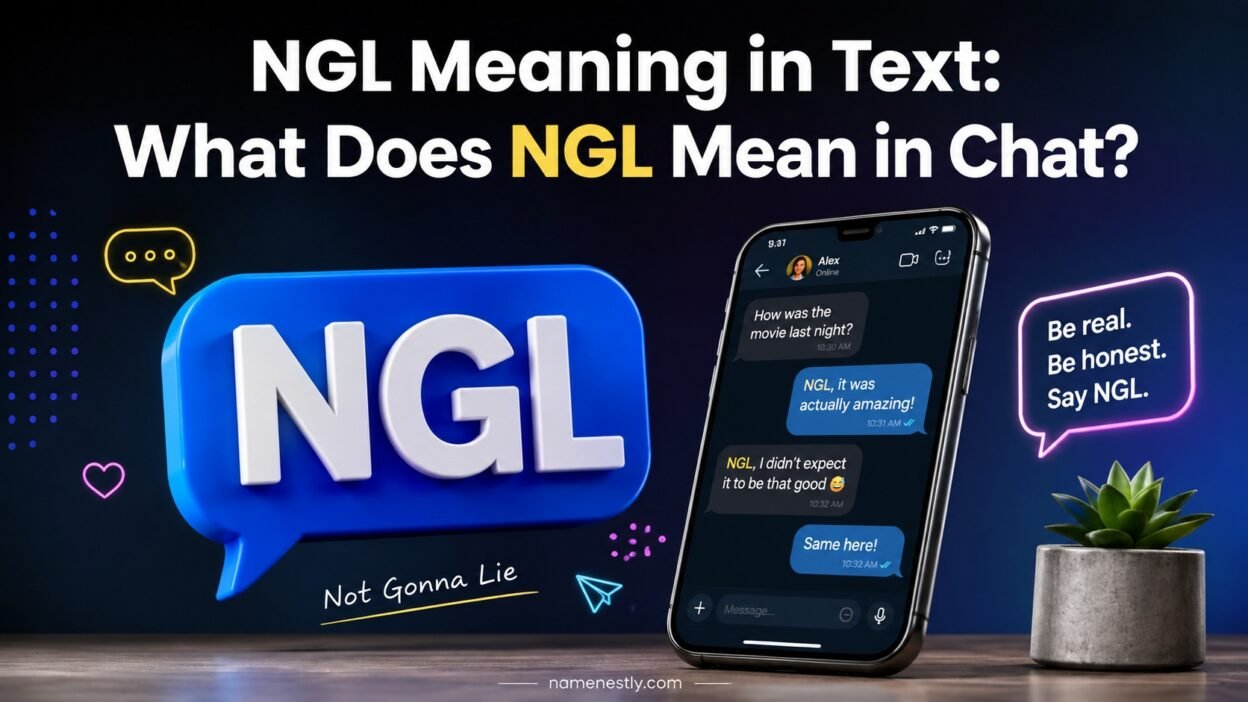
If you’ve ever received a message that starts with “NGL”, you might have wondered what the abbreviation actually means. This short piece of internet slang appears everywhere, from private texts and group chats to Instagram comments, TikTok captions, gaming conversations, and casual social media posts.
NGL means “Not Gonna Lie.” People use it when they want to introduce an honest opinion, reaction, confession, compliment, or admission. It often signals that the person is about to say what they genuinely think.
For example, someone might text, “NGL, that movie was way better than I expected.” Here, NGL tells you that the speaker is giving their honest reaction rather than simply making casual conversation.
Although the meaning looks simple, context matters. The same abbreviation can introduce praise, criticism, embarrassment, attraction, disappointment, or even a funny confession. Understanding the words that follow NGL usually tells you more than the abbreviation itself.
Quick Answer
NGL means “Not Gonna Lie” in text messages and online conversations. It introduces an honest thought, opinion, reaction, or admission. For example, “NGL, I really like this song” means “Not gonna lie, I really like this song.”
NGL is informal internet slang. You’ll commonly see it in texting, social media comments, gaming chats, group conversations, and other casual digital settings.
It can express several things, including:
- An honest opinion
- A personal confession
- A genuine reaction
- A compliment
- A criticism
- Agreement
- Surprise
- Attraction
- An embarrassing admission
The abbreviation itself doesn’t automatically reveal the speaker’s emotion. The rest of the sentence provides that context.
Comparison Overview
NGL belongs to a larger group of abbreviations people use to communicate quickly online. Several expressions have similar meanings, although their tone and purpose can differ.
| Abbreviation | Full Meaning | Common Purpose | Example |
| NGL | Not Gonna Lie | Honest opinion or admission | “NGL, this looks amazing.” |
| TBH | To Be Honest | Direct honesty | “TBH, I didn’t expect that.” |
| IMO | In My Opinion | Personal viewpoint | “IMO, the first one is better.” |
| IMHO | In My Humble Opinion | Personal viewpoint with a softer tone | “IMHO, this design works better.” |
| FR | For Real | Agreement or emphasis | “FR, that was funny.” |
| IKR | I Know, Right? | Strong agreement | “IKR, that ending was wild.” |
NGL and TBH overlap heavily. However, NGL often sounds more conversational because it mirrors the spoken phrase “not gonna lie.”
Main Differences Between NGL Meaning in Text
The biggest difference between NGL and similar expressions comes from how people use them in conversation.
NGL usually introduces something the speaker feels compelled to admit. It can make a statement sound spontaneous or candid.
For example:
“NGL, I didn’t think I’d enjoy the concert.”
The speaker isn’t simply giving an opinion. They’re admitting that their original expectation was wrong.
By comparison:
“IMO, the concert was too long.”
This directly identifies the statement as an opinion. It doesn’t carry the same sense of personal admission.
That small difference matters when interpreting casual messages.
What Does NGL Mean in Text?
NGL stands for “Not Gonna Lie.” It’s a shortened version of a phrase people use when they want to emphasize honesty.
The expression usually appears before a statement.
For example:
- “NGL, I’m exhausted.”
- “NGL, you did a great job.”
- “NGL, I didn’t like the ending.”
- “NGL, that was hilarious.”
- “NGL, I was nervous.”
In each case, NGL works like a conversational signal. It tells the reader, I’m about to give you my genuine reaction.
The phrase doesn’t necessarily imply that the speaker has been dishonest before. That’s a common misunderstanding.
If someone writes “NGL, this is my favorite,” they aren’t necessarily suggesting they lied earlier. They’re simply emphasizing that they’re being straightforward.
How NGL Is Used in Text Messages
NGL works in many types of everyday digital conversations. Its meaning stays consistent, but the emotional tone changes depending on what follows it.
NGL Before an Honest Opinion
This is probably the most common use.
Someone may write:
“NGL, I think the blue one looks better.”
The speaker uses NGL to emphasize that the opinion is genuine.
Another example:
“NGL, I thought the first episode was boring.”
The abbreviation gives the statement a casual, candid quality.
NGL Before a Confession
NGL can also introduce something personal or slightly embarrassing.
For example:
“NGL, I checked the menu before we went there.”
Or:
“NGL, I was scared to send that message.”
Here, NGL creates a small sense of openness. The speaker admits something without making the conversation overly serious.
NGL Before a Compliment
People often use NGL when giving compliments because it can make the praise feel spontaneous.
For example:
“NGL, that outfit looks really good on you.”
Or:
“NGL, your new profile picture looks amazing.”
The abbreviation doesn’t make the compliment romantic by itself. Context determines whether the message sounds friendly, affectionate, or flirtatious.
NGL Before Criticism
NGL can also introduce a negative opinion.
For example:
“NGL, the new update made the app harder to use.”
Or:
“NGL, I didn’t enjoy the ending.”
The phrase can soften the delivery slightly because it frames the criticism as an honest reaction. However, it doesn’t automatically make criticism polite.
NGL Meaning on Social Media
On social media, NGL works almost like a conversational opening phrase.
You’ll often see it in:
- Instagram comments
- TikTok captions
- YouTube comments
- Facebook posts
- X posts
- Snapchat messages
- Reddit discussions
- Gaming communities
For example:
“NGL, this trend is actually fun.”
A user might also comment:
“NGL, I wasn’t expecting this result.”
Social media encourages short, informal communication. NGL fits naturally into that environment because it communicates attitude without requiring a long explanation.
It also works well because readers already understand the abbreviation as common online shorthand.
NGL Meaning in Different Chat Contexts
| Context | What NGL Usually Signals | Example |
| Casual texting | Honest reaction | “NGL, I’m tired.” |
| Friendship | Genuine opinion | “NGL, that was hilarious.” |
| Dating | Personal admission | “NGL, I missed you.” |
| Gaming | Honest assessment | “NGL, that boss was difficult.” |
| Social media | Genuine reaction | “NGL, this trend is good.” |
| School chat | Casual opinion | “NGL, that assignment was long.” |
| Group chat | Candid comment | “NGL, we should’ve left earlier.” |
The context doesn’t change what NGL stands for. It changes what the speaker wants to communicate through the statement.
NGL Examples in Texting
Realistic examples make the slang easier to understand.
“NGL, that was actually funny.”
The person genuinely found something amusing.
“NGL, I forgot about the meeting.”
The speaker openly admits forgetting.
“NGL, I’m impressed.”
The person expresses genuine admiration or surprise.
“NGL, I don’t like this update.”
The abbreviation introduces an honest negative opinion.
“NGL, you did a great job.”
The person emphasizes that the compliment is sincere.
“NGL, I thought it would be easier.”
The speaker admits that their expectation was different.
“NGL, this is probably my favorite one.”
The person gives a genuine preference.
“NGL, I was nervous before the interview.”
The speaker openly shares a personal feeling.
The pattern stays remarkably simple: NGL + honest statement.
Read More: IMO Meaning in Text: What Does IMO Mean in Chat?
NGL vs. Other Similar Texting Abbreviations
NGL isn’t the only abbreviation people use to signal honesty or personal opinion. Understanding the differences can prevent confusion.
NGL vs. TBH
NGL means “Not Gonna Lie.”
TBH means “To Be Honest.”
They often perform the same conversational function.
For example:
- “NGL, that was difficult.”
- “TBH, that was difficult.”
Both communicate honesty.
However, NGL often feels slightly more conversational because it directly resembles spoken language.
NGL vs. IMO
IMO means “In My Opinion.”
The distinction is straightforward.
NGL emphasizes honesty or candidness.
IMO emphasizes personal viewpoint.
Compare:
“NGL, I really enjoyed it.”
with:
“IMO, it’s the best option.”
The first sounds like an admission. The second simply presents an opinion.
NGL vs. IMHO
IMHO means “In My Humble Opinion.”
It’s another way to introduce a personal viewpoint.
For example:
“IMHO, the original version was better.”
Compared with NGL, IMHO focuses more directly on opinion rather than a candid admission.
NGL vs. FR
FR means “For Real.”
People commonly use it to show agreement or emphasize sincerity.
For example:
“FR, that movie was incredible.”
Someone might reply:
“NGL, I loved it too.”
These expressions can appear together because they perform different conversational jobs.
NGL vs. TBH: What’s the Difference?
NGL and TBH are probably the closest alternatives.
Both introduce honest statements, but they carry slightly different conversational flavors.
| Feature | NGL | TBH |
| Full form | Not Gonna Lie | To Be Honest |
| Main purpose | Candid admission | Honest statement |
| Tone | Casual | Casual |
| Common placement | Often at the beginning | Beginning, middle, or end |
| Formal writing | Generally unsuitable | Generally unsuitable |
| Example | “NGL, I’m tired.” | “TBH, I’m tired.” |
In everyday texting, you can often replace one with the other without changing the basic meaning.
Still, native speakers may choose one based on rhythm or personal style.
What Does NGL Mean From a Girl?
When a girl uses NGL, the abbreviation still means “Not Gonna Lie.” It doesn’t have a separate female-specific definition.
The surrounding message matters more.
For example:
“NGL, you look really good today.”
This could be a friendly compliment or something more personal. The abbreviation itself doesn’t establish romantic interest.
Likewise:
“NGL, that movie was terrible.”
That’s simply an opinion.
The safest way to interpret the message is to read the complete sentence and consider the conversation around it.
What Does NGL Mean From a Guy?
A guy using NGL also means “Not Gonna Lie.”
The abbreviation doesn’t change based on who sends it.
For example:
“NGL, I was nervous.”
That’s an admission.
“NGL, your idea was pretty good.”
That’s a compliment.
“NGL, I don’t understand this game.”
That’s an honest statement.
The speaker’s gender doesn’t determine the meaning. Context does.
What Does NGL Mean in a Text From Someone You Like?
When someone you like sends an NGL message, it’s tempting to search for hidden meaning.
However, NGL alone doesn’t prove romantic interest.
Consider these examples:
“NGL, I missed talking to you.”
This expresses a personal admission. Depending on the broader relationship, it could carry emotional or romantic weight.
Now consider:
“NGL, that restaurant was amazing.”
That’s simply an opinion about food.
The difference comes from the words surrounding NGL.
Look at the complete message, previous conversations, relationship context, and overall tone rather than treating NGL as a secret romantic code.
Can NGL Be Used in Formal Communication?
Generally, NGL belongs in informal communication.
It works naturally in:
- Text messages
- Social media
- Group chats
- Casual emails between friends
- Gaming chats
- Online comments
It usually doesn’t belong in:
- Academic essays
- Business reports
- Professional proposals
- Formal applications
- Legal documents
- Official correspondence
Instead of writing:
“NGL, this strategy has several problems.”
A formal document could say:
“This strategy has several potential problems.”
Or:
“To be honest, this strategy has several limitations.”
The key issue isn’t that NGL is wrong. It’s that the abbreviation carries a strongly informal tone.
How to Reply When Someone Says NGL
Your response depends on what the person says after NGL.
If you agree, you can say:
“Honestly, same.”
If you want more details:
“What makes you say that?”
For a playful conversation:
“NGL, I was thinking the same thing.”
If they compliment you:
“Haha, thank you!”
If they make a surprising confession:
“Wait, seriously?”
You don’t need a special response just because someone uses NGL. Treat it as an ordinary conversational phrase.
Common Misunderstandings About NGL
Several misconceptions appear because people sometimes treat internet abbreviations like fixed codes.
NGL Doesn’t Mean Someone Was Lying
The phrase “Not Gonna Lie” emphasizes the following statement.
It doesn’t automatically accuse anyone of lying earlier.
NGL Doesn’t Always Signal a Confession
NGL can introduce a simple opinion.
“NGL, this pizza is great.”
That’s hardly a dramatic confession.
NGL Doesn’t Automatically Mean Romantic Interest
Someone can use NGL while discussing food, movies, sports, games, school, work, or almost anything else.
NGL Doesn’t Have a Gender-Specific Meaning
The abbreviation has the same basic meaning regardless of who sends it.
Context Determines the Tone
The words after NGL usually provide the emotional meaning.
“NGL, I’m proud of you.” sounds supportive.
“NGL, that was disappointing.” sounds critical.
Same abbreviation. Completely different message.
FAQs:
What does NGL stand for in texting?
NGL stands for “Not Gonna Lie.” People use it to introduce an honest opinion, reaction, admission, or confession.
What does NGL mean on Snapchat?
On Snapchat, NGL generally means “Not Gonna Lie.” The sender may use it before sharing an honest reaction or personal statement.
What does NGL mean on Instagram?
On Instagram, NGL means “Not Gonna Lie.” You’ll commonly see it in comments, captions, replies, and direct messages.
What does NGL mean on TikTok?
On TikTok, NGL usually means “Not Gonna Lie.” Users may place it before an opinion about a video, trend, creator, or situation.
Is NGL slang?
Yes. NGL is informal internet slang and a texting abbreviation. It’s most appropriate for casual digital communication.
Conclusion:
NGL means “Not Gonna Lie.” It’s a casual abbreviation people use to signal honesty before sharing an opinion, reaction, confession, compliment, or admission. You’ll commonly encounter NGL in texts, social media posts, comments, gaming chats, and group conversations. Its meaning remains consistent even though the emotional tone can change dramatically.