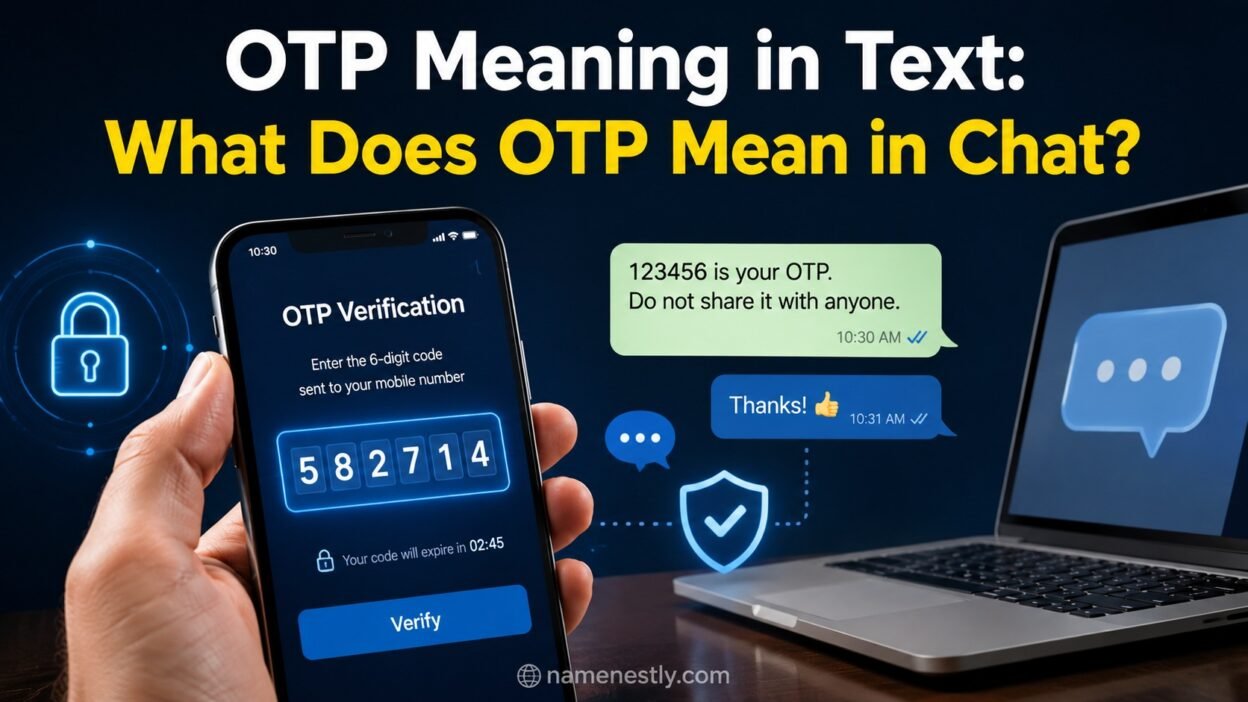
Seeing OTP in a text message can leave you wondering what the sender actually means. The same three letters appear in security messages, fandom conversations, social media posts, and everyday chats. Context usually provides the answer.
In technology and online security, OTP commonly means “One-Time Password.” It refers to a temporary code that helps verify your identity when you log in, make a payment, or complete another protected action.
However, internet communities use OTP differently. In fandom and relationship discussions, OTP means “One True Pairing.” People use it when talking about a fictional couple or pairing they strongly support.
That difference matters. If someone says, “Enter the OTP sent to your phone,” they’re talking about a security code. If someone says, “Those two characters are my OTP,” they’re talking about a favorite pairing.
This guide explains OTP meaning in text, its different uses, examples, related abbreviations, and the clues that help you understand which meaning someone intends.
Quick Answer:
OTP meaning in text depends on the conversation. The two most common meanings are One-Time Password and One True Pairing.
One-Time Password refers to a temporary verification code used for security. Banks, websites, apps, and online services may send an OTP when you sign in or confirm an action.
One True Pairing refers to a favorite fictional relationship or character pairing. Fans commonly use it when discussing movies, television shows, anime, books, comics, and video games.
For example:
- “Enter the OTP to verify your account.” → One-Time Password
- “They’ll always be my OTP.” → One True Pairing
- “I just received an OTP from my bank.” → One-Time Password
- “Those characters are definitely my OTP.” → One True Pairing
So, when you see OTP in a text, don’t assume it has only one definition. Look at the surrounding words first.
Comparison Overview
The easiest way to understand OTP meaning in text is to compare its two major meanings side by side.
| OTP Meaning | Full Form | Where It’s Used | Example |
| OTP | One-Time Password | Banking, accounts, apps, payments | “Enter the OTP to continue.” |
| OTP | One True Pairing | Fandoms, social media, entertainment | “They’re my favorite OTP.” |
| OTP | One-Time Password | Login verification | “I received an OTP by SMS.” |
| OTP | One True Pairing | Fictional relationships | “That couple is my OTP.” |
The difference becomes obvious once you identify the topic.
A message about logging in, verification, banking, or account security almost certainly uses OTP to mean One-Time Password.
A message about characters, couples, fictional stories, shipping, or fandoms usually uses OTP to mean One True Pairing.
Main Differences Between OTP Meaning in Text
The biggest difference between the two meanings involves purpose.
A One-Time Password serves a practical security function. It proves that someone attempting to access an account or complete an action has access to a particular device, phone number, email account, or authentication method.
A One True Pairing serves a social and entertainment purpose. It describes a fictional pairing that a fan particularly likes or supports.
Think of them as two completely different worlds sharing the same abbreviation. One protects an account. The other represents a fan’s favorite fictional relationship.
| Feature | One-Time Password | One True Pairing |
| Main purpose | Identity verification | Expressing fandom preference |
| Common setting | Banking and technology | Entertainment and social media |
| Usually temporary? | Yes | No |
| Refers to people or characters? | No | Usually fictional characters |
| Common phrase | “Enter the OTP” | “My OTP” |
| Security-related? | Yes | No |
| Common online communities | Banking, apps, websites | Fandoms, forums, social platforms |
Understanding this distinction prevents some surprisingly awkward misunderstandings.
What Does OTP Mean as One-Time Password?
One-Time Password is a temporary authentication code used to verify an action or identity.
Unlike a permanent password, an OTP normally works for a limited period or a specific authentication attempt. Depending on the system, the code may expire after a short period or become invalid once someone successfully uses it.
You may receive an OTP through:
- SMS
- An authentication app
- A hardware security token
- Another approved authentication system
For example, suppose you log into an online banking account from a new device. The service may ask for an OTP after you enter your regular password.
You receive a temporary code on your registered phone. Entering that code provides another layer of verification.
Why Do Websites Use OTPs?
Passwords alone can become compromised. Someone might steal, guess, reuse, or obtain a password through phishing.
An OTP adds another verification step.
For example, imagine someone knows your account password. If the service also requires a temporary code sent to your registered device, knowing the password alone may not be enough to complete the login.
That doesn’t make OTP-based security foolproof. Attackers can still use phishing, social engineering, malware, or other techniques to trick people into revealing verification codes.
Where Might You See a One-Time Password?
You may encounter an OTP when:
- Logging into an account
- Confirming a new device
- Resetting a password
- Verifying a phone number
- Confirming certain financial transactions
- Creating or recovering an account
- Completing identity verification
The exact process varies between services.
Example of OTP as One-Time Password
Consider this text:
“Your verification OTP is required to complete your login.”
Here, OTP clearly means One-Time Password.
The surrounding words provide the clue. “Verification” and “login” both point toward the security meaning.
What Does OTP Mean as One True Pairing?
In fandom culture, OTP means “One True Pairing.”
Fans use the term when they strongly favor a particular relationship or pairing between characters. The characters usually come from fictional entertainment such as television shows, movies, anime, books, comics, or video games.
For example:
“Those two characters are my OTP.”
The speaker isn’t asking for a security code. They’re saying that the pairing is one of their favorite relationships within that fictional universe.
The phrase doesn’t necessarily mean the characters have to be officially together. A fan can describe a pairing as an OTP even when the relationship remains fictional, complicated, unconfirmed, or even impossible within the original story.
What Does “My OTP” Mean?
“My OTP” means “my One True Pairing.”
It’s a way for someone to emphasize a favorite fictional pairing.
For example:
- “They’re my OTP.”
- “This will always be my OTP.”
- “I started watching the show because of this OTP.”
- “Their chemistry makes them my OTP.”
The expression often appears in fandom posts, fan art, edits, discussions, memes, and social media comments.
OTP and Fictional Relationships
The fandom meaning usually focuses on the relationship between characters, rather than the individual characters themselves.
Someone might enjoy a character without considering that character part of their OTP.
For instance, a fan could say:
“She’s my favorite character, but those two are my OTP.”
That sentence separates an individual favorite from a favorite pairing.
OTP Meaning in Fandom Discussions
Fandom communities have developed their own vocabulary for discussing fictional relationships. OTP is one of the most recognizable terms in that vocabulary.
You’ll often see it alongside words such as ship, shipping, and OT3.
“Shipping” generally means supporting or enjoying a particular relationship between characters. A “ship” refers to the pairing itself.
OTP carries a stronger personal preference. Someone may enjoy several ships while still describing one particular pairing as their OTP.
OTP vs Ship
A ship is a relationship or pairing that someone supports or enjoys.
An OTP is a particularly favored pairing.
For example, someone might enjoy several relationships within a television series. They could call one of those relationships their OTP because it holds special importance to them.
The terms overlap, but they aren’t always interchangeable.
What Is an OT3?
OT3 generally means One True Threesome in fandom terminology.
It describes a favored three-person relationship or pairing dynamic. The exact interpretation can vary between communities.
The important point is that OTP doesn’t always describe every possible favorite relationship. Fandom terminology can become more specific as the number and nature of characters change.
Read More: NGL Meaning in Text: What Does NGL Mean in Chat?
OTP Meaning on Social Media
Social media has made both meanings of OTP easy to encounter.
On platforms where people discuss technology, banking, or account access, OTP usually means One-Time Password.
On entertainment-focused accounts, OTP often means One True Pairing.
The surrounding post usually makes the intended meaning obvious.
For example:
Security context:
“Why hasn’t my OTP arrived yet?”
This likely concerns a verification code.
Fandom context:
“I can’t believe they finally got together. My OTP!”
This clearly concerns a fictional relationship.
OTP on TikTok and Instagram
Entertainment communities often use OTP in captions, comments, edits, and fan discussions.
A video featuring two fictional characters might receive comments such as:
- “They’re my OTP.”
- “Best OTP ever.”
- “I still ship this OTP.”
- “This OTP owns my heart.”
Meanwhile, an account-related message might use OTP in a completely different setting.
OTP on Reddit and Discord
Fandom communities on Reddit and Discord frequently develop their own shorthand. OTP can appear naturally alongside terms such as “ship,” “canon,” “fanon,” and “headcanon.”
In technical communities, however, OTP can refer to authentication.
That’s why the same abbreviation can appear repeatedly across the internet while carrying different meanings.
How to Know Which OTP Meaning Someone Means
Context is your best clue.
Before interpreting OTP, examine the words around it. The topic usually reveals the intended definition within seconds.
Look for these signals:
- Login, account, password, verification, code → One-Time Password
- Bank, payment, transaction, security → One-Time Password
- Characters, couple, ship, fandom → One True Pairing
- Movie, anime, show, book, game → One True Pairing
- Fan art, fictional romance, character edits → One True Pairing
The sentence itself can also provide a strong clue.
OTP in a Security Conversation
Consider these examples:
“The website sent me an OTP.”
“I need the OTP to finish the payment.”
“My OTP expired before I entered it.”
All three examples point toward One-Time Password.
Words such as “sent,” “payment,” and “expired” fit the security meaning naturally.
OTP in a Fandom Conversation
Now consider these:
“They have such good chemistry. They’re my OTP.”
“I still love this OTP after all these years.”
“That scene completely changed my view of this OTP.”
These sentences clearly describe a fictional relationship.
The surrounding topic does the heavy lifting.
OTP Meaning in Text Examples
Realistic examples make the distinction easier to remember.
| Text Message | Meaning | Why |
| “Please enter the OTP.” | One-Time Password | A code is being requested |
| “My OTP just expired.” | One-Time Password | Temporary codes expire |
| “I never received my OTP.” | One-Time Password | A verification code is expected |
| “They’re my OTP.” | One True Pairing | A favorite pairing is being discussed |
| “That OTP deserved a better ending.” | One True Pairing | The message discusses fictional characters |
| “This is still my favorite OTP.” | One True Pairing | The speaker expresses fandom preference |
| “The bank sent an OTP.” | One-Time Password | Banking requires verification |
| “Everyone in the fandom loves this OTP.” | One True Pairing | Fandom context makes the meaning clear |
A Simple Context Test
When you see OTP, ask one question:
“Is this conversation about security or entertainment?”
If it’s about security, OTP probably means One-Time Password.
If it’s about fictional relationships, OTP probably means One True Pairing.
This quick test solves most everyday uses.
Is OTP Used Only for One-Time Password?
No. OTP has several meanings, but One-Time Password and One True Pairing dominate everyday online usage.
Abbreviations often develop multiple meanings because different communities create their own shorthand.
Technology users may understand OTP as an authentication code. Fandom communities may immediately think about a favorite fictional couple.
Neither meaning automatically overrides the other.
Context decides.
That’s why dictionary-style definitions alone don’t always explain internet language well. Online communication changes depending on the community, platform, and subject.
How to Reply When Someone Says “OTP”
Your response depends entirely on the situation.
If someone sends:
“What’s the OTP?”
and you’re discussing account verification, they probably want the temporary code.
If you’re discussing a television series and someone says:
“What’s your OTP?”
they’re probably asking which fictional pairing you support most.
When the context isn’t obvious, a short clarification works best:
“Do you mean the verification code or your favorite pairing?”
There’s no need to guess when the conversation provides insufficient clues.
Is OTP Safe to Share in Text?
When OTP means One-Time Password, treat it as sensitive security information.
A verification code can help someone prove access to your account or authorize an action. Sharing it with another person can therefore create a serious security problem.
For example, imagine receiving a phone call from someone claiming to represent a bank. They say they need the OTP that just arrived on your phone.
That request should raise an immediate red flag.
A legitimate security process should not require you to casually hand a verification code to an unknown caller or stranger.
Practical OTP Safety Rules
Keep these habits in mind:
- Never share unexpected OTPs with strangers.
- Don’t post verification codes publicly.
- Don’t send OTP screenshots to other people.
- Don’t approve login requests you didn’t initiate.
- If an unexpected OTP arrives, check your account activity.
- Contact the service through its official support channel if something seems wrong.
- Use strong, unique passwords alongside additional security measures.
An OTP provides an extra security layer. It isn’t a magic shield against every attack.
OTP vs Other Common Texting Abbreviations
OTP can overlap with other technical or fandom terms. Understanding those differences makes online conversations easier to follow.
OTP vs 2FA
2FA means Two-Factor Authentication.
OTP can serve as one factor within a 2FA system, depending on how the service implements authentication.
The terms therefore aren’t exact synonyms.
2FA describes an authentication approach involving two distinct factors. OTP describes a temporary authentication credential.
For example, a service might require your password plus a temporary code.
OTP vs PIN
A PIN is generally a personal identification number used for authentication or access.
An OTP differs because it’s designed for temporary or single-use authentication.
A PIN may remain valid until the user changes it. An OTP generally has a limited validity period or specific use.
OTP vs Verification Code
In everyday conversation, people often use OTP and verification code interchangeably.
That’s because many services send a temporary code specifically for verification.
However, “verification code” is a broader phrase. Not every verification code necessarily follows the exact technical characteristics of an OTP.
FAQs:
What does OTP mean in texting?
In texting, OTP commonly means One-Time Password or One True Pairing. The subject of the conversation determines which meaning applies.
What does OTP mean on social media?
On social media, OTP can mean One-Time Password in account-security discussions or One True Pairing in fandom conversations.
What does OTP mean in relationships?
In fandom discussions, OTP means One True Pairing. It describes a fictional relationship or pairing that someone particularly supports.
What does OTP mean in fandom?
OTP means One True Pairing in fandom culture. Fans use it for a fictional pairing they strongly favor.
Does OTP mean One-Time Password?
Yes. One-Time Password is one of the most common technical meanings of OTP. It refers to a temporary authentication code.
Conclusion:
OTP meaning in text usually falls into two major categories: One-Time Password and One True Pairing. When you see OTP alongside words such as login, verification, payment, account, password, or code, it almost certainly refers to a One-Time Password. When you see OTP alongside words such as characters, couple, ship, fandom, anime, movie, or relationship, it usually means One True Pairing.