If you’ve ever seen “IMO” in a text, comment, or group chat, you might have wondered what those three letters actually mean. The abbreviation appears constantly in casual online conversations, especially when someone wants to share a personal view.
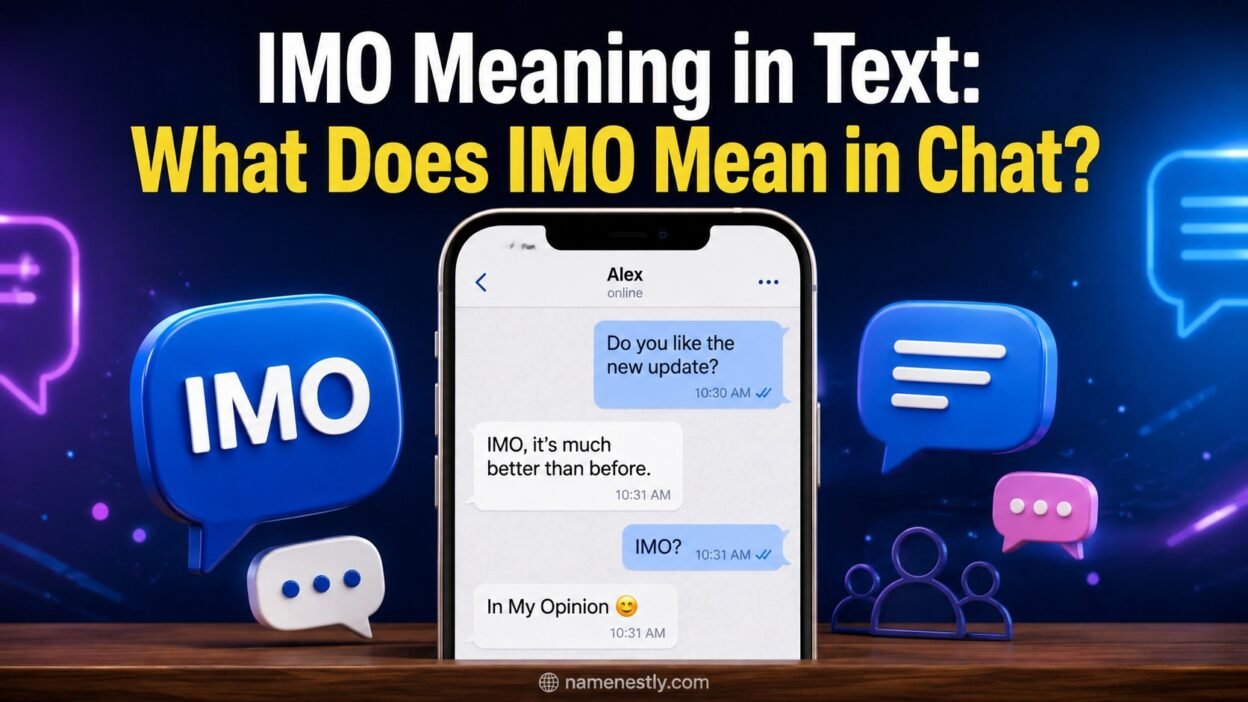
IMO means “in my opinion.” People use it to signal that the statement that follows reflects their personal judgment, preference, or viewpoint. For example, “IMO, this is the best pizza place” tells the reader that the speaker is sharing an opinion rather than stating an objective fact.
The phrase works because it adds a small but useful layer of context. Without IMO, a statement can sometimes sound absolute. With it, the writer makes their position clear. That distinction matters during discussions, recommendations, debates, and everyday conversations.
You’ll commonly find IMO in text messages, social media comments, gaming chats, online forums, group conversations, and casual direct messages. It usually has a relaxed tone and doesn’t require much explanation.
Quick Answer
IMO means “in my opinion.” It’s a common texting and internet abbreviation used when someone wants to introduce or emphasize a personal opinion.
For example:
“IMO, that was the best movie of the year.”
The speaker isn’t claiming that everyone agrees. They’re simply saying that, from their perspective, the movie was the best.
IMO Meaning at a Glance
| Detail | Meaning |
| IMO | In My Opinion |
| Category | Internet abbreviation |
| Primary use | Expressing a personal opinion |
| Tone | Casual and conversational |
| Common locations | Texts, chats, social media, forums, gaming |
| Formal equivalent | “In my opinion” |
| Related abbreviation | IMHO |
Comparison Overview
| Abbreviation | Full Meaning | Main Purpose | Typical Tone |
| IMO | In My Opinion | Expresses a personal viewpoint | Casual |
| IMHO | In My Humble Opinion | Expresses an opinion with a modest tone | Casual |
| TBH | To Be Honest | Introduces a frank or candid statement | Casual |
| IME | In My Experience | Shares something based on personal experience | Casual |
| I think | I think | Introduces a personal belief or judgment | Casual to neutral |
These abbreviations can overlap in everyday conversation, but they aren’t interchangeable in every situation. IMO specifically tells the reader that you’re giving your opinion.
Main Differences Between IMO Meaning in Text
The biggest distinction is simple: IMO marks a statement as a personal opinion.
Compare these two messages:
- “This restaurant has the best burgers in town.”
- “IMO, this restaurant has the best burgers in town.”
The first sounds like a broad claim. The second clearly presents the statement as someone’s personal judgment.
That small difference can change the tone of a conversation. It gives other people room to disagree without treating the disagreement as a correction of fact.
IMO vs IMHO
IMHO means “in my humble opinion.”
Both expressions introduce a personal viewpoint. The main difference comes from tone.
IMO is straightforward:
“IMO, the first game was better.”
IMHO can sound slightly more self-conscious or modest:
“IMHO, the first game was better.”
In modern online communication, people often use both casually. The distinction isn’t always strict.
IMO vs TBH
TBH means “to be honest.”
It doesn’t specifically mean that the following statement represents an opinion. Instead, it signals that the speaker intends to be candid or direct.
For example:
“TBH, I didn’t enjoy the movie.”
This expresses an honest reaction. By contrast:
“IMO, the movie needed a better ending.”
This specifically frames the statement as an opinion.
IMO vs IME
IME means “in my experience.”
The difference matters because experience and opinion aren’t the same thing.
“IME, this software takes a while to learn.”
The writer is referring to personal experience.
“IMO, this software has the best interface.”
The writer is giving a judgment.
A person can base an opinion on experience, but the abbreviations highlight different things.
What Does IMO Mean in Text?
In texting, IMO means “in my opinion.” People use it to quickly introduce a personal belief, preference, recommendation, or judgment.
Because texting favors speed, abbreviations often replace longer expressions. IMO saves several words while still making the speaker’s intention obvious.
You might see messages such as:
- “IMO, pizza is better than burgers.”
- “That was IMO the funniest scene.”
- “IMO, you should choose the blue one.”
- “The second option looks better, IMO.”
The abbreviation doesn’t automatically make an opinion more convincing. It simply identifies the statement as subjective.
Why People Use IMO
People often use IMO because it:
- Clearly marks a personal viewpoint
- Keeps messages short
- Makes casual conversations feel natural
- Helps separate opinions from facts
- Allows disagreement without creating unnecessary tension
- Works well in fast-moving digital conversations
Think of IMO as a small conversational signpost. It tells the reader, “This is how I see it.”
IMO Meaning in Chat
Chat conversations move quickly, so short abbreviations fit naturally into the format. IMO works particularly well when people exchange recommendations, reactions, preferences, or judgments.
For example, imagine friends discussing two video games:
Alex: “Which one should I buy?”
Sam: “IMO, get the second one. The gameplay is much better.”
Sam isn’t presenting the recommendation as an undeniable fact. The abbreviation signals that the recommendation comes from personal judgment.
IMO in Group Chats
Group chats often contain different preferences. Adding IMO can make a strong statement sound more clearly personal.
For example:
“IMO, we should meet on Saturday.”
That doesn’t necessarily mean Saturday is objectively the best day. It means the person favors Saturday.
IMO in Online Discussions
Online discussions can become argumentative when people present subjective views as universal truths. IMO can help establish the intended perspective.
For example:
“IMO, the ending was disappointing.”
The statement remains open to discussion. Another person can simply respond:
“I disagree. I thought the ending worked well.”
That creates a conversation rather than a fact-checking dispute.
How to Use IMO in a Text
There isn’t one mandatory position for IMO. You can place it at different points in a sentence depending on the style of your message.
IMO at the Beginning of a Sentence
This is probably the clearest and most common placement.
“IMO, this is the easiest way to do it.”
Starting with IMO immediately tells the reader that you’re about to share a personal view.
This format works especially well when you’re giving advice or evaluating something.
IMO in the Middle of a Message
You can also place IMO within a sentence.
“That is IMO the most interesting part of the story.”
This style is understandable, although it can feel slightly less natural than putting IMO at the beginning or end.
For casual texting, people may use it wherever it fits naturally.
IMO at the End of a Message
IMO can appear at the end of a sentence as well.
“The second option makes more sense, IMO.”
This placement often feels conversational because the writer states the opinion first and then adds the abbreviation as a final signal.
IMO Text Examples
Seeing the abbreviation in different situations makes its meaning easier to understand.
Everyday Conversation
“IMO, weekends go by way too fast.”
Movies
“IMO, the sequel was better than the original.”
Food
“That burger is the best thing on the menu, IMO.”
Gaming
“IMO, the new map is much harder.”
Fashion
“IMO, black sneakers work with almost anything.”
School
“IMO, the second topic would be easier for the presentation.”
Work
“IMO, we should finish the first task before starting another.”
Social Media
“IMO, this trend has already gone too far.”
Notice the pattern. Each example expresses a viewpoint rather than an established fact.
Read More: PMO Meaning in Text: What Does PMO Mean in Chat?
Is IMO Formal or Informal?
IMO is primarily informal. It belongs naturally in texting, messaging, social media, forums, gaming conversations, and other casual digital communication.
You generally wouldn’t use IMO in a formal academic essay unless the context specifically allows conversational language.
Instead of writing:
“IMO, this argument is more convincing.”
A formal document could use:
“In my opinion, this argument is more convincing.”
Even then, formal writing may favor more precise phrasing depending on the subject and purpose.
Where IMO Fits Naturally
- Text messages
- Group chats
- Social media comments
- Online forums
- Gaming chats
- Casual emails
- Direct messages
- Informal discussions
Where the Full Phrase Works Better
- Academic papers
- Formal reports
- Business documents
- Professional correspondence
- Official statements
The key isn’t that IMO is grammatically wrong. The issue is register. Different situations call for different levels of formality.
Is IMO Rude or Disrespectful?
IMO isn’t inherently rude. The surrounding message determines how it comes across.
Compare:
“IMO, I think your idea needs more work.”
with:
“IMO, your idea makes absolutely no sense.”
Both contain IMO. However, the second statement sounds much harsher because of the wording around the abbreviation.
IMO can sometimes soften a statement because it makes the personal nature of the opinion explicit. However, it doesn’t magically make criticism polite.
Respectful Use of IMO
A considerate opinion might look like:
“IMO, the first design looks cleaner, but both options work.”
This acknowledges another person’s effort while still expressing a preference.
Blunt Use of IMO
A more direct message could say:
“IMO, that was a terrible decision.”
The abbreviation doesn’t remove the criticism. It simply tells the reader that the statement represents the speaker’s judgment.
How to Reply When Someone Says IMO
Your response depends on whether you agree, disagree, or want more information.
If You Agree
“IMO, you’re right. The second option is much better.”
If You Disagree
“I see your point, but I prefer the first one.”
If You Want an Explanation
“Interesting. What makes you prefer that one?”
If You Have a Different Opinion
“I feel differently. IMO, the original version worked better.”
If You Want to Keep Things Casual
“Fair enough. I can see why you’d think that.”
The abbreviation doesn’t require a special response. Treat it like any ordinary statement of opinion.
Common Ways People Use IMO
IMO can appear in several sentence patterns.
| Pattern | Example |
| IMO, + opinion | “IMO, this one looks better.” |
| Opinion + IMO | “This one looks better, IMO.” |
| IMO + recommendation | “IMO, you should wait.” |
| IMO + evaluation | “IMO, the ending was weak.” |
| IMO + preference | “IMO, chocolate ice cream wins.” |
The first and last patterns often sound especially natural in casual conversation.
Is “IMO, I Think” Redundant?
Sometimes it is.
For example:
“IMO, I think this is better.”
Both IMO and I think already signal a personal opinion. Using both isn’t necessarily confusing, but it adds unnecessary repetition.
A cleaner version would be:
“IMO, this is better.”
Or:
“I think this is better.”
Shorter usually sounds more natural in fast-paced conversations.
Common Mistakes When Using IMO
Although IMO is simple, a few usage mistakes appear regularly.
Treating an Opinion Like a Fact
IMO signals subjectivity. Don’t use it while pretending your personal preference represents universal truth.
Instead of:
“IMO, everyone knows this is the best movie.”
Consider:
“IMO, this is the best movie in the series.”
The second version keeps the statement clearly personal.
Using IMO Too Often
Repeating IMO in every sentence can make a message feel mechanical.
For example:
“IMO, the food was good. IMO, the service was slow. IMO, the place was expensive.”
One introductory IMO may be enough.
Using IMO in Formal Writing Without Considering Context
Abbreviations suit casual communication. Formal writing usually benefits from complete phrases and a more deliberate tone.
Confusing IMO With IME
Remember the difference:
- IMO: In My Opinion
- IME: In My Experience
One emphasizes a viewpoint. The other emphasizes personal experience.
Confusing IMO With TBH
TBH focuses on honesty or frankness. IMO focuses specifically on opinion.
IMO Meaning in Social Media and Online Conversations
Social media provides one of the most common environments for IMO.
Users often need to express strong preferences without presenting them as objective conclusions. IMO gives them a quick way to establish that distinction.
For example:
“IMO, this is the best album they’ve released.”
A social media commenter can make a strong judgment while recognizing that others may disagree.
Why IMO Works Well Online
Online communication has its own shorthand. Users frequently shorten common expressions because speed matters.
IMO also carries useful conversational information. It tells readers how to interpret what follows.
A statement such as:
“That restaurant is overrated.”
sounds categorical.
Adding IMO:
“IMO, that restaurant is overrated.”
makes the speaker’s position more explicit.
The underlying opinion remains strong. The framing simply changes.
FAQs:
What does IMO mean in texting?
IMO means “in my opinion.” People use it to introduce a personal viewpoint, preference, judgment, or recommendation.
What does IMO stand for?
IMO stands for “in my opinion.” It’s a common abbreviation used in informal digital communication.
Is IMO slang?
IMO is better described as an internet or texting abbreviation. People commonly use it in casual digital conversations rather than formal writing.
Is IMO rude?
No. IMO isn’t inherently rude. The tone depends on the words used around it and the context of the conversation.
What is the difference between IMO and IMHO?
IMO means “in my opinion.” IMHO means “in my humble opinion.” Both introduce personal opinions, while IMHO can carry a slightly more modest tone.
Conclusion:
IMO means “in my opinion,” and its main purpose is straightforward: it tells the reader that the statement reflects a personal viewpoint. You’ll mostly see it in texts, chats, social media comments, gaming conversations, and online discussions. The abbreviation helps people communicate opinions quickly without writing the full phrase.