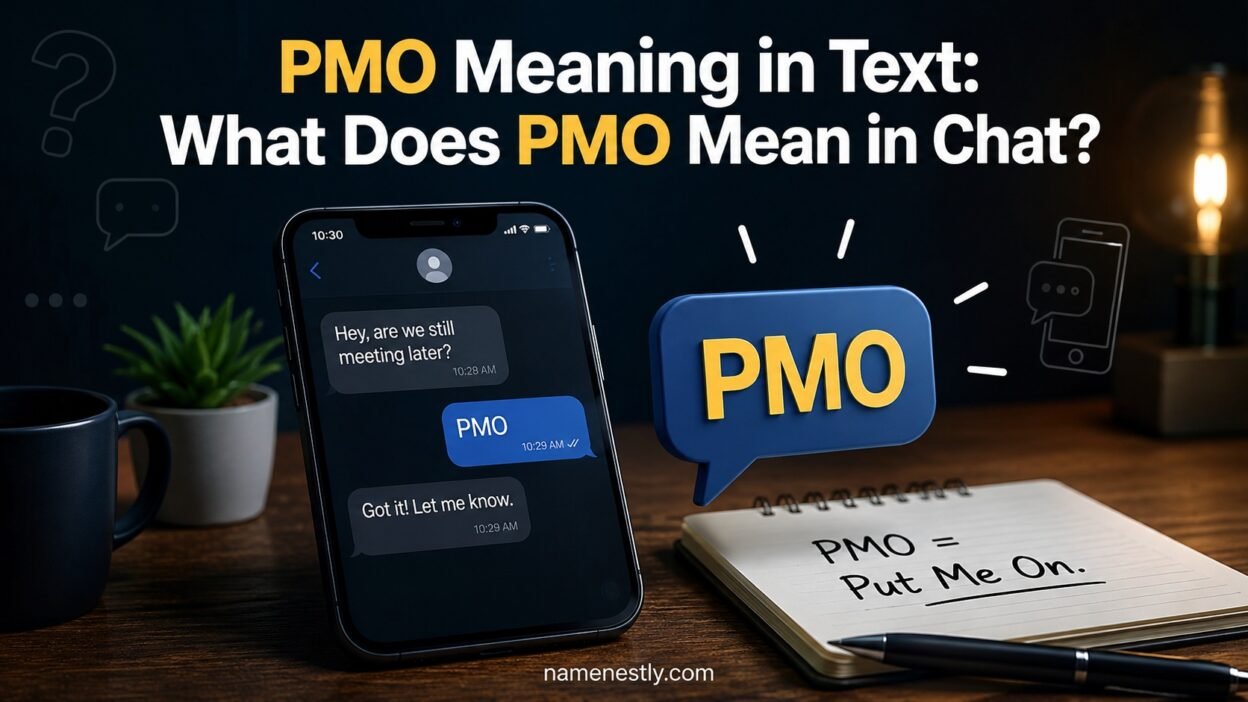
If someone sends you “PMO” in a text, the meaning can change completely depending on the conversation. In one message, PMO might express frustration. In another, it could mean someone wants a recommendation or introduction.
That makes PMO meaning in text a little tricky for anyone unfamiliar with modern texting slang. Unlike traditional abbreviations, PMO has developed more than one popular meaning across social media, messaging apps, gaming chats, and everyday conversations.
The two meanings you’ll encounter most often are “Piss Me Off” and “Put Me On.” The first expresses irritation or anger. The second usually asks someone to recommend or introduce something.
For example, “That attitude really PMO” usually expresses annoyance. Meanwhile, “PMO to some good music” normally means “Put me on to some good music,” which is essentially a request for recommendations.
Quick Answer
PMO meaning in text usually refers to “Piss Me Off” or “Put Me On.”
When someone uses PMO to express frustration, it means “Piss Me Off.” For example, “You really PMO sometimes” means “You really piss me off sometimes.”
When someone asks for a recommendation or introduction, PMO usually means “Put Me On.” For example, “PMO to some good movies” means “Put me on to some good movies.”
| PMO Meaning | What It Means | Common Use |
| Piss Me Off | Make me angry or annoyed | Complaints, arguments, frustration |
| Put Me On | Recommend or introduce something | Music, movies, food, fashion, people |
| Project Management Office | A business function that supports project management | Workplace and business conversations |
The first two meanings are the ones most relevant to casual texting and social media. Project Management Office is a separate professional meaning that appears mainly in workplace contexts.
Comparison Overview
PMO becomes much easier to understand when you compare its common meanings side by side.
| Feature | Piss Me Off | Put Me On |
| Basic meaning | Expresses annoyance | Requests a recommendation or introduction |
| Tone | Frustrated, irritated, sometimes aggressive | Casual, curious, friendly |
| Typical context | Arguments, complaints, bad experiences | Music, movies, food, fashion, trends |
| Example | “That really PMO.” | “PMO to some good songs.” |
| Similar phrase | “That annoys me” | “Recommend something to me” |
| Usually positive? | No | Usually neutral or positive |
| Common online setting | Texts, comments, arguments | DMs, comments, social media |
| Contains profanity? | Yes, indirectly | No |
The biggest clue comes from the subject of the conversation.
If someone talks about something irritating and then says PMO, “Piss Me Off” probably fits. If they’re asking about a song, restaurant, show, game, outfit, or trend, “Put Me On” makes more sense.
Main Differences Between PMO Meaning in Text
The main difference between the two common PMO meanings comes down to emotion versus recommendation.
“Piss Me Off” describes an emotional reaction. Someone uses it when something bothers them or makes them angry.
“Put Me On” describes a request. Someone uses it when they want another person to introduce them to something worth checking out.
Consider these two examples:
“That guy keeps PMO.”
Here, PMO almost certainly means “Piss Me Off.” The sentence describes repeated annoyance.
Now consider:
“PMO to some good rap songs.”
Here, PMO means “Put Me On.” The person wants music recommendations.
The letters haven’t changed. The surrounding context has.
What Does PMO Mean in Texting?
In everyday texting, PMO works as informal shorthand. People use it because typing three letters feels faster than writing an entire phrase.
When PMO means “Piss Me Off,” the abbreviation usually appears after something annoying.
Examples include:
- “That traffic really PMO.”
- “You PMO when you do that.”
- “This situation is starting to PMO.”
- “Why does everything PMO today?”
- “That comment seriously PMO.”
In these examples, the speaker expresses irritation.
However, “Put Me On” appears differently. It often accompanies a request for information or recommendations.
Examples include:
- “PMO to some good music.”
- “PMO to a good restaurant.”
- “PMO to some new games.”
- “PMO to that artist.”
- “PMO to some good shows.”
Here, the speaker wants someone else to introduce them to something.
PMO as “Piss Me Off”
“Piss Me Off” is a casual phrase that means to annoy, frustrate, or anger someone.
The phrase can describe a temporary reaction or repeated irritation. Its intensity depends heavily on the conversation.
For example:
“That delay really PMO.”
The speaker feels frustrated about the delay.
By contrast:
“You always PMO me.”
This sounds more personal because the speaker directly blames another person for causing frustration.
PMO can also appear in joking conversations. Friends sometimes exaggerate their annoyance without genuinely starting an argument.
For example:
“You ate my fries again. You PMO 😂”
The emoji changes the tone. Without context, the phrase might sound hostile. With a laughing emoji and a familiar relationship, it can become playful teasing.
PMO as “Put Me On”
“Put Me On” has a completely different meaning.
In this context, someone wants you to recommend, introduce, or tell them about something.
The phrase often appears with music, entertainment, food, fashion, games, products, and internet trends.
For example:
“PMO to some underrated artists.”
The person isn’t angry. They’re asking for music recommendations.
Another example:
“PMO to that jacket brand.”
Here, the person wants to know where the jacket came from or which brand makes it.
The phrase can also mean introducing someone to a person or community, depending on context.
PMO Meaning on Snapchat, TikTok, and Instagram
Social media has helped spread PMO beyond ordinary text messaging.
On platforms such as Snapchat, TikTok, Instagram, and similar services, users often write PMO in comments, captions, replies, and private messages.
“Put Me On” is particularly useful in recommendation-based conversations.
For example:
- “PMO to more accounts like this.”
- “PMO to some good anime.”
- “PMO to your favorite sneakers.”
- “PMO to some underrated rappers.”
- “PMO to a good editing app.”
The phrase essentially tells another person, “Show me what you know.”
On the other hand, social media arguments often use PMO to mean “Piss Me Off.”
Examples include:
- “People in these comments PMO.”
- “That video PMO so bad.”
- “This trend really PMO.”
- “Why does this keep PMO?”
Because social media removes much of the tone found in face-to-face conversations, context becomes especially important.
PMO Meaning in Text From a Guy
When a guy sends PMO, the abbreviation itself doesn’t reveal his intention. You need to examine the surrounding message.
For example:
“PMO to some good songs.”
This almost certainly means “Put Me On.”
He wants recommendations.
Now consider:
“Why do you keep PMO?”
This most likely means “Why do you keep pissing me off?”
The sender’s gender doesn’t determine the definition. The sentence structure and conversation topic provide much stronger clues.
If you’re unsure, look at what came immediately before PMO.
Was the person discussing music, movies, clothes, food, or another interest? “Put Me On” probably fits.
Were they complaining, arguing, or describing something frustrating? “Piss Me Off” likely fits.
Read More: HN Meaning in Text: What Does HN Mean in Chat?
PMO Meaning in Text From a Girl
The same basic rule applies when a girl uses PMO.
For example:
“Girl PMO to some cute outfit ideas.”
The likely meaning is “Put Me On.” She’s asking for ideas or recommendations.
Meanwhile:
“That situation really PMO.”
Here, the likely meaning is “Piss Me Off.”
It’s better to avoid assigning a special meaning based solely on who sent the message. Texting slang generally follows the same basic definitions regardless of the sender.
A Simple Context Test
Ask yourself three questions:
- Is the person complaining about something?
- Are they asking for a recommendation?
- Does the surrounding message suggest anger or curiosity?
If the conversation centers on frustration, PMO probably means “Piss Me Off.”
If it centers on recommendations, PMO probably means “Put Me On.”
How to Tell Which PMO Meaning Someone Intended
Context acts like a decoder.
Imagine seeing only this:
“PMO.”
You can’t reliably determine the intended meaning from those three letters alone.
Now add context:
“This stupid app keeps crashing. PMO.”
The meaning becomes much clearer. The person is expressing annoyance.
Now change the conversation:
“You’ve got great taste in music. PMO.”
This likely means “Put Me On.” The person wants recommendations.
Look at the Words Around PMO
Certain words strongly suggest one interpretation.
Words associated with “Piss Me Off” can include:
- annoying
- angry
- stupid
- hate
- frustrating
- mad
- irritated
- tired
Words associated with “Put Me On” can include:
- song
- artist
- movie
- show
- game
- brand
- restaurant
- recommendation
- outfit
- music
These aren’t strict rules. They’re useful clues.
Consider the Conversation’s Tone
Tone matters, especially when PMO means “Piss Me Off.”
For example:
“You PMO 😂”
This could be playful.
“You PMO. Stop doing that.”
This sounds more serious.
Meanwhile, “Put Me On” generally carries a more curious or friendly tone.
PMO Text Examples
Realistic examples make the distinction much easier to remember.
| Text | Meaning | Why |
| “That noise PMO.” | Piss Me Off | The speaker feels annoyed |
| “PMO to some good albums.” | Put Me On | The speaker wants recommendations |
| “You really PMO sometimes.” | Piss Me Off | Someone’s behavior causes irritation |
| “PMO to that restaurant.” | Put Me On | The speaker wants information or a recommendation |
| “This weather PMO.” | Piss Me Off | The speaker is complaining |
| “PMO to some good horror movies.” | Put Me On | The speaker wants suggestions |
| “That comment PMO.” | Piss Me Off | The comment caused frustration |
| “PMO to your favorite sneakers.” | Put Me On | The speaker wants recommendations |
| “Why do you PMO me?” | Piss Me Off | The speaker feels annoyed |
| “PMO to that new artist.” | Put Me On | The speaker wants to discover the artist |
Case Study: Understanding PMO From Context
Imagine two friends are discussing music.
Friend A says:
“I’ve been listening to the same artists all week.”
Friend B replies:
“PMO to some new artists.”
Here, “Put Me On” clearly fits. Friend B wants recommendations.
Now imagine a different conversation.
Friend A says:
“He canceled our plans again without telling me.”
Friend B replies:
“That would PMO me too.”
Here, PMO means “Piss Me Off.”
The abbreviation stays identical while the meaning changes because the conversational setting changes.
That’s why dictionary-style definitions alone don’t always solve slang questions. You need the surrounding sentence.
PMO vs Similar Text Abbreviations
PMO can appear alongside other internet abbreviations. However, these expressions don’t always mean the same thing.
| Abbreviation | Meaning | Typical Use |
| PMO | Piss Me Off / Put Me On | Frustration or recommendations |
| PYO | Put You On | Introducing someone to something |
| LMK | Let Me Know | Asking for information |
| IDK | I Don’t Know | Expressing uncertainty |
| WYD | What You Doing? | Asking what someone is doing |
| FR | For Real | Agreement or emphasis |
| IMO | In My Opinion | Sharing an opinion |
| SMH | Shaking My Head | Disappointment or disbelief |
One important distinction involves PYO.
Someone might say:
“Let me PYO to this artist.”
That can mean they’re going to introduce the other person to an artist.
By comparison:
“PMO to some artists.”
The speaker asks someone else to recommend artists.
The direction of the phrase changes.
Is PMO a Bad Word?
It depends on which PMO meaning someone uses.
When PMO means “Piss Me Off,” it represents a phrase containing profanity. The phrase remains informal even when abbreviated.
That doesn’t mean every use sounds highly offensive. Among friends, someone might casually say:
“You PMO 😂”
However, the same wording can sound inappropriate in a professional environment.
You probably wouldn’t use it in:
- A formal email
- A job application
- A school assignment
- A business presentation
- A professional complaint
- A workplace report
When PMO means “Put Me On,” there is no profanity involved.
For example:
“PMO to some good coffee shops.”
This is simply a casual request for recommendations.
Is PMO Rude?
PMO can be rude when it means “Piss Me Off,” but context determines how harsh it sounds.
A person might use it seriously during an argument.
“You keep PMO, and I’m done talking.”
That sounds confrontational.
A friend might use the same abbreviation jokingly:
“You ate the last slice? You PMO 😂”
The second example probably isn’t intended as a serious insult.
Several factors affect the tone:
- Relationship between the speakers
- Topic of the conversation
- Punctuation
- Emojis
- Previous messages
- Whether the speaker normally uses slang
Don’t interpret the abbreviation in isolation.
FAQs:
What does PMO mean in text?
PMO usually means “Piss Me Off” or “Put Me On.” The surrounding conversation determines which meaning applies.
What does PMO mean from a guy?
It can mean either “Piss Me Off” or “Put Me On.” The sender’s gender doesn’t determine the definition.
What does PMO mean from a girl?
It can also mean “Piss Me Off” or “Put Me On.” Check the sentence and conversation topic for the intended meaning.
What does PMO mean on Snapchat?
On Snapchat, PMO commonly appears as either “Piss Me Off” or “Put Me On.” Recommendation-related conversations often point toward “Put Me On.”
What does PMO mean on TikTok?
On TikTok, PMO can mean “Put Me On” when someone wants recommendations. It can also mean “Piss Me Off” when someone expresses frustration.
Conclusion:
PMO meaning in text depends heavily on context. In casual conversations, the two meanings you should know are “Piss Me Off” and “Put Me On.” When someone expresses frustration, PMO usually means “Piss Me Off.” When someone asks for recommendations or wants to discover something new, it usually means “Put Me On.” A quick context check can usually solve the mystery. Look at what the person discusses, notice the emotional tone, and consider the words surrounding PMO.